A Beginner's Guide to Tempo Blockchain

A Beginner's Guide to Tempo Blockchain

Tempo is a Layer 1 blockchain for stablecoin payments, and $206.27 million in transfers moved through it over the past 30 days (according to rwa.xyz, August 2026). The network has no coin of its own: the fee is charged in the same stablecoin you send, so there is no gas token to buy before your first transfer.

Key Takeaways

  • The Stablecoin Pays the Fee: Tempo has no native coin, and when the right asset runs short, the protocol picks a replacement on its own, down to pathUSD as the fallback.
  • $0.0006 per Stablecoin Transfer: This is the cap on the base fee in Tempo, and the price of a transfer does not go above it even at peak load.
  • One Address for Every Stablecoin on the Network: pathUSD, USDC.e, USDT0, EURC.e, and yield-bearing tokens all arrive at the same 0x address, the same one you use on Ethereum.

What Is the Tempo Blockchain?

Tempo is a Layer 1 blockchain for stablecoin payments that grew out of the joint work of a global payments company and a crypto venture fund: Stripe brought its experience in processing payments worldwide, and Paradigm brought its expertise in crypto infrastructure. The network has no coin of its own, so the fee is charged in the same asset as the transfer itself. Tempo is EVM compatible (Ethereum Virtual Machine - the environment that runs Ethereum smart contracts), so a 0x address and the familiar tools Solidity, Foundry, and Hardhat all work here without changes.

For a more detailed breakdown of the network, read our article What Is the Tempo Blockchain.

Brief History and Development

Tempo was built inside Stripe together with Paradigm, and the company is led by Matt Huang, co-founder of Paradigm. The public testnet opened on December 9, 2025, mainnet went live on March 18, 2026, and by April the first external validators had joined the network - Stripe, Visa, and Zodia Custody by Standard Chartered. In its first two months the network processed 3.9 million transactions, and by July 2026 the counter passed 7.5 million (according to Dune); the live state of the network is shown by the Tempo blockchain explorer.

How Payments Work on the Tempo Blockchain

Three mechanics set Tempo apart from a usual EVM network in practice: the fee is counted in attodollars (an attodollar is 10⁻¹⁸ of a dollar, the smallest unit of account on the network) and charged in a stablecoin, the protocol picks a replacement asset on its own when the right one runs short, and private zones with shared liquidity run alongside the mainnet.

How Much a Transfer Costs on Tempo

A stablecoin transfer on Tempo costs $0.0006 at the cap of the base fee and $0.00003 in quiet periods, because the protocol limits the gas price both from above and from below. The gap between the most expensive and the cheapest minute on the network is only 20x, so the separate ETH reserve for fees that other networks make you freeze on every operating address is not needed on Tempo.

What Pays the Fee on Tempo

The fee on Tempo can be paid with any supported stablecoin: the protocol checks, in order, the asset named in the transaction itself, the account setting, the token contract, and the internal swap contract of the network, and it takes pathUSD at the very end. Because of that, a transfer does not fail even when a specific token is no longer on your balance.

What Are Tempo Zones

Tempo Zones are private EVM chains that run alongside the mainnet, where only three parties see a transaction: the sender, the recipient, and the zone operator, so a payroll run does not end up in a public explorer. The funds stay in a contract on the mainnet, and the zone operator cannot move them.

Zones share TIP20 tokens, liquidity, and the compliance policies from the TIP-403 registry with the mainnet, and the zone software is open - anyone can deploy a zone.

Tempo Blockchain Use Cases

Tempo CEO Matt Huang described the use cases for the network like this:

  • Cross-Border Payments and Payroll: A company pays employees and contractors in different countries in one batch of transfers, and a payroll run for 1,000 people takes about a tenth of a block and costs $0.60 for all of them.
  • Remittances: Money reaches your family in another country in seconds, and the distance affects neither the fee nor the speed.
  • Tokenized Deposits for 24/7 Settlement: Banks and treasuries move funds at night, on weekends, and on holidays, when banking channels are closed.
  • Embedded Financial Accounts: A service opens a stablecoin account for a customer right inside its own app, without a separate bank.
  • Micropayments: With a fee below one cent, you can pay per item - for a single API request, a single article, a single minute of a service.
  • Agentic Payments: The Machine Payments Protocol lets a program or an AI agent pay for a service on its own, without a person and without a credit card.

Assets in the Tempo Ecosystem

Stablecoins on Tempo fall into four groups, and any of them can pay the fee:

  • pathUSD: The settlement stablecoin of the network from the issuer Bridge, backed 1:1 and minted with USDC.e, and the protocol takes it as the fallback fee asset.
  • USDC.e, USDT0, and USDB: The dollar stablecoins of the network; USDC.e and USDT0 are USDC and USDT on Tempo, and these are the ones most users hold.
  • EURC.e and EURAU: The euro stablecoins, and EURAU is issued by AllUnity - a regulated issuer with an e-money license - with the token live on mainnet since April 21, 2026.
  • Yield-Bearing Stablecoins: sUSDe, USDe, Frax USD, cUSD, stcUSD, and syrupUSDC - the TIP20 standard can distribute yield at the level of the token itself.

The TIP20 standard is not limited to the dollar: bridged BTC and ETH on Tempo are issued as TIP20 as well, so the rules for compliance and fee payment are the same for every asset on the network.

How to Start Using Tempo

To work with the network you need to install Tempo Wallet - Gem Wallet gives you self-custody access to Tempo with 100% open-source code and a CertiK audit from April 2026. Setup takes a couple of minutes, with no email, no phone number, and no ID.

How to Create a Tempo Wallet

Install Gem Wallet on iOS, Android, or from the APK, then create a new wallet or import an existing one and save the 12-word secret phrase offline. Your Tempo address is created automatically along with the other networks, so there is nothing to add by hand.

How to Acquire Stablecoins on Tempo

You can acquire stablecoins on Tempo with a transfer from an exchange or another wallet, and an imported wallet picks up the assets of the network on its own. You can also buy crypto with a credit card right in the app, where the fiat on-ramp works in 170+ countries.

How to Swap Assets on the Tempo Network

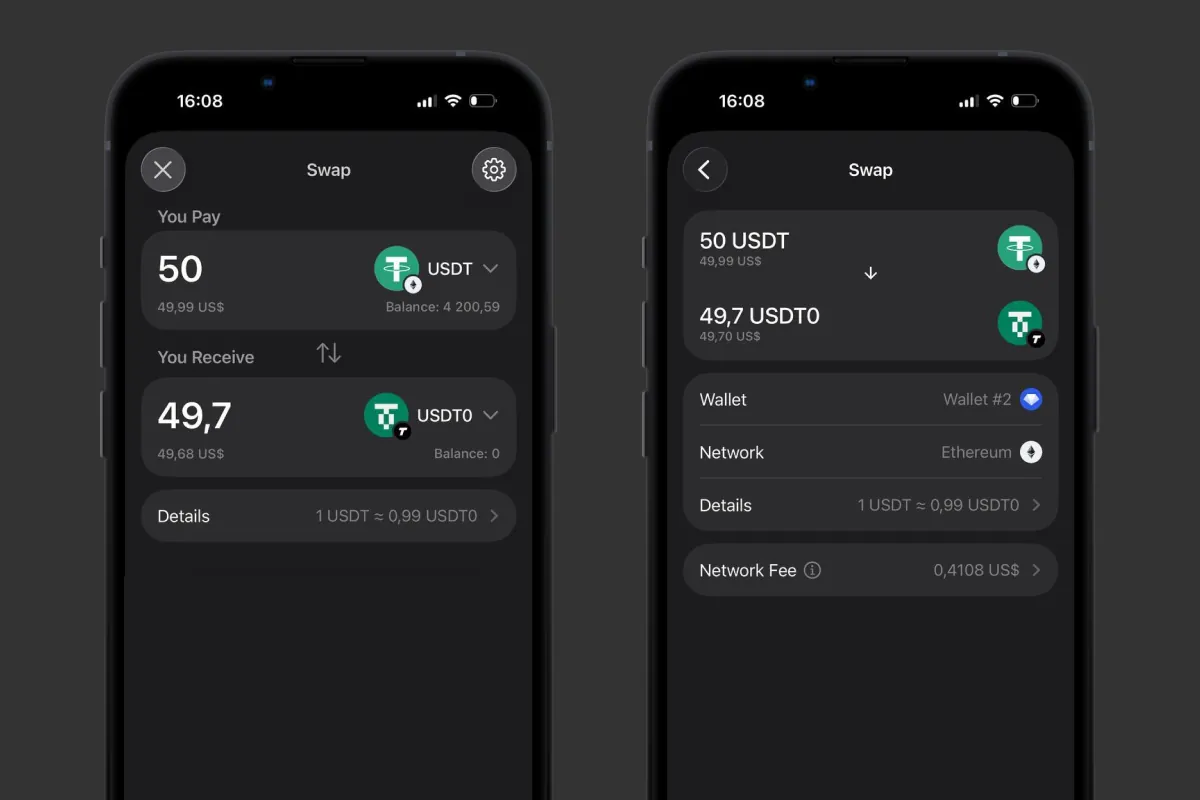
In Gem Wallet you can swap assets both onchain - USDT TIP20 for pathUSD inside the Tempo network, for example - and cross-chain: USDT ERC20 for USDT on Tempo. The routes are collected by the built-in DEX aggregator from top DEX providers - Relay, THORChain, Uniswap, and others.

Two Gem Wallet app screens: entering a swap amount of 50 USDT and the confirmation screen with the network fee Swapping USDT on Ethereum for USDT on Tempo in Gem Wallet

Install Gem Wallet and open up the world of the Tempo blockchain with us - securely, privately, and transparently, starting today.

試試寶石錢包!

支援100多種區塊鏈的自架錢包

App Store App Store 評分 4.9 ★ | Google Play Google Play 評分 4.8 ★
立即下載

常見問題

Yes, through the built-in DEX aggregator in Gem Wallet.
No, there is no staking on the Tempo blockchain.
No, the network has no coin of its own - only stablecoins circulate on Tempo.
Yes, Tempo is fully EVM compatible.
Private EVM chains that run alongside the Tempo mainnet.