Table of Contents
Arc is a stablecoin-native Layer 1 blockchain from Circle, the issuer of USDC: the dollar works as the fuel of the network here, the fee is charged in USDC, settlement becomes final the moment you send, and blocks are signed by BlackRock, Visa, and Mastercard.
Key Takeaways
- The fee is counted in dollars, not in a floating coin - USDC is the native gas asset here, and the protocol targets about $0.01 per transaction no matter what the market is doing.
- A transfer is final before you lock your screen - a block closes roughly every 0.5 seconds and cannot be rewritten afterwards, so there are no confirmations to wait for.
- The network launches with institutions on board - more than 500 million testnet transactions and 100 institutional participants stand behind the public mainnet on September 16, 2026.
What Is the Arc Blockchain?
Arc is a Layer 1 blockchain (a standalone network with its own consensus rather than an add-on to someone else’s) that Circle calls stablecoin-native. It means that a stablecoin here is not one of the tokens on the network but its base asset: USDC works as the gas asset, so the fee is paid by the same dollar you send, and a second coin on the balance is not needed.
Circle is a public American company and the issuer of USDC, the second largest stablecoin in the world.
- USDC in Circulation: More than $73 billion as of the second quarter of 2026, 19% more than a year earlier.
- Onchain Transfer Volume: $14.8 trillion in the same quarter, 2.5 times more than a year earlier.
A stablecoin is a cryptocurrency whose price is pegged to the value of another asset: most often the dollar, less often the euro, gold, or a basket of assets.
The History of the Arc Blockchain
Circle introduced Arc on August 12, 2025, and explained the idea simply: existing blockchains were not built around the needs of dollar settlement. The public testnet opened on October 28, 2025, and in May 2026 the whitepaper of the ARC token was released, with $222 million raised in its presale. The consensus of the network came from the Malachite team that moved to Circle from Informal Systems, and the public mainnet is set for September 16, 2026.
“This is the birth of a new operating system layer” - that is how Circle chief executive Jeremy Allaire described the launch of Arc on the second quarter 2026 earnings call.
How the Arc Blockchain Works
A transfer on Arc becomes final in about 350 milliseconds: you sign the transaction, validators (computers that check transfers and collect them into blocks) agree on the block through the Malachite consensus engine, and that block can no longer be rewritten. The network is EVM compatible (Ethereum Virtual Machine - the virtual machine that runs Ethereum smart contracts), so an ordinary Ethereum-format address and Solidity contracts work here without changes. Every transfer, block, and address is visible in the Arc blockchain explorer Arcscan: by transaction hash it shows the amount, the fee, and the time to finality.
Throughput follows from the parameters of the network: a block holds 30 million gas, a simple USDC transfer spends 21,000 gas, and a block closes in 0.5 seconds - that comes to about 2,857 payments per second. In a testnet with 20 validators distributed around the world, Arc reached close to 3,000 transactions per second.
How Much a Transfer Costs on Arc
A USDC transfer on Arc costs from 0.00042 USDC, and the protocol target for a typical transaction is about $0.01. The base fee cannot go below 20 Gwei or above 20,000 Gwei, so the most expensive minute on the network is exactly 1,000 times the cheapest one and goes no higher. For comparison: on networks with an auction fee, the upper limit is set by whoever pays the most in that minute.
Gwei is a billionth of the unit the gas price is counted in: on Arc one Gwei equals 0.000000001 USDC.
Key Advantages of the Arc Blockchain
The key advantages of Arc are a predictable fee in dollars, final settlement in less than a second, and the ready infrastructure of Circle, and eleven organizations of the founding validator set stand behind them: BlackRock, Visa, Mastercard, DTCC, ICE, Standard Chartered, Galaxy, MoneyGram, SBI, Sumitomo, and Global Payments.
- Predictable Fee in Dollars: Gas is paid in USDC, and EWMA smoothing (a moving average of network load) absorbs short traffic spikes, so the price of a transfer can be named in advance and written into a contract.
- Final Settlement: The Malachite consensus finalizes a block with no risk of reorganization, that is, of rewriting blocks that have already been accepted, so an application treats a received payment as irreversible right away.
- Familiar Ethereum Tools: The network runs on the Ethereum virtual machine of the Osaka version, so Solidity contracts move over without a rewrite, and the address looks the same as in Ethereum Wallet.
- Circle Infrastructure Out of the Box: Arc is connected to USDC, to CCTP (Cross-Chain Transfer Protocol - moving USDC between networks without wrappers), and to the Gateway service, so dollars arrive on the network as native ones rather than as a bridged token.
- Privacy by Choice: Balances and transfers can be selectively shielded, so a company does not disclose its counterparties yet still meets its own reporting obligations.
- Not Only the Dollar: Besides USDC the network natively supports EURC for settlement in euros and the yield-bearing USYC token, and the built-in StableFX engine exchanges them for each other around the clock.
How Arc Differs From Other Blockchains
Arc differs from other blockchains in two decisions: the gas asset here is the dollar rather than the network’s own coin, the way ETH works in Ethereum and SOL in Solana, and blocks are produced by a named list of companies rather than an open queue of validators. The closest network to Arc is Tempo, where the fee is also paid with a stablecoin.
| Parameter | Arc | Ethereum | Solana | Tempo |
|---|---|---|---|---|
| What pays for gas | USDC | ETH only | SOL only | any TIP20 stablecoin |
| Finality | ~350 ms, final | ~12.8 min | ~12.8 sec | ~0.6 sec |
| Validators | a listed set of institutions | thousands, open to join | thousands, open to join | 3 organizations, closed |
| Role of the native token | ARC stakes and votes, never pays fees | ETH pays fees and secures the network | SOL pays fees and secures the network | no coin of its own |
USDC: Gas on the Arc Blockchain
USDC pays every fee on Arc, so the balance has to cover both the amount of the transfer and the fee. There is no need to buy a second coin for gas - this is the main difference from networks where you have to keep ETH or SOL next to USDT or USDC. The other stablecoins of the network, EURC and USYC, are supported natively, but in the current configuration the fee is paid in USDC.
The USDC contract in the Arc testnet explorer already counts 4.6 million holders (September 2026).
One detail matters for a wallet: inside the protocol USDC is counted with 18 decimals, and under the ERC20 standard with 6. The wallet converts one into the other on its own, so the familiar dollar amount stays on the screen, and native and token USDC appear as one line rather than two different assets.
ARC: The Native Token of the Arc Blockchain
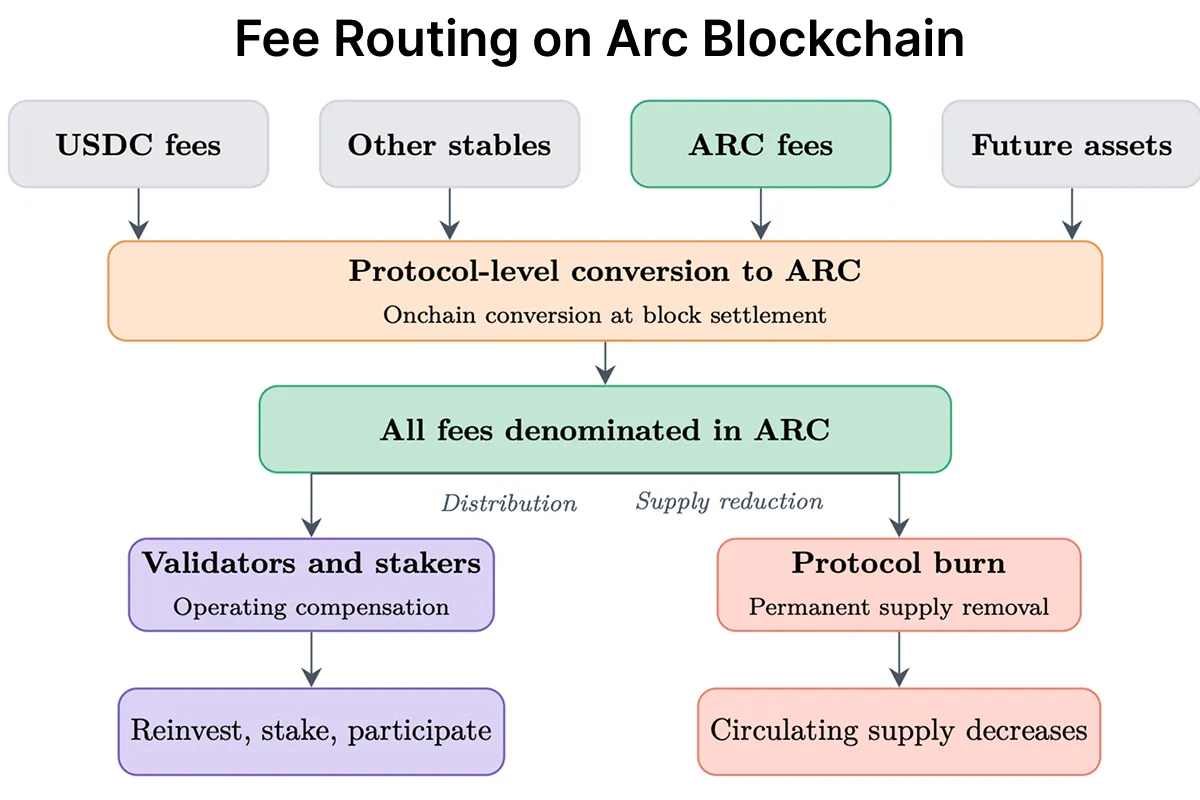
ARC is the token responsible for the security and the governance of the network, but not for fees. Circle published its whitepaper in May 2026: validators produce blocks against staked ARC, holders vote on the economics of the network, and protocol fees are converted into ARC no matter which asset they were paid with. The company calls the parameters preliminary, and until the switch to proof-of-stake the network runs on proof-of-authority, where blocks are produced by a pre-approved list of validators.
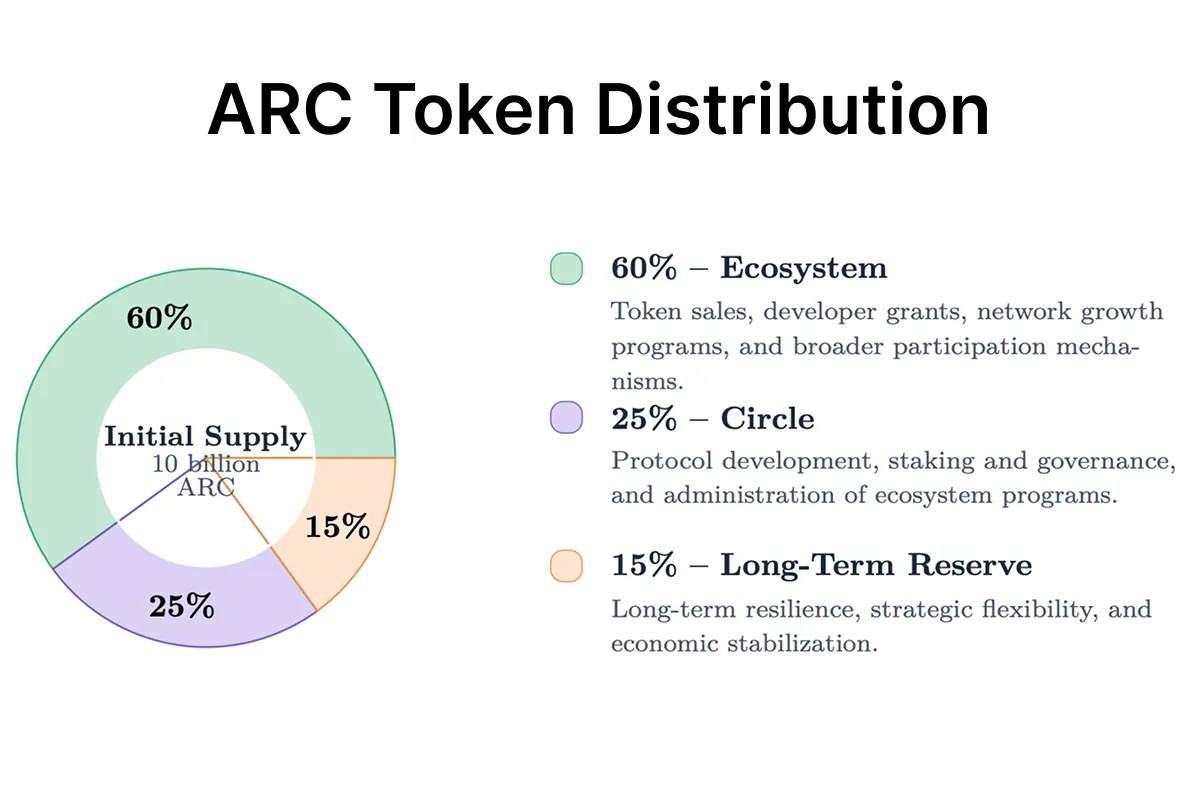
Distribution of the initial ARC supply. Source: arc.io
ARC Tokenomics
- Initial Supply: 10 billion ARC.
- Distribution: 60% ecosystem, 25% Circle, 15% long-term reserve.
- Inflation: Around 2-3% a year at the start, declining to neutral, when the burn covers new issuance.
- Fee Mechanism: Fees are converted into ARC and split between rewards for validators and stakers and a permanent burn.
- Presale Valuation: $222 million raised at a valuation of $3 billion for the network.
How network fees turn into ARC and travel further. Source: arc.io
What the Arc Blockchain Is Used For
Arc is used for everyday money tasks: settlement takes less than a second, it works around the clock, and the fee is known before you send.
- Cross-Border Transfers: You send USDC to family in another country, the money arrives in a second, and the fee does not depend on the amount of the transfer.
- Salaries and Payouts to Freelancers: A company pays USDC to hundreds of contractors in seconds, and the recipient does not need the coin of the network to take the money.
- Exchanging Dollars for Euros: USDC is exchanged for EURC right on the network, at night and on weekends, when banks do not work.
- Payments Between Programs: An AI agent pays for a service by the rules it was given, with no person and no credit card involved.
- Tokenized Stocks and Bonds: Securities are issued on the same network that holds the dollars to buy them, so the payment and the delivery of the security happen at the same time.
How to Get Started With the Arc Blockchain
To work with the network you need an Arc Wallet - Gem Wallet gives self-custody access to Arc: the code is 100% open-source, and the CertiK audit was passed in April 2026. Setup takes a couple of minutes, with no email, no phone number, and no ID.
- Create a Wallet: Install Gem Wallet on iOS, Android, or from the APK, create a new wallet or import an existing one, and save the 12-word secret phrase offline - your Arc address is created automatically along with the other networks.
- Get USDC: Fund the address with a transfer from an exchange or another wallet, or buy USDC with a credit card right in the app, where the fiat on-ramp works in 170+ countries.
- Swap Assets: Through swap you can exchange any supported asset for USDC, and the routes are collected by the built-in DEX aggregator from Relay, THORChain, Uniswap, and other top DEX providers.
- Send and Connect: Send USDC to the address of the recipient and connect to Arc applications through WalletConnect - every asset stays on one address and under your key.
Download Gem Wallet today to meet the launch of Arc fully prepared: the address of the network will already be in the wallet, and the dollars for the fee on the balance.