What Is an EVM Wallet and How One Address Works Across Ethereum Networks

What Is an EVM Wallet and How One Address Works Across Ethereum Networks

An EVM Wallet is a wallet with a 0x address that works on Ethereum, Base, Arbitrum, Optimism, Polygon, BNB Chain and other compatible networks at once. The address is the same in all of them, and the balance in each one is its own.

Key Takeaways

  • One 42-character address covers every EVM network at once, because they all build the address from the secret phrase the same way.
  • Tokens do not disappear when sent to the wrong EVM network - the same key controls the address on every network, and the balance stays invisible only while that network is switched off in the wallet.
  • One token on two networks is two different tokens - USDC on Ethereum and USDC on Base are issued by separate contracts and are not connected to each other.
  • Gas is paid in the network’s own token - BNB on BNB Chain, POL on Polygon, AVAX on Avalanche, and without it the transaction will not go through.

What Is an EVM Wallet

An EVM Wallet is a wallet built for the Ethereum Virtual Machine - the software environment that runs Ethereum smart contracts. Every blockchain that runs the same environment accepts the same 0x address. It is also called an EVM-compatible wallet - the two mean the same thing.

Layer 2 networks on top of Ethereum - Base, Arbitrum, Optimism, Linea, Unichain - copied its rules, and so did standalone layer 1 blockchains: BNB Chain, Avalanche, Polygon, Sonic. Such networks are called EVM-compatible.

Why You Need an EVM Wallet

An EVM Wallet gives you one place for ERC20 tokens from every EVM network, full control of the keys, and access to DApps without an account.

  • One App For Every EVM Network: USDT, USDC, DAI, LINK, UNI and their counterparts on other EVM networks sit side by side - the standard is the same, only the network changes.
  • Full Control Of Your Keys: A transfer, a swap, a login to an app - every action is signed by the key on your device, and only the signature goes to the network.
  • Access To DApps Without An Account: Swap on Uniswap, trade on Hyperliquid, mint an NFT on a marketplace - you connect by scanning a QR code, with no login, password or registration.
  • Freedom To Pick The Cheaper Network: You bought ETH, moved it to Base for the cheaper fee and swapped it for USDC there - all in one app and on one address.

How an EVM Wallet Works

An EVM Wallet does not store coins. It stores the key you sign transactions with, while the assets themselves are recorded on the blockchain.

The chain works like this: a secret phrase of 12 or 24 words unfolds into one private key, and the key produces a public EVM address. Every EVM network uses the same scheme - Base, Polygon and the rest - so one phrase always produces one address.

What Types of EVM Wallets Exist

EVM Wallets split first by who holds the private key. In a custodial wallet the key belongs to the service, so access depends on that company and can be frozen or lost with it. In a self-custodial wallet the key is created and stored on your device, and no one else can sign a transaction for you.

A second split goes by what stands behind the address: a private key or a smart contract. The first type is called an EOA, from externally owned account, and the second one a smart account.

ParameterEOA (externally owned account)Smart account
What stands behind the addressA private keyA smart contract under the ERC-4337 standard
Access recoveryThe secret phrase onlyConfigurable: trusted contacts, a second device
Who pays the feeThe address ownerThe owner or a third-party service
Several signersNoYes
Network supportEvery EVM networkDepends on the network

The Pectra upgrade of May 7, 2025 made the line between the two types movable. The EIP-7702 standard lets an ordinary address behave like a smart account - for example, give an approval and make a swap in one action instead of two.

What Is an EVM Wallet Address

An EVM Wallet address is a string of 42 characters: 0x and 40 more characters, for example 0x7a3f9e0c4d5b8a12f6e3d049c7b18a2e5f4d9b2c. The wallet creates it from the secret phrase, and the same string receives funds on every EVM network.

Outside the EVM the format changes: Bitcoin, Solana, TRON, XRP Ledger and Cardano each use their own, so the prefix alone tells you which network an address belongs to.

The same address appears in lowercase and in mixed case - these are not two different addresses: the capital letters work as a check against a typo when the address is copied.

Why One EVM Address Shows a Different Balance on Each Network

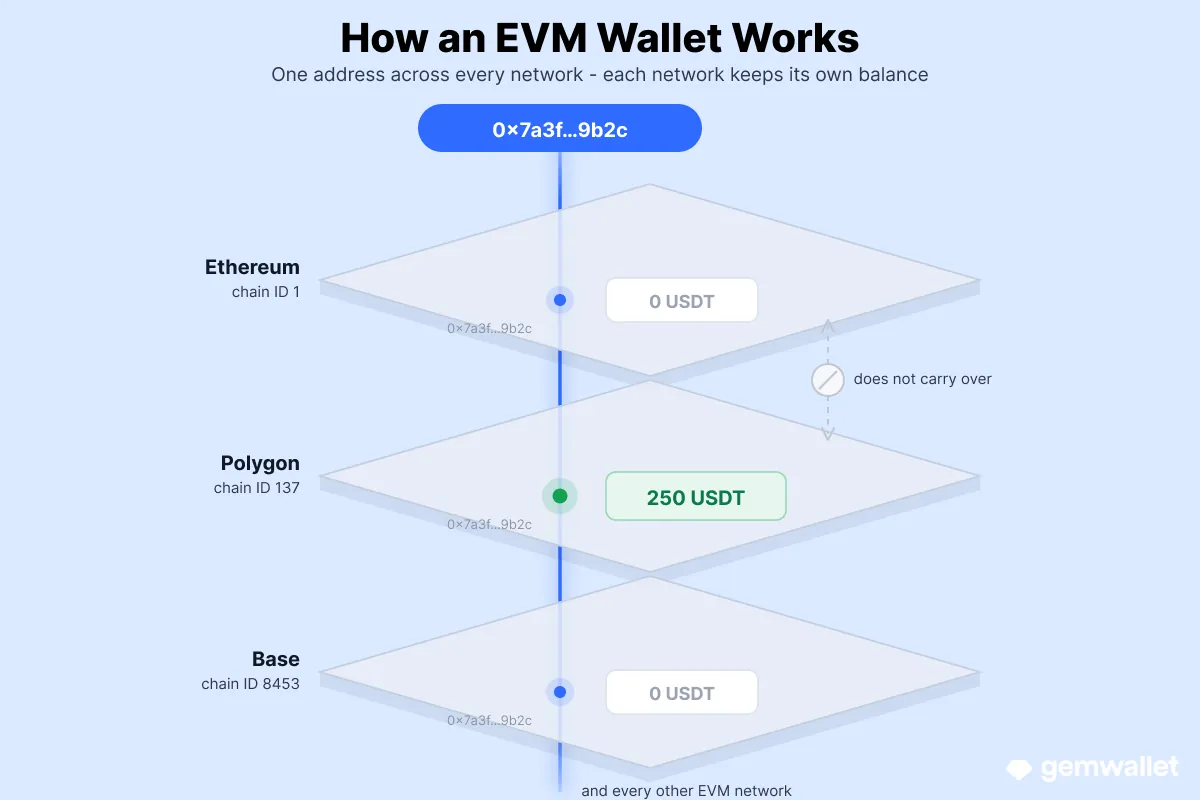
What separates the networks is not the address but the network number, the chain ID: Ethereum has 1, Polygon 137, Base 8453. A signature is valid only on the network with that number, so the same address does not mean the same balance - if someone sent you USDT on Polygon and you are looking at the Ethereum screen, it will show zero.

Balances are separated by the tokens themselves too. USDC on Ethereum and USDC on Base are issued by different contracts: they are two independent tokens. A balance does not move between networks by itself - it is moved by a bridge or a swap.

One EVM address runs through three networks - Ethereum, Polygon and Base - and holds a separate balance on each This is how an EVM Wallet works: one address on every network, and a balance that belongs to the network, not to the address. Source: Gem Wallet

Which Networks an EVM Wallet Supports

One EVM Wallet works with the Ethereum blockchain and with every network that copied its rules:

  • Layer 2 Networks On Top Of Ethereum: Base, Arbitrum, Optimism, Unichain, Linea, zkSync Era, Blast.
  • Standalone Layer 1 Blockchains: BNB Chain, Polygon, Avalanche C-Chain, Sonic, Mantle.
  • Newer EVM Networks: Monad, Berachain, Sei EVM, HyperEVM, Plasma, Tempo.

One 0x address already covers the three largest EVM networks by DeFi value - Ethereum with $48.4 billion, Base with $5.5 billion and BNB Chain with $5.5 billion, while Solana, TRON and Bitcoin next to them in the ranking each need an address of their own (DefiLlama data, September 2026).

What Pays for Gas on EVM Networks

Every EVM network charges the fee in its own token. Say you want to send USDT on BNB Chain: the tokens are on the balance and the recipient address is correct, but the transaction does not go through, because the network charges the fee in BNB and there is no BNB on the account. The same happens on Polygon without POL and on Avalanche without AVAX.

NetworkGas token
EthereumETH
BaseETH
Arbitrum OneETH
OptimismETH
LineaETH
BNB ChainBNB
PolygonPOL
Avalanche C-ChainAVAX
Sei EVMSEI
MonadMON
BerachainBERA
MantleMNT

Two cases break the general rule:

  • Token Renames: The gas token on Polygon is called POL, not MATIC - since September 4, 2024 the fee on Polygon PoS is charged in POL only; Fantom has been running as Sonic with the S token since 2025.
  • Gas In A Stablecoin: On Stable, launched in December 2025, the fee is charged in USDT0, and on Tempo, which went live on March 18, 2026, in USDC or USDT. No separate gas token is needed there.

Which Networks an EVM Wallet Does Not Work On

An EVM Wallet does not cover blockchains built on rules other than Ethereum’s: they use their own signature scheme, and one address for everything no longer works. Wallets that work only with 0x networks are called EVM-only. Two limits are worth knowing in advance:

  • Some Networks Have Two Addresses At Once: Sei has a native address in the sei1… format and an EVM address, and XRP Ledger has a native address and a separate XRPL EVM Wallet. Their assets are not shared, which is why Gem Wallet keeps Sei EVM, XRPL EVM and HyperEVM as separate networks.
  • Compatibility Is Not The Same As Support: A new layer 2 network will technically accept your EVM address long before it shows up in the wallet interface. Compatibility is a property of the network, support is a property of the app.

What to Do If Tokens Were Sent to the Wrong EVM Network

The tokens are not lost. The same private key controls your address on every EVM network, so the funds are where they were sent - they are invisible only because the network is not switched on in the wallet yet. Switch that network on in the wallet’s network list and the balance appears on the main screen.

Can You Recover Tokens Sent to the Wrong EVM Address

No. A blockchain transaction cannot be cancelled: only the person who holds the private key to the receiving address can send the funds back.

Your own key does not help in two cases:

  • A Transfer To A Network Without EVM Support: In the network list you picked TRC20 instead of ERC20 and pasted an EVM address. The funds went to TRON, where that address does not exist, and the key opens nothing there.
  • A Transfer To A Smart Contract Address: You copied a token contract address from an explorer instead of your own and sent the tokens to it. The tokens ended up with code that has no owner holding a private key.

Which EVM Wallet to Choose in 2026

In 2026 the wallet to choose is a self-custodial EVM Wallet with fully open source code and support for every EVM network out of the box - Gem Wallet:

  • Full Self-Custody: Gem Wallet private keys are created and stored on your device - only you have access to the funds on any EVM network.
  • 100% Open Source: The Gem Wallet code is published in full, and any crypto enthusiast can check the wallet for vulnerabilities; in April 2026 it was audited by CertiK.
  • Privacy By Default: Gem Wallet does not ask for a phone number, an email or documents - no registration, no KYC, no collection of user data.
  • Multichain Out Of The Box: Gem Wallet supports more than 100 blockchains - every EVM network, including BNB Chain, Polygon, Monad and the layer 2 networks Base, Arbitrum, Unichain, and alongside them Bitcoin, Solana, TON and other non-EVM networks.
  • Built-In DEX Aggregator: In Gem Wallet you can swap any assets, within one network and cross-chain: USDT on ERC20 for ETH, ETH for BNB to move to BNB Chain. The aggregator collects rates from Uniswap, PancakeSwap, Chainflip and others.
  • Buying Crypto With A Card: You can buy crypto with a credit card right in the app, in 170+ countries - the native token of the network you need, ETH, BNB, POL, AVAX and others.

Download Gem Wallet on iOS or Android and manage every EVM network from one address, securely and privately.

试试宝石钱包!

支持100多种区块链的自托管钱包

App Store App Store 评分 4.9 ★ | Google Play Google Play 评分 4.8 ★
立刻下载

常见问题

Yes, the address will be the same, but the balance on each network is separate - funds do not move from one network to another on their own.
No, Solana has a different address format and a different execution environment, so an EVM address does not work there.
Most likely the network that holds the tokens is switched off in the wallet - until it is enabled, its balance is not shown on the main screen.
No, TRON uses a different address format - your EVM address does not exist there, and the private key gives no access to it.
Gem Wallet - a self-custodial wallet with fully open source code and support for every EVM network out of the box.