What Is a DeFi Wallet? How It Works, Uses, and Risks

What Is a DeFi Wallet? How It Works, Uses, and Risks

A DeFi Wallet is a self-custody crypto wallet that can sign smart contracts and connect directly to decentralized apps - the entry point to a DeFi market holding around $160 billion in total value locked (DefiLlama, June 2026). What separates it from an ordinary wallet is not storage, but the ability to authorize on-chain actions like swaps, loans, and staking without a middleman.

Key Takeaways

  • Works on Every Chain - one multichain DeFi Wallet holds assets and connects to DApps across 100+ blockchains, instead of one wallet per network.
  • You Hold the Key - unlike an exchange account, a DeFi Wallet keeps the private key on your device, so every on-chain action is approved by you alone.
  • Approvals Are the Real Risk - the most common DeFi loss comes from token approvals left active, not from the wallet itself - review and revoke them regularly.

What Is a DeFi Wallet?

A DeFi Wallet is a self-custody wallet built to interact with decentralized finance protocols - lending markets, decentralized exchanges, staking validators, and yield aggregators. It stores your private keys on your device and uses them to sign the cryptographic permissions each protocol needs before it can move your assets.

Any wallet can send and receive tokens. A DeFi Wallet adds the part that matters on-chain: it speaks directly to smart contracts, so you can stake, swap, lend, or borrow straight from the app. A custodial exchange account cannot do this, because the exchange holds the keys and never exposes them to a protocol. That is why DeFi Wallet and self-custody wallet describe the same core idea from two angles - one names the use, the other names the ownership.

How a DeFi Wallet Works: Keys, Signing, and Connection

A DeFi Wallet runs on three mechanisms that turn a key into financial access.

  1. Key Control: Your wallet generates a private key from a seed phrase and stores it on-device. The matching public address is what others see; the private key is what signs transactions, and only you hold it.
  2. Transaction Signing: When you stake or swap, the protocol returns a smart contract instruction. Your wallet signs it with your private key and broadcasts it to the network - no bank or exchange approves it.
  3. DApp Connection: The wallet links to a decentralized app through a standard like WalletConnect, which creates an encrypted bridge between the app and your device. The app can request actions, but it never sees your key.

This is why a DeFi Wallet is often called a gateway rather than a vault. The funds live on the blockchain; the wallet is the tool that proves they are yours and authorizes what happens to them.

DeFi Wallet vs Exchange Wallet: What Actually Changes

What is the real difference between holding crypto in a DeFi Wallet and holding it in an exchange account? It comes down to who holds the key and who can sign a contract. An exchange wallet is an IOU - a record in a company’s database saying it owes you the funds - while a DeFi Wallet is a key in your own hands.

FeatureDeFi WalletExchange (Custodial) Wallet
Private keyHeld by you, on-deviceHeld by the exchange
Smart contract accessDirect - can sign any DApp interactionNone - cannot connect to protocols
Identity verificationNo KYC requiredKYC required
Counterparty riskNone - no company can freeze fundsFunds frozen if the exchange fails
Responsibility for keysEntirely yoursManaged by the exchange

The trade-off is symmetrical: a DeFi Wallet removes counterparty risk like the FTX collapse, but it moves full responsibility for key security onto you.

What You Can Do With a DeFi Wallet

A DeFi Wallet unlocks the financial services that run on-chain, all without an account or intermediary. The main categories are:

  • Swapping: Trade one token for another through a decentralized exchange, usually routed by a built-in aggregator that finds the best rate across several DEXs.
  • Lending and Borrowing: Supply assets to a protocol like Aave or Compound to earn interest, or borrow against your crypto as collateral.
  • Staking: Lock tokens to help secure a network and earn rewards, straight from the wallet.
  • Yield Farming: Add a token pair to a liquidity pool on a DEX like Uniswap and earn a share of trading fees plus incentive rewards.
  • Governance: Vote on protocol proposals with governance tokens like UNI or AAVE, since many DeFi platforms are run by their communities.

Ethereum anchors most of this activity, holding roughly 68% of all DeFi TVL (as of June 2026), and most DeFi tokens follow its ERC20 standard - though the same wallet reaches the same services on Solana, BNB Chain, TRON, and dozens of other networks.

Three DeFi Risks You Can Avoid

Self-custody removes the exchange as a point of failure, but interacting with smart contracts adds risks of its own. All three are avoidable:

Token Approvals: Every approval lets a protocol move your tokens, so a forgotten one can be drained in a later exploit. Revoke approvals you no longer use.

Phishing: Fake DApp clones trick you into signing a draining transaction. Open protocols from a bookmark and read every request before confirming. See how to spot crypto phishing attacks.

Smart Contract Risk: Buggy or malicious code can drain funds, so stick to audited protocols and test new ones with small amounts.

Gem Wallet: A DeFi Wallet to Swap, Stake, and Earn in 2026

Gem Wallet is a self-custody, 100% open-source DeFi Wallet that runs on 100+ blockchains. Your private key stays on your device, never on a server, and using it needs no email, phone number, or identity verification. Here is what that looks like in practice:

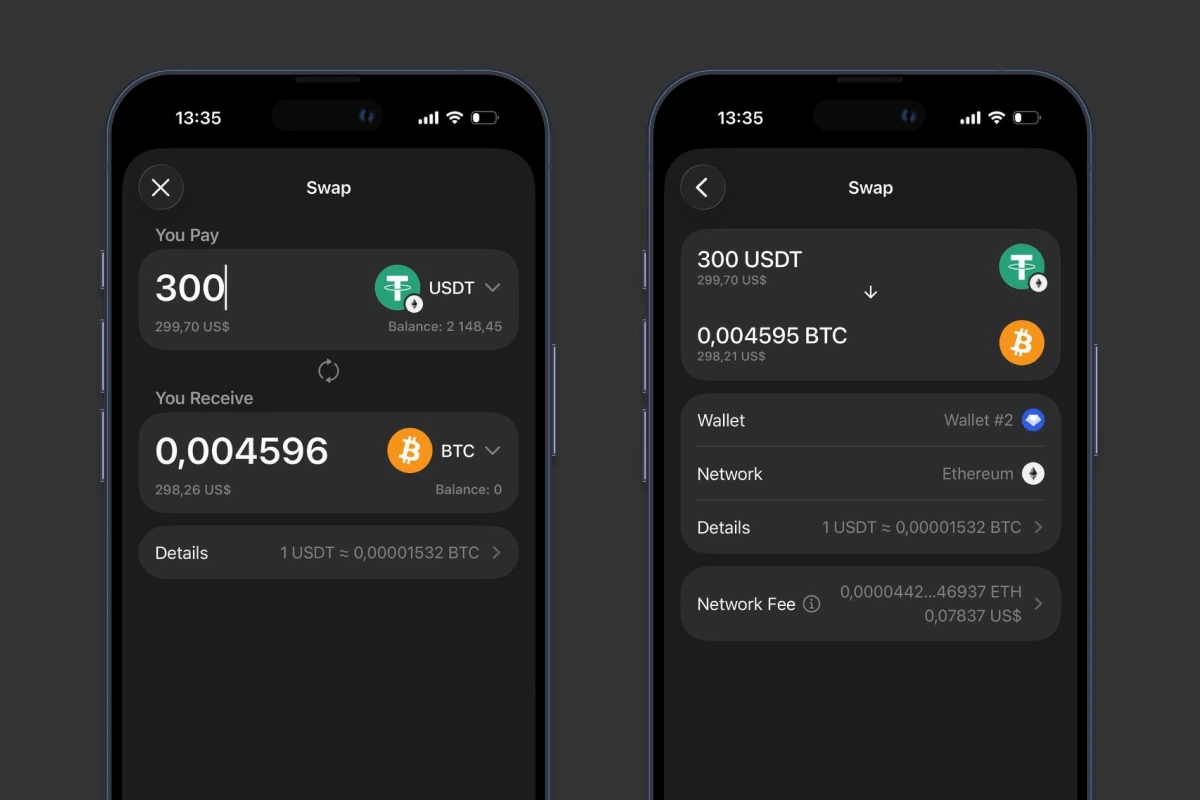
  • Built-in DEX Aggregator: Swap all tokens at the best rate, for example USDT to ETH on the same network or BTC to ETH across chains, through one aggregator that compares THORChain, Uniswap, PancakeSwap, and others.
  • Staking: Earn rewards on SOL, BNB, TRX, HYPE, and other tokens by staking with trusted validators, and unstake any time.
  • Lending: Connect through WalletConnect to lend USDC or USDT on a lending protocol like Aave and earn yield, without moving funds to an exchange.
  • Stablecoins and Real-World Assets: Hold around 20 stablecoins, keep USDT as ERC20 or TRC20, or convert it into tokenized gold like Tether Gold.

Gem Wallet swap screen converting USDT on Ethereum to BTC Swapping USDT on Ethereum to Bitcoin in Gem Wallet.

Ready to Make Your First DeFi Move?

You do not need an exchange account to start - just a self-custody wallet. Open Gem Wallet, add some crypto, and make your first swap, stake, or stablecoin transfer in minutes across 100+ chains.

试试宝石钱包!

支持100多种区块链的自托管钱包

App Store App Store 评分 4.9 ★ | Google Play Google Play 评分 4.8 ★
立刻下载

常见问题

Any self-custody wallet that can sign smart contracts works, such as Gem Wallet; custodial exchange wallets cannot connect to DeFi.
Yes if you control the keys - staying secure depends mostly on what you approve and sign, not the wallet itself.
A permission that lets a protocol move your tokens - revoke unused ones so they cannot be drained later.
No - no KYC, email, or phone number is needed.
Yes - a multichain wallet like Gem Wallet covers 100+ networks in one app.