


Table of Contents
A DEX aggregator is a service that compares prices across many decentralized exchanges at once and routes your swap through the best ones, so the same trade returns more - usually 1-5% more than a single DEX.
Key Takeaways
A DEX aggregator queries many DEXs at once and routes your trade for the best price after fees, gas, and slippage - all in one signed transaction.
Aggregators work across blockchains - cross-chain routers swap native assets like BTC for ETH without wrapped tokens or a centralized exchange.
Aggregators are self-custody - they never hold your funds, so the swap settles straight from your own wallet.
What Is a DEX Aggregator?
A DEX aggregator is a decentralized finance (DeFi) tool that compares many decentralized exchanges (DEXs) at once and routes your swap through whichever ones offer the best price. Instead of checking each DEX by hand, you send one request and get the best available rate - the way a flight-search site scans airlines for the cheapest ticket.
Every DEX keeps its own liquidity in separate pools, so the same swap can pay out differently on each one. This is the liquidity fragmentation problem, and an aggregator - 1inch on EVM chains or Jupiter on Solana, for example - solves it by treating all those pools as a single market and finding the cheapest path through them.
How a DEX Aggregator Works
A DEX aggregator runs a smart order router. The moment you request a swap, it checks the price, fees, and available liquidity on every connected DEX and picks the route that leaves you with the most tokens. Small swaps usually go through a single pool; large ones are split so no single pool moves too far against you.
Take a large swap from ETH into USDC. Pushing it all through one pool would move the price against you - that lost value is slippage. Instead, an aggregator like 1inch splits the order: a portion through Uniswap, another through PancakeSwap, and the rest across smaller venues, all settled in one transaction you sign. On Solana, Jupiter does the same, spreading a swap from SOL into USDC across Orca, Raydium, and other pools. The result is a better overall rate than you would get on any single DEX.
Types of DEX Aggregators
Not all aggregators work the same way. There are three main kinds:
- Same-Chain Aggregators route a swap between DEXs on a single network. 1inch covers Ethereum and other EVM chains, while Jupiter and OKX DEX lead on Solana.
- Cross-Chain Aggregators move value between different blockchains in one step. With THORChain or Mayan you can exchange your Bitcoin for Ethereum - real, native coins, with no wrapped tokens and no centralized exchange in the middle.
- Intent-Based Aggregators let you state the result you want - say, trading 10 ETH for at least 30,000 USDC - and let competing solvers find the best way to fill it. NEAR Intents works this way and helps shield your order from front-running.
DEX Aggregator vs DEX vs CEX
So why not just swap on Uniswap directly? On trades above roughly $1,000, routing through one pool can quietly cost 1-5% in extra slippage - money an aggregator recovers by spreading the order. Here is how the three options compare:
| Feature | DEX Aggregator | DEX | Centralized Exchange |
|---|---|---|---|
| Liquidity source | Many DEXs at once | One protocol’s pools | Internal order book |
| Price on large trades | Best route, less slippage | Higher slippage | Deep but custodial |
| Custody of funds | Self-custody | Self-custody | Exchange holds keys |
| Identity check (KYC) | None | None | Required |
| Settlement | One signed transaction, on-chain | Single pool, on-chain | Off-chain, internal |
A DEX aggregator works for a swap of any size, and it is far more convenient and secure than a centralized exchange (CEX), because your coins never leave your own custody.
Leading DEX Aggregators in 2026
In 2025, DEX aggregators routed over $1.6 trillion in swaps, and a handful of names handle most of that volume (figures from DefiLlama, as of June 2026):
- 1inch - the largest aggregator on EVM chains, live across 14 networks including Ethereum, BNB Chain, Arbitrum, and Base; its Pathfinder algorithm popularized split routing and has handled over $266 billion in lifetime volume.
- Jupiter - the dominant aggregator on Solana, routing trades across Orca, Raydium, Meteora, and more, with over $1.2 trillion in lifetime volume.
- OKX DEX - a top-three aggregator by 2025 volume (~$109 billion), routing swaps across Solana and EVM chains.
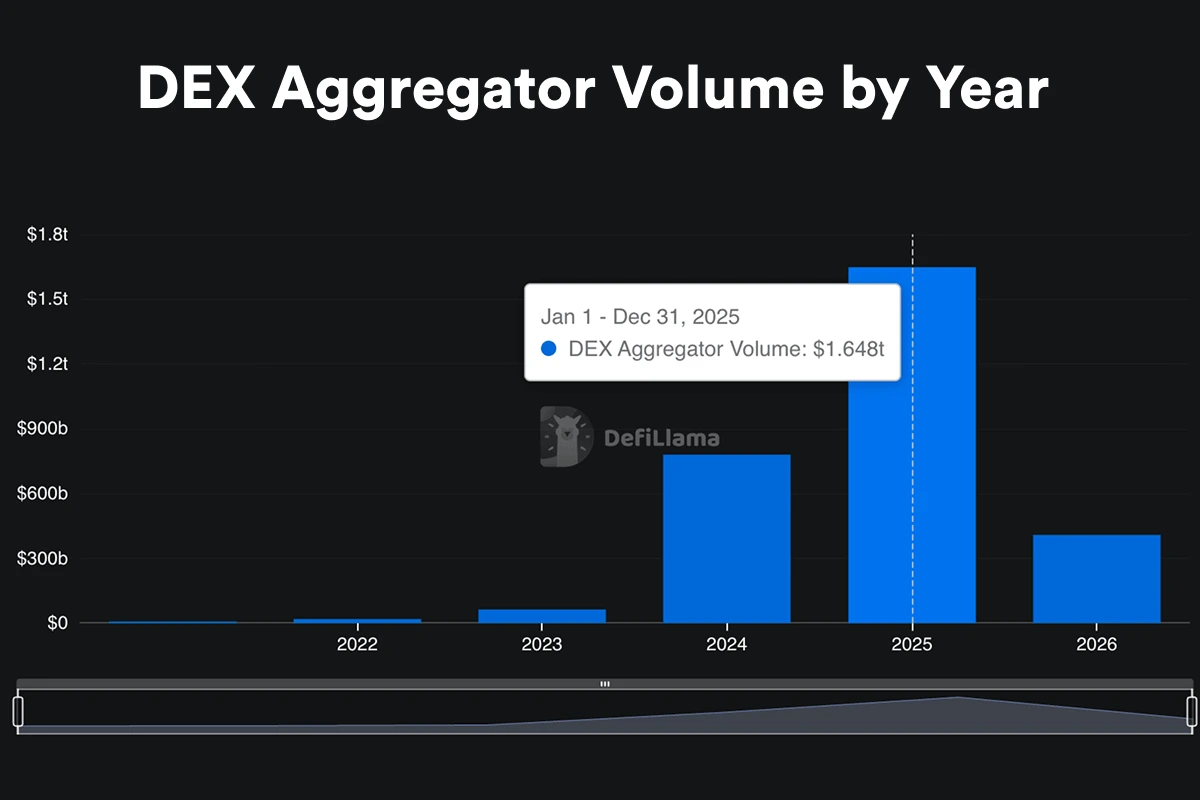 Annual DEX aggregator volume more than doubled in 2025, reaching $1.648 trillion. Source: DefiLlama
DEX Aggregator Risks and What to Watch Out For
An aggregator routes your trade through several DEX smart contracts at once, and you approve and sign each swap yourself - so a few risks are worth managing:
- Token Approvals: A swap requires you to approve the aggregator’s contract to move a token; grant only what you need and revoke approvals you no longer use.
- Slippage Tolerance: Set it deliberately - a tolerance that is too high invites sandwich and MEV (maximal extractable value) attacks that eat into your trade.
- Gas on Small Trades: Splitting one order across many pools raises gas, so for tiny EVM swaps a single pool can be cheaper than a multi-route path.
- Aggregator Fees: Most are free or earn from positive slippage, but check whether a small protocol fee applies before you confirm.
Swap Any Asset With Gem Wallet’s Built-In DEX Aggregator
Gem Wallet is a self-custody, fully open-source wallet that lets you swap any asset directly inside the app - no need to connect to third-party websites or trust intermediaries.
The built-in DEX aggregator pulls live quotes from top providers - THORChain, Chainflip, Mayan, Jupiter, Uniswap, and others - covering both on-chain swaps, such as ETH to USDT or SOL to USDC, and cross-chain ones, such as Bitcoin to Ethereum or XRP to SOL, in seconds - all secure and private.
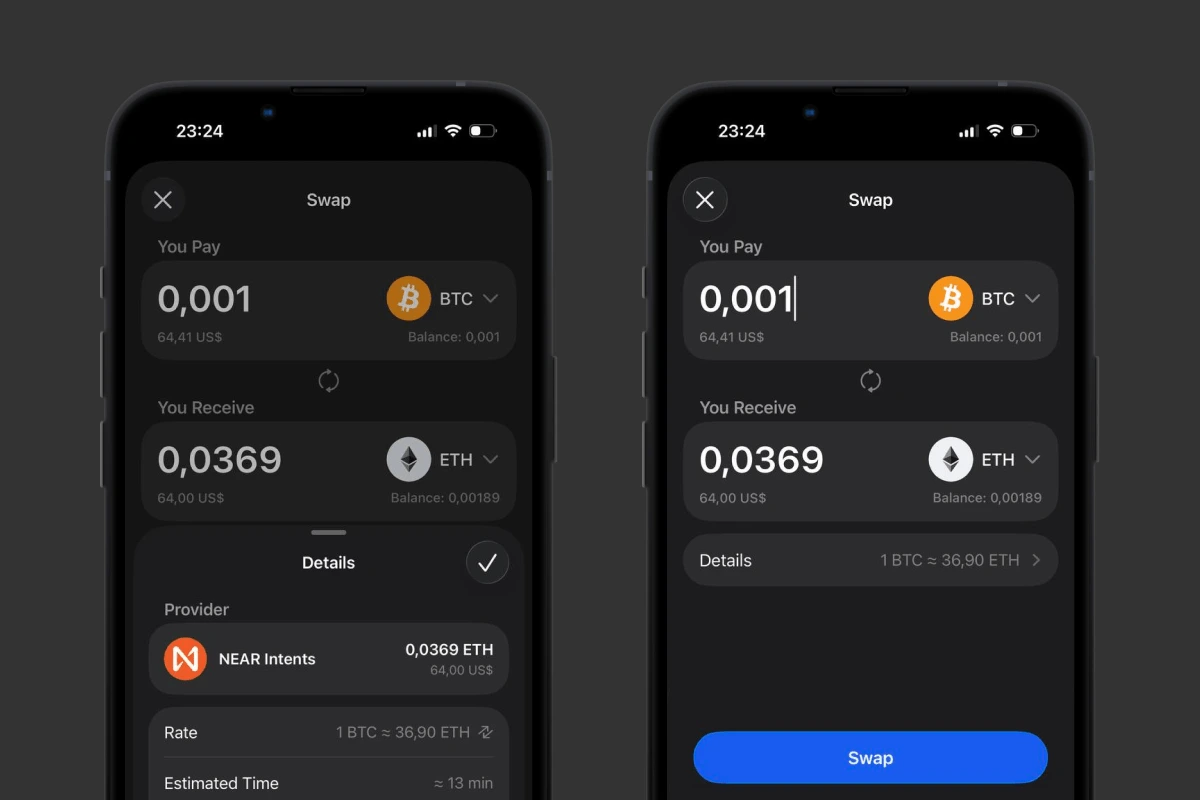 Swapping BTC for ETH with Gem Wallet’s built-in DEX aggregator.
The best route is selected automatically and every fee shown upfront - just open Gem Wallet and make your first swap right now.


