


Table of Contents
USDT is the largest stablecoin by market cap, pegged 1:1 to the US dollar - it lets you hold and move dollar value on-chain without the volatility of other crypto.
Key Takeaways
- USDT is pegged 1:1 to the US dollar and backed by a reserve of US Treasuries, cash, gold, and Bitcoin - verified by quarterly BDO attestations, not a full audit.
- USDT runs on multiple networks - ERC20, TRC20, SPL, and BEP20 - so the network you pick sets your transfer fee and speed.
What Is USDT?
USDT, also known as Tether, is a stablecoin pegged to the value of the United States Dollar (USD). Issued by the centralized entity Tether, USDT aims to maintain a stable value of $1, providing a reliable medium for trading and transferring value in the volatile cryptocurrency market. With its widespread availability on major exchanges and platforms, USDT has become a cornerstone of the crypto economy, facilitating seamless transactions and liquidity access for users globally.
Tether is most commonly associated with USDT, but the company has issued other tokens as well. These include Tether Gold (XAUt), backed by physical gold, and MXNt, pegged to the Mexican peso. They give users additional options to diversify while still benefiting from Tether’s infrastructure.
What Is a Stablecoin?
A stablecoin is a type of cryptocurrency designed to maintain a stable value by being pegged to a reserve asset such as a fiat currency or a commodity. The primary goal of stablecoins is to combine the benefits of digital currencies, such as fast transactions and security, with the stability of traditional currencies. This stability makes them useful for everyday transactions, trading, and as a hedge against market volatility. Stablecoins can be collateralized by assets like the US dollar (e.g., USDT), other cryptocurrencies, or even algorithmically managed to maintain their peg.
The History of USDT
USDT, originally named RealCoin, was introduced in 2014 by Brock Pierce, Reeve Collins, and Craig Sellars. It was developed on the Bitcoin blockchain via the Omni Layer protocol. In 2015, the cryptocurrency was rebranded as Tether (USDT). The company behind it, Tether Limited, operates under the ownership of iFinex Inc., which also owns the Bitfinex exchange. Over the years, USDT has expanded to multiple blockchains, including Ethereum, TRON, Solana, TON, and BNB Chain, enhancing its accessibility and adoption across the crypto ecosystem. More than half of all USDT in circulation now runs on the TRON network (as of 2026), with Ethereum the next largest.
Key Features of USDT
USDT offers several key features that make it a preferred choice for many users:
- Stability: Pegged to the US dollar, USDT provides a stable value, minimizing the risk of price volatility.
- Liquidity: High liquidity makes USDT easily tradable and widely accepted across various exchanges and platforms.
- Ease of Use: Simplifies transactions and value storage within the crypto ecosystem.
- Widespread Adoption: Supported by multiple blockchain networks, ensuring broad usability and acceptance.
Advantages and Uses of USDT
USDT serves four main uses: storing dollar value, paying for services, paying for goods, and swapping into other cryptocurrencies - all without leaving the crypto ecosystem.
- Storing Dollar Value: USDT allows users to store dollar value digitally, offering quick access to funds and high liquidity.
- Paying for Services: Widely used for paying for services due to its stable value and low transaction costs.
- Paying for Goods: USDT is also convenient for purchasing goods, making it a practical option for everyday transactions.
- Convenient Swaps: The ability to easily swap USDT with other cryptocurrencies attracts traders and investors.
The versatility and reliability of USDT make it a preferred choice for many users in the crypto space.
USDT, or Tether, is the largest stablecoin by market capitalization and the third-largest cryptocurrency overall, widely used across various blockchain platforms. It holds over $184 billion in assets (as of July 2026), according to CoinMarketCap, reflecting its significant role in the cryptocurrency market. The high liquidity and active use of USDT in trading, money transfers, and value storage contribute to its dominant position in the crypto ecosystem.
USDT vs USDC: Key Differences
USDT and USDC are both stablecoins pegged to the US dollar, but they differ in their issuers and use cases. USDT is issued by Tether Limited, while USDC is issued by Circle. USDC is often seen as more transparent due to its regular audits and regulatory compliance. Both stablecoins serve similar purposes but cater to different preferences in the market.
What Are the Risks of USDT?
USDT holds $1 by design, but every holder should know three real risks:
- Reserves and Audit: Tether backs USDT with US Treasuries, cash, gold, and Bitcoin, but publishes only quarterly BDO attestations - not a full Big Four audit. In November 2025, S&P Global cut USDT’s stability assessment to “weak”, its lowest level, after Bitcoin reached 5.6% of reserves.
- Centralization and Freezes: Tether can freeze USDT at the smart contract level and has frozen over $4.4 billion in cooperation with law enforcement (as of 2026). Holding USDT in a self-custody wallet cuts the risk of a custodian or exchange freezing your funds to zero - your keys and assets belong only to you. It does not remove issuer risk, since Tether controls the contract itself.
- Regulation: Under the EU’s MiCA framework, several exchanges delisted USDT for European users through 2024-2025.
Even so, USDT has held its peg across 10+ years as the largest stablecoin by market cap - these are tail risks, not day-to-day ones.
USDT Token Formats: ERC20, TRC20, and More
Tether (USDT) is available in several formats, each built for a different blockchain.
- TRC20: Issued on the TRON network, the most widely used network for USDT, with over 74 million holder accounts (per Tronscan, as of July 2026) and high transaction throughput.
- ERC20: Operates on the Ethereum blockchain, home to around 15 million USDT holders (per Etherscan, as of July 2026), benefiting from its extensive ecosystem and smart contract capabilities.
- SPL: Issued on the Solana blockchain, offering high throughput and low latency.
- BEP20: Issued on BNB Chain, offering low fees and fast confirmation.
The original Omni format on the Bitcoin blockchain is no longer issued by Tether as of 2024.
How to Start Using USDT
Getting started with USDT is very simple. We have outlined basic steps for you to follow, which will help you become a confident user of the USDT stablecoin:
Create a Wallet: Setting up a USDT Wallet is simple. Click on the “Download Now” button at the top of the screen and follow the instructions to generate your new USDT wallet. Make sure to write down and securely store your secret phrase in a safe place.
Obtain USDT: Once your wallet is created, it will be empty. You need to acquire USDT tokens for your new wallet. There are several options: you can ask friends to send you some stablecoins or transfer from your exchange account. You can also buy USDT directly within the wallet app using a credit card. This method is convenient, saves time, and reduces the risk of errors in the receiving address as the process is automated.
Store USDT: Store your new USDT in your Gem Wallet for a safe and private experience. The wallet is self-custody, fully open-source, and secure, offering the best solution for the safety and privacy of your assets.
Manage Assets: Manage your assets conveniently and securely. Whether you want to transact with USDT TRC20, another stablecoin, or even a full blockchain, you will always have all the necessary tools and capabilities in one app. From simple transfer functions to WalletConnect, staking, and full interaction with DEX, everything you need is at your fingertips.
Swap USDT: USDT is your gateway to the wider crypto market. You can swap USDT across different networks - both for major assets like BTC, ETH, Solana, and BNB and for meme coins like TRUMP, BONK, and DOGE - thanks to the built-in DEX aggregator inside wallet, which routes through top DEX providers including THORChain, Chainflip, Uniswap, and others.
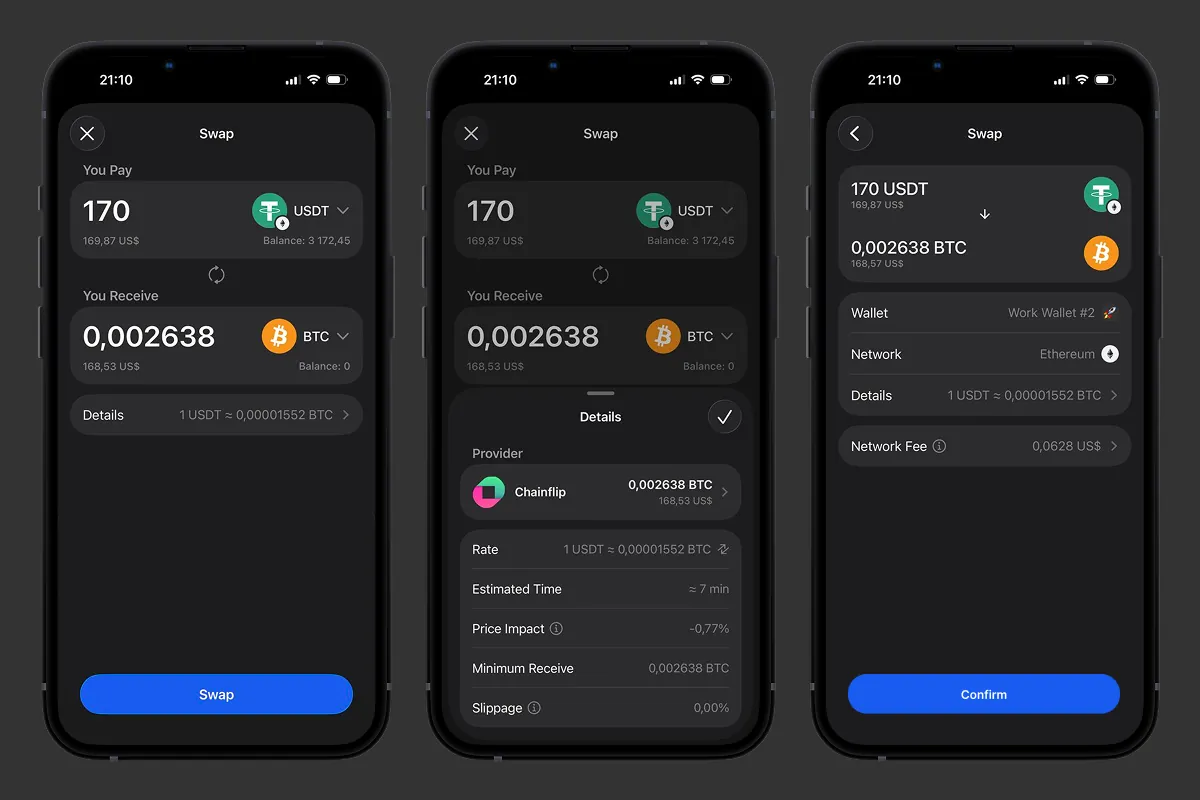 Swapping USDT ERC20 for BTC in Gem Wallet - the rate and network fee shown before you sign.
By following these steps, you can easily begin to reap the benefits that USDT offers.
Now: Which Network Should You Choose?
You now know what USDT is and what backs it. The next choice is practical: the network you send it on decides your fee and speed - TRC20, ERC20, and BEP20 can differ by 10x or more. Before your first transfer, see which one fits your amount: Which Network Is Best for USDT →


