


Table of Contents
A crypto swap fee is what you pay to convert one cryptocurrency into another, and in a typical swap it adds up to 0.5-2% of the amount. You will never see a single “fee” line: the cost is split between several components, each with its own recipient. In this article we break down each one and show exactly where the money leaks - and how to save it.
Key Takeaways
- A swap has more than one fee - a DEX fee for liquidity, a wallet fee for executing the trade, and a network fee to the blockchain for confirmation. A centralized exchange has a different set: a trading fee, a spread, and a withdrawal fee.
- The only honest metric is the “you receive” field - it already includes every charge and slippage, so compare offers by that number, not by advertised percentages.
What Are Crypto Swap Fees?
A crypto swap fee is the charge you pay to exchange one cryptocurrency for another: for the liquidity behind the trade, for routing it, and for recording the transaction on the blockchain. You pay a single final price, but several charges sit inside it - you just never get an itemized receipt.
For example: you swap 500 USDT for BTC - you hand over $499.56 at the market rate and receive bitcoin worth $496.09. The $3.47 difference (about 0.7%) is the entire swap fee. Who took it, and why next time it could be 0.3% or 3% - let’s break it down.
How Swap Fees Work
A swap fee is charged once - at the moment of the exchange - and deducted automatically: you enter the amount, the app shows what you will get with every charge already subtracted, and only then you decide whether to confirm the trade. How transparent that process is depends on where you swap:
- Centralized Exchange (CEX): Charges a trading fee (usually around 0.1%), bakes a spread into the rate - an invisible markup between the buy and sell price - and adds a withdrawal fee: from ~$1 (the exchange’s flat fee) to $20+ on ERC20 when Ethereum is congested. The main downside: you learn the full cost only after the coins arrive - there is no way to compare upfront and walk away.
- Decentralized Exchange (DEX): A decentralized exchange takes a liquidity fee plus the blockchain’s network fee, but rates for the same pair differ from one DEX to another - you have to compare them manually.
- A Crypto Wallet With Built-in Swaps: Swapping straight from the wallet removes both problems - no withdrawals, no comparing DEXs by hand. Gem Wallet is a self-custody wallet: there is no withdrawal fee, your coins never leave your address, and swaps work across 100+ blockchains with no sign-up and no KYC.
What Makes Up a Crypto Swap Fee
When you swap in a crypto wallet, the fee consists of the following components:
| Component | Who Gets It | Typical Size |
|---|---|---|
| DEX fee | Liquidity providers | 0.01-1% |
| Wallet fee | The wallet executing the swap | 0-1% |
| Network fee | Blockchain validators | From cents to $2-4 |
| Slippage | The market (not a fee) | 0-3%, depends on size and pool |
DEX Fee: Paying for Liquidity
The DEX fee is what you pay a decentralized exchange, where the coins for your trade come not from a company but from regular users - liquidity providers. They pool their assets together and earn a percentage of every swap as the reward for putting their capital at risk. The size depends on the pair: stablecoin pairs like USDT/USDC trade in 0.01-0.05% pools, while a rare low-liquidity token can cost up to 1%. On Uniswap, the largest DEX by trading volume on Ethereum (data from DefiLlama), the fee is set by tiers - 0.01%, 0.05%, 0.3%, and 1%: the more volatile the pair, the higher the tier.
Wallet Fee: Paying to Execute the Swap
The wallet fee is what you pay the app that compares rates across DEXs, builds the route, and executes the swap in one tap. Gem Wallet charges 0.5% per swap and 0.25% for stablecoin-to-stablecoin pairs (as of July 2026); the fee is already included in the final amount, with no extra charges after confirmation.
Gem Wallet’s built-in DEX aggregator polls top protocols - THORChain, Uniswap, Chainflip, and others - and shows each quote: the difference is visible in dollars, and you can pick a provider manually. Before you confirm, everything is on screen: the rate, estimated time, price impact, and minimum receive. After the swap, the exact rate is saved in your transaction history, and you can repeat the pair with the “Swap Again” button.
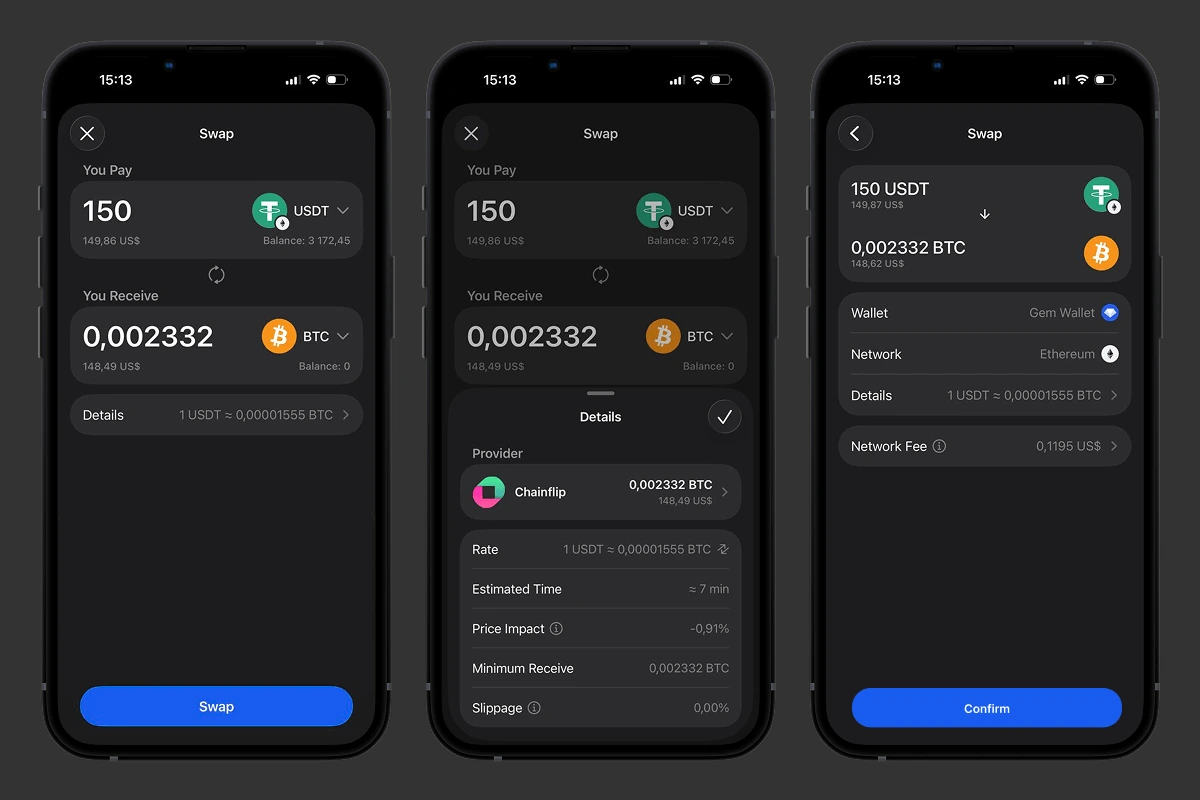 Swapping USDT ERC20 to BTC in Gem Wallet: the full fee is visible before you confirm
Network Fee: Paying the Blockchain
The network fee is the only component that goes not to services but to the blockchain itself: validators receive it for including your transaction in a block. It is paid in the network’s native coin and does not depend on the swap amount - only on the network and how busy it is.
The range is wide, and the usual assumptions about “cheap” and “expensive” networks often don’t hold. A USDT transfer, for example, costs about $0.01 on Solana and a few cents on BNB Chain, around $0.25-1 on Ethereum after the upgrades (as of July 2026), and $2-4 on TRON - once among the cheapest, but the dollar cost climbed because a USDT transfer burns TRX for network energy and TRX’s price went up. More in our guide: which USDT network is cheapest.
A cross-chain note: when you swap between two blockchains (say, ETH → BTC), there are two network fees - one on the sending chain and one on the receiving chain - and the second is already included in the final amount.
Slippage: The Hidden Part
Slippage is when a swap executes at a slightly worse price than shown: the market moved in those few seconds. On liquid pairs like BTC or USDT it’s barely noticeable, but on thin tokens the gap can eat more than all the visible fees. The protection is the “minimum receive” parameter: if the market drops below it, the swap cancels.
How to Lower Your Crypto Swap Fees
Four habits lower your swap fee - and none of them involves hunting for a “zero-fee” service:
- Compare “You Receive”, Not Percentages: It’s the only number that already includes every charge and slippage.
- Match the Network to the Asset: If a coin exists on several networks, pick the cheaper one - the difference can reach a few dollars on a single swap.
- Swap Stablecoins for Each Other: Pairs like USDT → USDC go through the cheapest pools and get a reduced fee - the cheapest type of swap there is.
- Let an Aggregator Pick the Route: Rates for the same pair differ by 1-5% across DEXs, and a DEX aggregator compares them automatically and routes your swap down the best path.
And the reverse rule: don’t swap small amounts on expensive networks - a $20 swap on an expensive network can lose 10-20% to the network fee alone.
Can Swap Fees Be Zero?
No. Liquidity providers and validators always get paid, so zero-fee swaps don’t exist. A “0% fee” banner usually means the fee is hidden in the rate. The check is simple: compare “you receive” against the market rate on CoinGecko - the difference is the real fee.
What Will Your Next Swap Actually Cost?
Want to see the real price of your swap? Open Gem Wallet, pick a pair, and make a swap: provider quotes, price impact, and minimum receive - all on one screen before you confirm.


