


Table of Contents
A bridge moves the same asset to another chain, while a swap changes which asset you hold: bridging USDC from Ethereum to Arbitrum leaves you with USDC on a new chain, while swapping ETH for USDC turns your ETH into a different token. The simple rule: a bridge is about where your asset lives, a swap is about what your asset is - and getting it wrong costs you an extra step, a double fee, or a wrapped token you’re stuck with.
Key Takeaways
- Bridge = movement, swap = conversion - a bridge leaves you the same token (often a wrapped version), a swap gives you a different one.
- Bridges lost around $2B in 2022 alone (Chainalysis) - 69% of all crypto stolen that year; Ronin lost $625M (March 2022), Wormhole $320M (February 2022).
- A cross-chain swap combines both actions in one step - a wallet with a DEX aggregator compares routes across top providers and delivers the native asset, with no manual bridging or wrappers.
What Is a Crypto Bridge?
A crypto bridge (blockchain bridge, cross-chain bridge) connects two blockchain networks and moves the same asset between them: blockchains don’t talk to each other natively, so a bridge creates a workaround.
Most bridges use a “lock and mint” model: the original token is locked by a smart contract on the source chain, and an equivalent is minted on the destination chain. Send 1,000 USDC on Ethereum - the bridge locks it and mints 1,000 USDC.e on Avalanche. That’s not the native asset but its wrapped version, pegged 1:1 to the original: the same amount, but technically a different token. The category is huge: major bridges like Stargate, Wormhole (45+ chains), and deBridge moved roughly $18.8B over the last 30 days (per DefiLlama).
What Is a Crypto Swap?
A crypto swap converts one token into another, and unlike a bridge it changes the asset itself, not its location. Swapping ETH for USDT leaves you with a different token; a same-chain swap is the most common action in any DeFi Wallet.
A cross-chain swap goes further: it combines movement and conversion into one flow. Without it, you’d first bridge ETH to Polygon, wait for the transfer, then use a DEX on Polygon to swap it into USDC - three steps and two fees. A cross-chain swap does it in one operation: the main job here is conversion plus movement.
Bridge vs Swap: Key Differences
A bridge always works across chains, so the fair comparison is with a cross-chain swap - a plain swap can also happen within a single chain. What actually separates them? Three things: what you get out, how many steps it takes, and which risks you take on.
| Feature | Bridge | Cross-Chain Swap |
|---|---|---|
| Main goal | Move an asset between chains | Exchange an asset between chains |
| Example | USDC from Ethereum to Arbitrum | ETH on Ethereum → USDC on Polygon |
| Output | Same token, often a wrapped version | Different token on another chain |
| Steps | Bridge first, swap separately | Bridge and swap in one flow |
| Best for | Moving liquidity to another chain | Entering a new chain with the token you need |
| Risks | Bridge, wrapped-asset, destination-chain risk | Route, liquidity, slippage risk |
Bridges remain a concentrated point of risk: per Chainalysis, cross-chain bridges lost around $2B across 13 hacks in 2022 alone - 69% of all crypto stolen that year. The largest were Ronin ($625M, March 2022) and Wormhole ($320M, February 2022), both through vulnerabilities in the contracts holding the locked assets.
Which One Should You Use?
The choice comes down to one question - do you want the same token or a different one?
- Use a bridge when your goal is to keep the same token and move it to a specific chain you already know - for example, moving USDC from Ethereum to Base to use the same stablecoin in another ecosystem.
- Use a swap when your goal is to receive a different token, especially on another chain - for example, turning ETH on Arbitrum into USDT on Polygon. A single cross-chain swap is usually more convenient and cheaper than bridging then swapping, because it doesn’t charge a fee twice and doesn’t leave you with a wrapped token you still have to deal with.
In practice, it’s easier to keep both cases in one place: a single wallet that decides when you need a swap and when you need a bridge, finds the route, and doesn’t make you hop between apps by hand. That’s exactly how it works in Gem Wallet.
How Gem Wallet Finds the Best Route
Gem Wallet runs cross-chain operations as swaps, not manual bridging: the built-in DEX aggregator compares routes across top providers - THORChain, Chainflip, Maya, Uniswap, PancakeSwap, and others - and picks the one with the best combination of rate at the moment of the trade, speed, and fees.
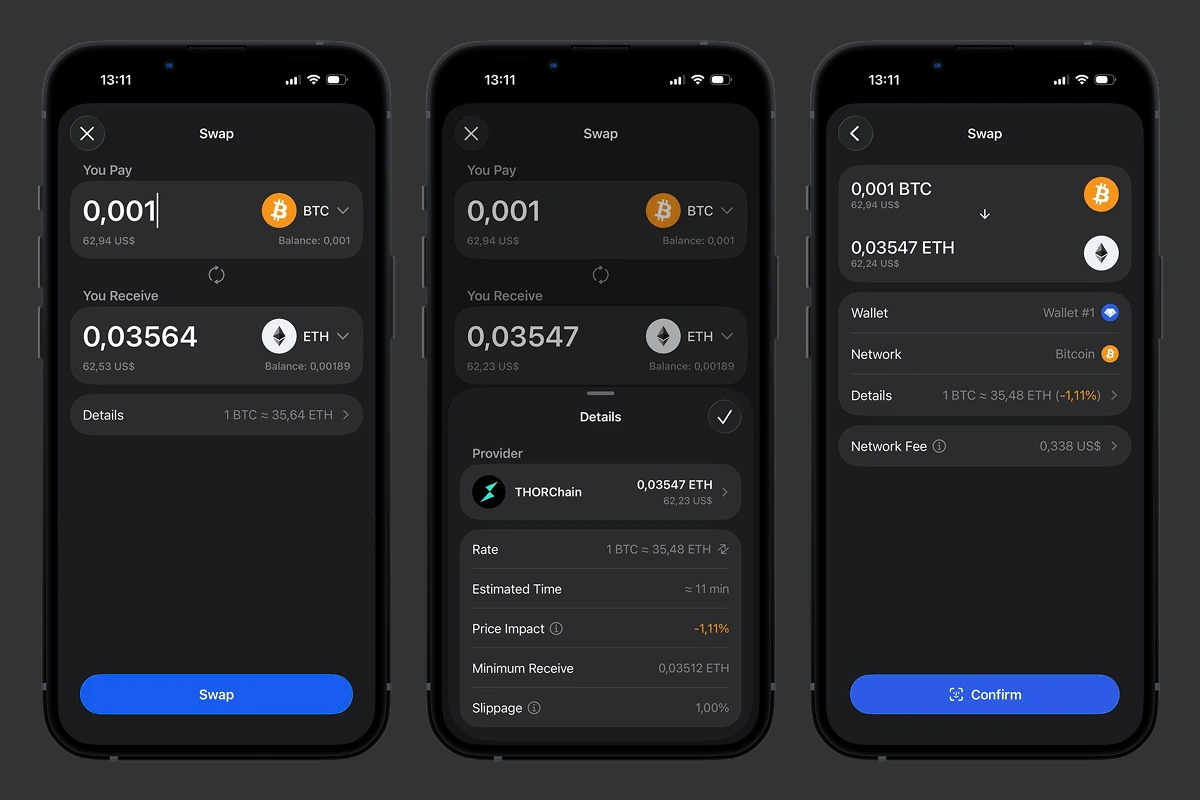 Swapping BTC for ETH via THORChain in Gem Wallet.
Here’s what that means for you in practice:
- Security and Privacy: Gem Wallet is a self-custody, fully open-source wallet: your private keys never leave your device, and swaps run with no registration, no KYC, and no handing assets to a custodial service - securely and privately.
- Broad Swap Coverage: Gem Wallet supports 100+ blockchains, and swaps cover both scenarios - on-chain (for example, USDC to ETH within Ethereum) and cross-chain (for example, BTC to SOL or ETH to USDT across different networks).
- Automatically the Best Rate: Gem Wallet’s aggregator compares routes in real time and picks the one that returns the most on the output - or, if you prefer, you can choose a provider manually from the options.
- Native Assets, Not Wrappers: Some routes deliver real BTC or ETH directly, with no wrapped token and no separate bridge - removing the wrapped-asset risk typical of classic bridges.
- One Transparent Fee: Gem Wallet charges 0.5% per swap and 0.25% for stablecoin-to-stablecoin pairs (as of July 2026), and you see the rate and final amount before you confirm.
Download Gem Wallet and swap crypto securely, privately, and at the best rate - right inside your wallet, in seconds and without an exchange.


