# What Is The Dash Blockchain?
> Find out in 2 minutes how the Dash blockchain works: a transfer here is confirmed in a couple of seconds, and a fifth of every block reward funds the network.
Dash is a Layer 1 blockchain for fast and cheap payments, launched in 2014: a transfer on it is confirmed in a couple of seconds and costs less than a cent.
> **Key Takeaways**
>
> - **A transfer is confirmed before you put your phone away:** The network locks the transaction in about 2 seconds, and the same coins cannot be spent again - there is no need to wait for a block.
> - **A fee far below one cent:** A regular transfer costs about 0.0000023 DASH, which is about $0.00014 (September 2026), and the amount you send does not affect the price.
> - **The network pays for its own development:** 20% of every block reward goes to the treasury, and 23.5% of all coins in circulation are locked as masternode collateral.
## What Is the Dash Blockchain?
Dash is a Layer 1 blockchain (a standalone network, not an add-on to another one) built as digital cash: the name itself is short for "digital cash". Dash grew out of the Bitcoin code but added masternodes to the miners - participants who confirm transfers quickly and decide how the network budget is spent. The market cap of DASH is $776 million (according to CoinGecko, September 2026).
*A masternode is a server whose owner has locked DASH as collateral and in return receives part of the block reward and a vote in how the network is run.*
### The History of the Dash Blockchain
American programmer Evan Duffield launched Dash on January 18, 2014: he wanted to fix what he saw as the weaknesses of Bitcoin - slow transfers and a fully public payment history. The network started under the name Xcoin, became Darkcoin almost right away, and in March 2015 got its current name, Dash. The old name was linked to the darknet, although, in the words of its creator, *"The goal of Darkcoin was never to support the dark web, it was to fix all the problems that have plagued bitcoin since the beginning"*.
In 2015 Dash also became the first cryptocurrency to fund its own development: part of every block reward goes to the treasury, and masternode owners vote on how to spend it. In May 2019 the network got protection against 51% attacks, and in July 2024 it launched Dash Platform, where you can send coins to a username instead of a long address.
## How the Dash Blockchain Works
A transfer on Dash is confirmed in two steps: InstantSend (instant locking of a transfer by masternodes) locks it in about 2 seconds, and 2.5 minutes later a miner adds it to a block. Masternodes set the lock, and after that the same coins cannot be spent a second time. Then masternodes also sign the block itself - this is a ChainLock, so even a miner with more computing power cannot cancel the transfer.
As of September 2026, the network runs 1,759 regular masternodes and 316 Evonodes - masternodes with a larger collateral that serve Dash Platform (according to MNOWatch). The network is designed for about 56 transactions per second and is less than 1% loaded, so there are no queues or fee spikes.
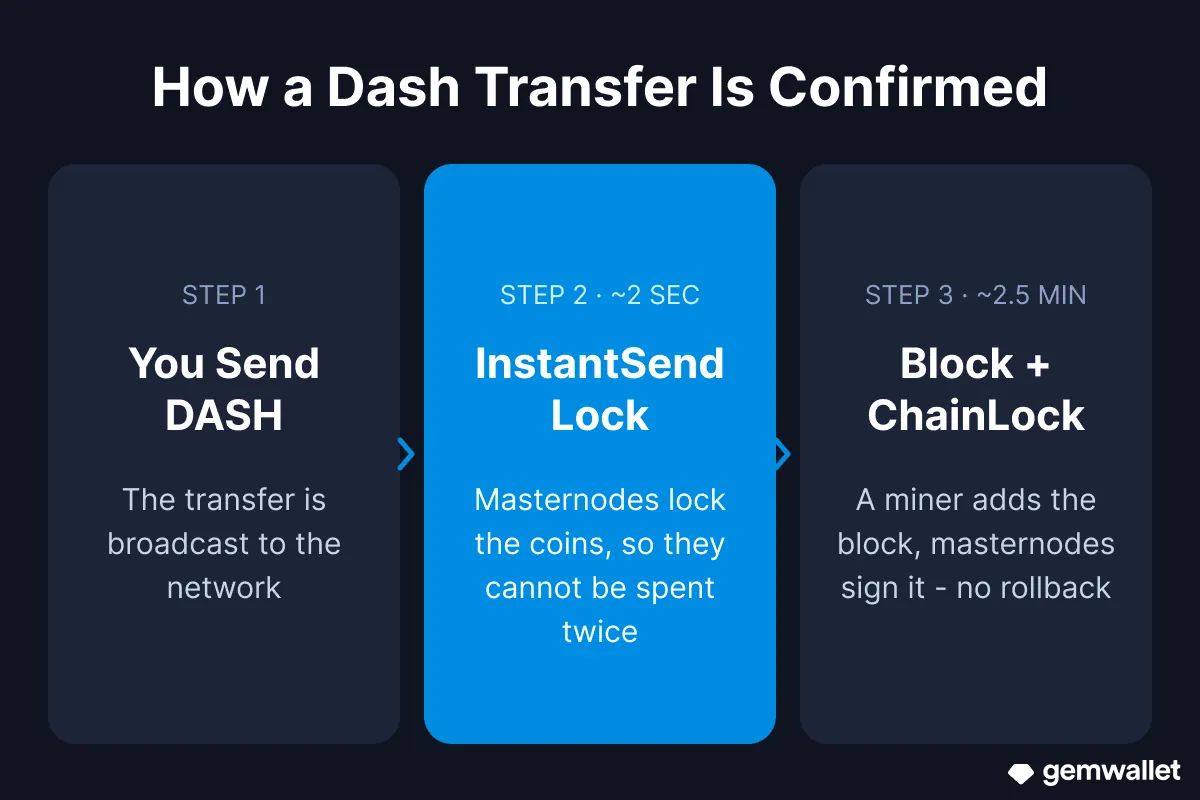
*Dash transfer confirmation steps. Source: Gem Wallet*
### How Much a Transfer Costs on Dash
A transfer on Dash costs about 0.0000023 DASH, which is about $0.00014 at the DASH price in September 2026. The fee depends on the size of the transaction, not the amount, so a $5 transfer and a $5,000 transfer cost the same. By our calculation, $1 in fees covers about 7,100 regular transfers.
## Key Advantages of the Dash Blockchain
The key advantages of Dash are transfers confirmed faster than a new block appears, protection against canceled transfers, and its own development budget, backed by more than 2,000 masternodes:
- **Instant Confirmation:** InstantSend applies to all transfers automatically and at no extra cost, so a shop can hand over the goods without waiting for a block.
- **Protection Against 51% Attacks:** ChainLocks secures every block with a masternode signature, so a miner with a lot of computing power cannot cancel transfers that are already confirmed.
- **Network Budget Built Into the Protocol:** 20% of the block reward goes to the treasury, and once a month masternodes vote on which development and promotion projects receive it.
- **Privacy by Choice:** CoinJoin is turned on manually, and 10 rounds of mixing cost 0.001 DASH on average.
## What the Dash Blockchain Is Used For
Dash is used for everyday money tasks where fast confirmation and a fee that does not depend on the amount matter:
- **Paying in Shops:** You pay with DASH at the checkout, and the seller sees a confirmed transfer before you put your phone away.
- **Sending Money to Family:** The money goes to another country directly from address to address, with no bank in the middle and no fee that grows with the amount.
- **Private Payments:** The built-in CoinJoin feature mixes your coins with the coins of other users, so the recipient cannot see where they came from.
- **Masternode Income:** The owner of 1,000 DASH runs a masternode and earns about 7.45% a year on the collateral (according to MNOWatch, September 2026), while an Evonode with 4,000 DASH in collateral receives four times more payouts.
- **Sending by Username:** You send DASH to a username on Dash Platform instead of copying a long address.
## How Dash Differs From Bitcoin
Dash differs from [Bitcoin](/learn/what-is-the-bitcoin-blockchain/) in that transfers here are checked not only by miners but also by masternodes: that is why a transfer is confirmed in seconds and the network funds its own development. The table below compares Dash and Bitcoin across seven parameters, from launch date to maximum supply, as of September 2026.
| Parameter | Dash | Bitcoin |
|---|---|---|
| Launch | January 2014 | January 2009 |
| Block time | 2.5 min | 10 min |
| When a transfer is safe to accept | ~2 sec, InstantSend lock | after 1-6 blocks, 10-60 min |
| Who checks transfers | miners and masternodes | miners only |
| Built-in privacy | CoinJoin by choice | none |
| Development funding | 20% of the block reward, treasury | not built into the protocol |
| Maximum supply | 17.74-18.92 million DASH | 21 million BTC |
As the table shows, the main difference is speed: on Bitcoin a large transfer waits for several blocks, while on Dash it becomes final in a couple of seconds. That is why [Bitcoin](/bitcoin-wallet/) is more often kept as savings, while Dash was built for everyday payments.
## DASH: The Native Coin of the Dash Blockchain
DASH is the native coin of the Dash blockchain: it pays the fee for every transfer, serves as collateral for masternodes, and gives their owners a vote on the network budget. Unlike networks with the [ERC20](/erc20-wallet/) standard, the base layer of Dash does not issue tokens through smart contracts, so DASH is the main asset people use on the network.
### DASH Tokenomics
The supply of DASH is capped: between 17.74 and 18.92 million coins will be issued in total, and 12.84 million are in circulation now (September 2026):
- **Maximum Supply:** The exact number within the range depends on how much of the treasury funds remains undistributed.
- **Reward Reduction:** The block reward drops by 7.14% roughly every 383 days, and issuance will continue until 2477.
- **Reward Split:** Masternodes receive 60%, miners 20%, and the network treasury 20%.
- **Inflation:** 2.67% a year (according to MNOWatch, September 2026).
- **Masternode Collateral:** By our calculation, active masternodes hold about 3 million DASH as collateral, which is 23.5% of the coins in circulation.
## How to Get Started With the Dash Blockchain
To use the network, you need a Dash Wallet - Gem Wallet gives you self-custody access to it: the code is 100% open-source, and it passed a CertiK audit in April 2026. Setup takes a couple of minutes, with no email, no phone number, and no ID.
1. **Create a Wallet:** Install Gem Wallet on iOS, Android, or from the APK, create a new wallet or import an existing one, and save the 12-word secret phrase offline - your Dash address is created automatically along with the other networks.
2. **Get DASH:** Fund the address with a transfer from an exchange or another wallet, or [buy DASH](/buycrypto/) right in the app with a credit card - buying is available in 170+ countries.
3. **Swap Assets:** With [swap](/swap/) in Gem Wallet, you can exchange BTC, ETH, USDT, and other coins for DASH, and the built-in DEX aggregator picks the route through Maya Protocol, NEAR Intents, and other providers.
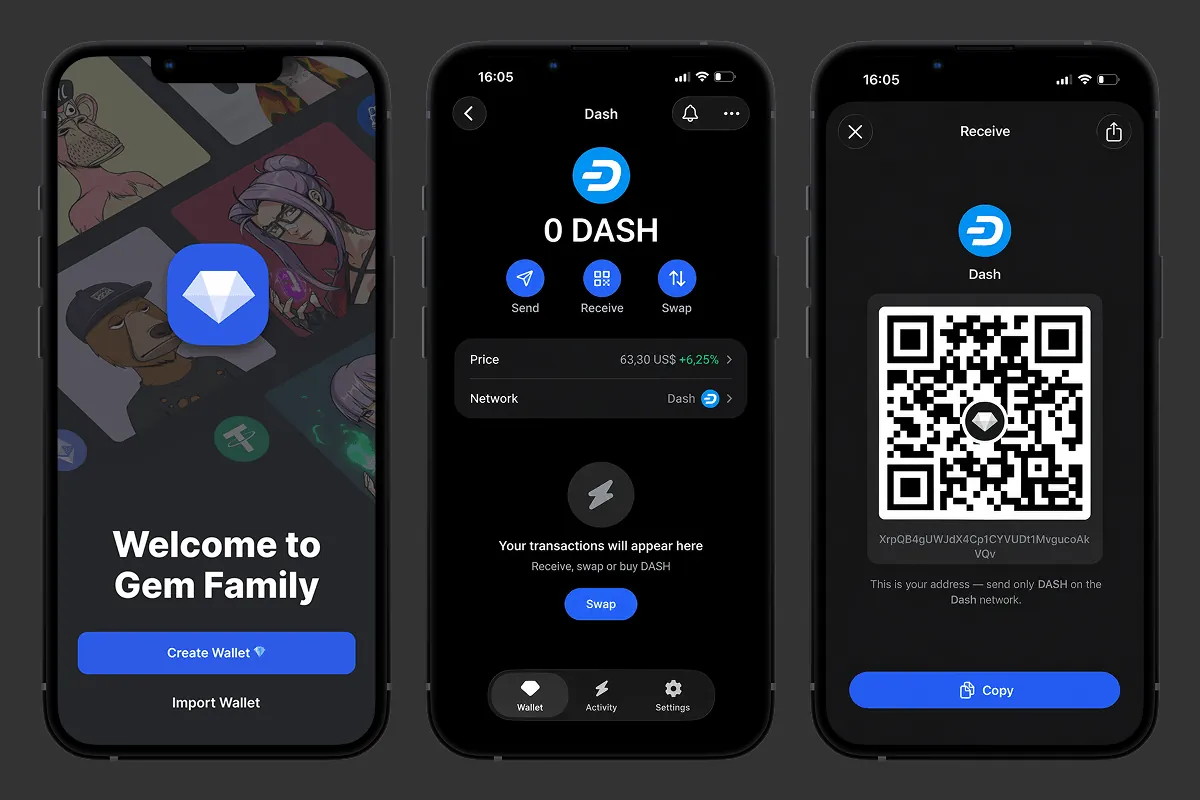
*Creating a Dash Wallet and receiving DASH in Gem Wallet*
Download Gem Wallet today and keep DASH always at hand: store, swap, and send it in a couple of seconds, while your keys stay only with you - privately and securely.