

Table of Contents
Open USD (OUSD) is a dollar stablecoin from Open Standard, a company founded by Coinbase, Mastercard, Shopify, Stripe and Visa so that businesses can use stablecoins as easily as regular money.
Key Takeaways
- Reserve income: All reserve income from OUSD, minus a small Open Standard management fee, goes to partner companies, while OUSD holders earn no interest.
- Where the coins live: 93% of all OUSD is issued on Tempo, the blockchain from Stripe, not on Ethereum or Solana (according to DefiLlama, October 2026).
- One ticker, two coins: Another stablecoin, Origin Dollar, has used the OUSD ticker since 2020, so the real OUSD can only be identified by its contract address.
What Is the Open USD (OUSD) Stablecoin?
Open USD (OUSD) is a fiat-backed stablecoin: every OUSD is backed by a dollar in reserves, so the coin is worth $1 and can be exchanged for a dollar at a 1:1 rate. OUSD is issued by Bridge, a Stripe company, and managed by Open Standard, an independent company in which Coinbase, Mastercard, Shopify, Stripe and Visa hold equal stakes.
OUSD enters a market dominated by USDT, with $183.8 billion in circulation, and USDC, with $74.5 billion (according to DefiLlama, October 2026), while OUSD has about $468 million in circulation (according to Bridge, October 2026). To make the new stablecoin usable from day one, the founders committed over $1 billion in launch liquidity, and more than 200 banks, fintechs and payment companies, including UBS and SBI Holdings, have joined the Open Standard network.
A stablecoin is a cryptocurrency whose price is pegged to the dollar or another stable asset, so its value barely changes.
Why Did Stripe and Visa Launch OUSD?
Stripe, Visa and the three other founding companies launched OUSD on September 30, 2026, so that the reserve income of a stablecoin goes to the companies that use it rather than to the issuer:
- Reserve Income Stays With the Issuer: With USDC and USDT, Circle and Tether keep the income from the bonds in their reserves, while Open Standard passes all of that income, minus a small management fee, to the companies that grow OUSD volume.
- Fees Hold Back Frequent Transfers: Moving existing stablecoins costs businesses 0.05-0.1% of the amount, so shifting money back and forth several times a day does not pay off.
- US Law Set the Rules: The GENIUS Act, signed in July 2025, requires every stablecoin to be backed 1:1 by dollars and the composition of reserves to be disclosed regularly.
“Existing stablecoins have great strengths, but to use them at scale, businesses need something that’s open, low-cost, high-throughput, broadly accessible and aligned to their interests.” - Zach Abrams, CEO of Open Standard
Can You Buy Open USD Stock?
No, you cannot buy Open USD stock: OUSD is issued by Open Standard, and Open Standard is a private company whose shares do not trade on any stock exchange. Only partners receive a stake in Open Standard: the five founders joined with equal stakes, and other companies earn equity in proportion to how much OUSD they issue and move through their platforms.
The OUSD coin itself does not generate income either: the GENIUS Act prohibits stablecoin issuers from paying interest to holders. The company is governed by a board of directors representing its shareholders, and its CEO is Zach Abrams, co-founder of Bridge.
Key Features of the OUSD Stablecoin
The OUSD stablecoin differs from other digital dollars in where its reserves are held, how much businesses pay to issue coins and which blockchains the coins are issued on.
1. Reserves With a Monthly Report
OUSD reserves are held at BlackRock, BNY and Lead Bank, and Bridge publishes a report on them every month. In October 2026, the reserves covered 100% of OUSD supply: 54.9% of reserves were cash and 45.1% were funds of US Treasury bills with maturities of under three months.
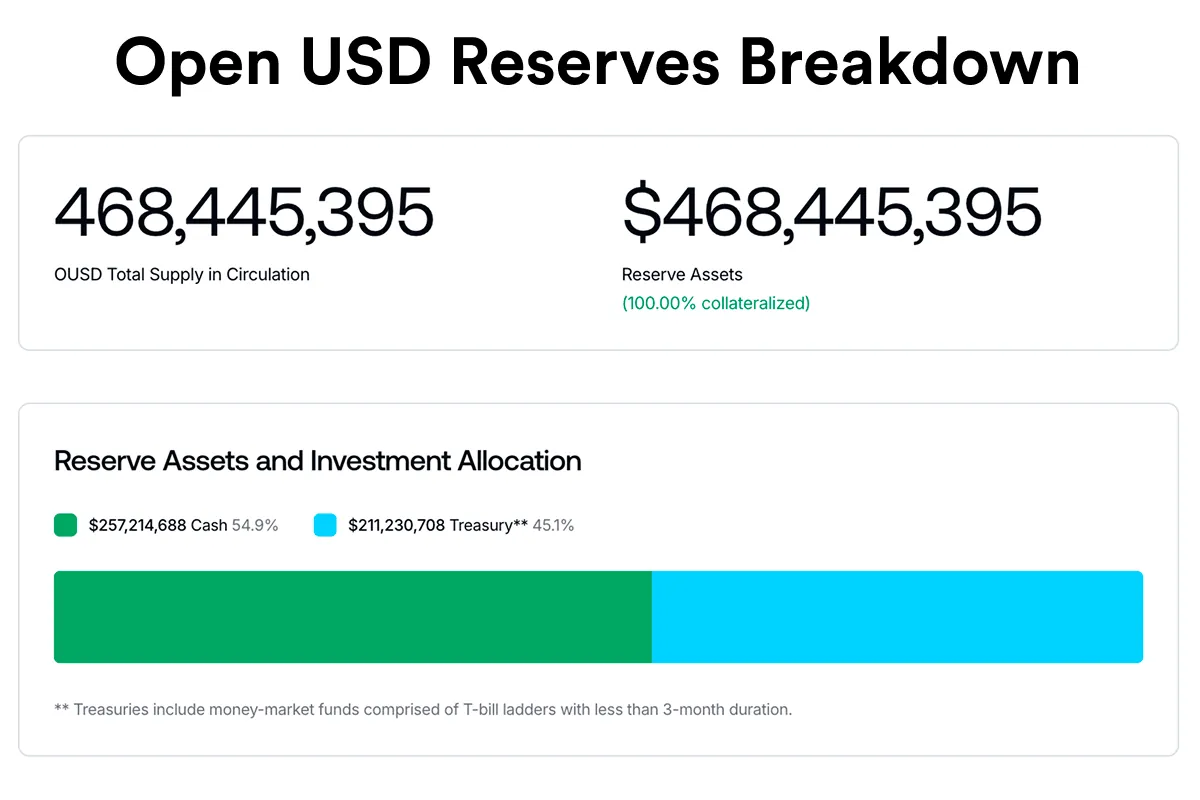 OUSD reserve composition. Source: reserves.bridge.xyz
2. Free Issuance and Redemption for Businesses
Companies exchange dollars for OUSD and back at a 1:1 rate with no fee through Stripe, Mastercard, Visa and, starting October 1, 2026, Coinbase. Tether, by comparison, charges 0.1% to issue USDT and at least $1,000 to redeem it, with a minimum transaction of $100,000 (according to Tether, October 2026). Only issuance and redemption of OUSD are free: Open Standard charges a small fee on transfers, and the company does not disclose its size.
3. Four Blockchains With Native Issuance
OUSD is issued natively on four networks: Ethereum, Solana, Base and Tempo. The payments blockchain Tempo from Stripe holds 93% of all OUSD in circulation (according to DefiLlama, October 2026). Each network has its own OUSD token, so OUSD must be sent on the same network where it is held: a transfer to a different network can result in lost coins.
OUSD vs USDC vs USDT: Key Differences
OUSD differs from USDC and USDT above all in who receives the reserve income: with USDC, Circle keeps it, with USDT, Tether keeps it, and with OUSD, it goes to Open Standard partner companies. The table below compares OUSD, USDC and USDT by issuer, launch year, supply in circulation in dollars, recipient of reserve income and frequency of reserve reports as of October 2026, with OUSD supply according to Bridge and USDC and USDT supply according to DefiLlama.
| OUSD | USDC | USDT | |
|---|---|---|---|
| Issuer | Bridge (Stripe) for Open Standard | Circle | Tether |
| Launch Year | 2026 | 2018 | 2014 |
| In Circulation | ~$468 million | $74.5 billion | $183.8 billion |
| Who Receives Reserve Income | Open Standard partners | Circle | Tether |
| Reserve Reports | Monthly | Monthly | Quarterly |
For a regular user, the main difference between OUSD and the two market leaders is size: USDT has almost 400 times more coins in circulation than OUSD.
Is OUSD the Same as Origin Dollar?
No, Open USD and Origin Dollar are two different stablecoins that share the OUSD ticker: Origin Dollar has been issued by Origin Protocol since 2020, and unlike Open USD, it pays its holders a yield. Both coins can appear side by side in token lists and on DEXs, so the real Open USD can only be identified by its contract address. Open Standard publishes the official OUSD addresses for each network:
- Ethereum: 0x9f6F3991D525015a6F8CaF062C83b62fD3AC4436
- Base: 0xB2000000000000000000002fEb517dFeC7415344
- Solana: ousd2mJsPEckLHcSCDxyKD7NDGARZcfLbDZkKiatYHB
- Tempo: 0x20c0000000000000000000006a37DA5C996874BE
Before buying or receiving OUSD, compare the token contract address with the official one.
Is OUSD Safe to Hold?
OUSD is safe to hold as a dollar equivalent because every coin is backed 1:1 by reserves, but the issuer can freeze OUSD at any address. According to the OUSD contract code on Ethereum, the issuer can pause transfers, block an address and burn the coins held at it, just as Tether and Circle can with USDT and USDC.
Use Cases for the OUSD Stablecoin
The OUSD stablecoin is built for business money - merchant settlements, corporate treasury and international transfers through fintechs:
- Merchant Settlements: A payment company sends the merchant payment in OUSD right after a purchase, around the clock, and a stablecoin transfer on Tempo, where most OUSD is issued, costs between $0.00003 and $0.0006 because the protocol caps the fee.
- Corporate Treasury: A company places idle cash in tokenized money market funds for as little as 15 minutes or 30 seconds and moves it back into OUSD when it needs to pay.
- Transfers Through Fintechs: Ramp, powered by Stripe, opens OUSD accounts for its customers, who use them to send money to other countries.
Quick Guide to Getting Started With OUSD
To start using OUSD, you need a secure OUSD Wallet - for example, Gem Wallet, a self-custody mobile wallet with fully open-source code that keeps your keys only on your device:
- Create a wallet
- Obtain OUSD
- Store OUSD
- Manage assets
- Swap OUSD
Let’s go through each step in detail.
1. Create an OUSD Wallet
Download and install the wallet from the App Store, Google Play or the official website in just a few taps. When you create the wallet, store your 12-word secret phrase in a safe place - it is the only key to your funds.
2. Obtain OUSD
You can buy OUSD right in the wallet with a credit card, such as Visa, Mastercard and others: Gem Wallet works with top fiat providers - Mercuryo, MoonPay and others - in 170+ countries. You can also top up your balance with a transfer from an exchange or from friends via QR code - just make sure to send OUSD on the same network where you receive it.
3. Store OUSD Securely
Your OUSD Wallet is accessible only to the owner of the secret phrase: no one else has access to your funds, and the wallet code is fully open, so anyone can verify it.
4. Manage Assets
Gem Wallet works as a stablecoin wallet for USDT, USDC, RLUSD, USAT and more, and supports over 100 blockchains. In one app, you can store and send coins, stake, connect to DApps via WalletConnect and use DeFi.
5. Swap OUSD
You can swap OUSD for other coins right in the wallet, such as BTC, ETH, SOL or BNB: the built-in DEX aggregator with top providers - Uniswap, Relay, THORChain and others - finds the best rate at the moment of the trade.
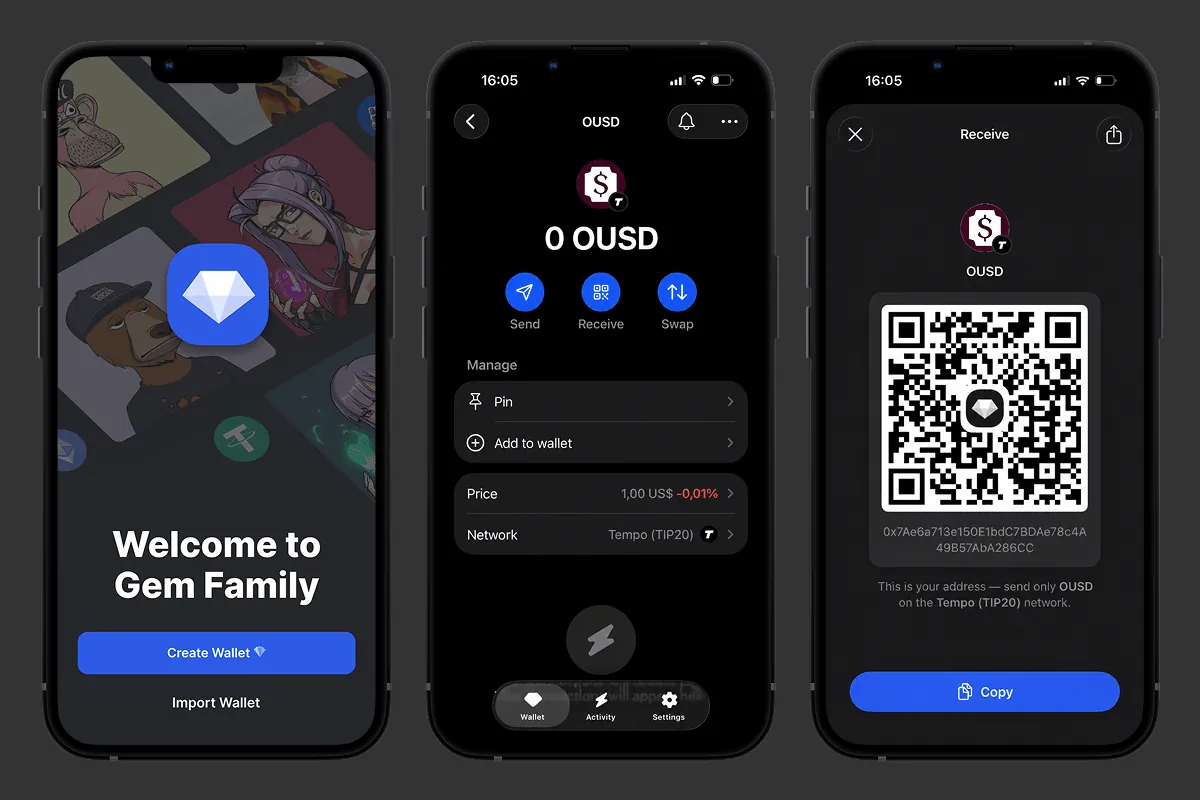 Buying, storing and swapping OUSD in Gem Wallet.
Install Gem Wallet and start using OUSD today - securely, privately and in just a few taps.
Disclaimer: This article is for informational and educational purposes only and is not financial or investment advice. Crypto assets are highly volatile, and you can lose all the money you invest. Do your own research and make decisions at your own risk.