

Table of Contents
A USDT wallet address is where you receive Tether, and every network has its own format: on TRON it starts with T, on Ethereum and BNB Chain with 0x, and on TON (The Open Network) with UQ. In this article, we show what a USDT address looks like on five popular networks and break down the mistakes that most often send money to the wrong place.
Key Takeaways
- Typo protection differs by network: A random typo slips past the check about 1 time in 4.3 billion in a TRON address, 1 time in 4,000 in an ERC20 address, and a Solana address has no protection at all.
- USDT BEP20 is not issued by Tether: On BNB Chain it is Binance Bridged USDT, and it uses the same 0x address as USDT ERC20.
- Checking “4+4 characters” is weaker than it seems: Comparing the first six and last six characters of an address filters out 65,536 times more fakes.
What Is a USDT Address
A USDT address is the public address of your wallet on the network where your USDT is held. People send money to it, but only the owner of the keys can move funds out. USDT has no single universal address: the Tether stablecoin runs on several blockchains, and you have a separate address on each one.
You can share your USDT address with anyone, just like a bank account number. Your 12-word secret phrase, however, should never be shown to anyone, not even “support.” To learn where USDT came from, how it differs from USDC, and what risks it carries, read our guide What Is USDT.
USDT (Tether) is a stablecoin, a cryptocurrency whose price is pegged to the US dollar, so 1 USDT is worth about $1.
USDT Networks and Address Formats
According to Tether’s website, as of October 2026, USDT is issued on 13 networks, and all versions are equal in value: 1 USDT on TRON is worth the same as 1 USDT on Ethereum. Each blockchain keeps its own record of balances, so a USDT transfer always happens within one network, and the recipient’s address must belong to that same network. The fee for each transfer is paid in the network’s native coin, TRX on TRON and ETH on Ethereum, so your address should always hold a little of it.
TRC20, ERC20, and BEP20 are not different coins but standards of the same USDT on different blockchains. The addresses you will see most often start with T and 0x: TRON holds about $89.7 billion in USDT and Ethereum about $76.5 billion out of $184 billion in circulation (DefiLlama, July 2026). If you haven’t chosen a network for your USDT yet, start by comparing fees and speed: Which Network Is Best for USDT.
A token standard is a set of rules for how a token is issued and transferred on a specific blockchain: TRC20 on TRON, ERC20 on Ethereum, and BEP20 on BNB Chain.
USDT TRC20 Wallet Address
A USDT address on TRC20 is a regular TRON address of 34 characters that starts with a capital T, and uppercase and lowercase letters in it are not interchangeable. The end of the address contains a 4-byte checksum (a short code the wallet uses to confirm the address was typed without errors), and by our calculation a random typo passes it only 1 time in 4.3 billion. So a wallet that checks the address will almost certainly catch the mistake.
USDT ERC20 Wallet Address
On Ethereum, a USDT address under the ERC20 standard consists of 0x followed by 40 characters: digits from 0 to 9 and letters from a to f. Uppercase and lowercase letters protect it from typos under the EIP-55 standard, but less reliably than on TRON: a random error passes the check about 1 time in 4,000 - by our calculation (4,294,967,296 ÷ 4,050), that is about a million times weaker than a TRON address - and an address written only in lowercase is not checked at all.
USDT BEP20 Address
A USDT address on BEP20 is the same as your ERC20 address: BNB Chain is compatible with Ethereum, so one secret phrase gives you the same 0x address on both networks. The token itself is issued not by Tether but by Binance, and CoinGecko lists it as Binance Bridged USDT. This doesn’t affect transfers, but because the address is identical, this is where people mix up networks most often.
USDT Address on Solana
A Solana address is 32-44 letters and digits with no checksum, so a wallet will not catch a typo in it. Never type such an address by hand: always copy it or scan the QR code.
USDT on Solana is issued under the SPL standard and is held not directly on the wallet address but on a token account linked to it (an Associated Token Account, a separate slot for each token). If the recipient doesn’t have this slot yet, the sender’s wallet creates it with the first transfer and pays a refundable deposit for it: according to the official Solana RPC (the server that answers requests to the network), this is 0.00148844 SOL as of October 2026, although many guides still list the old amount of 0.00203928 SOL.
USDT Address on TON
A TON address has 48 characters, and USDT on TON is issued under the Jetton standard. The same TON address can be written in two ways: with UQ (an address for a regular wallet) or with EQ (a “bounceable” address, where a transfer that can’t be accepted returns to the sender). For receiving funds to a personal wallet, the TON documentation recommends the UQ version.
USDT Wallet Address Example
A USDT wallet address looks different on every network: its first characters and length (from 32 to 48) instantly show which network it belongs to. We prepared a table that helps you identify the network of a USDT address in a couple of seconds (as of October 2026).
| Network | USDT Name | Address Starts With | Characters | Example (Shortened) |
|---|---|---|---|---|
| TRON | USDT TRC20 | T | 34 | TQ9a…3Xf9Lp |
| Ethereum | USDT ERC20 | 0x | 42 | 0xA3f9…7E2bD4 |
| BNB Chain | USDT BEP20 | 0x (same as on Ethereum) | 42 | 0xA3f9…7E2bD4 |
| Solana | USDT SPL | A letter or a digit | 32-44 | 7xKX…sAsU |
| TON | USDT Jetton | UQ | 48 | UQDK…PuwA |
The examples are shortened on purpose: never send USDT to an address from an article, a video, or someone else’s screenshot. Always take your own address from your own wallet.
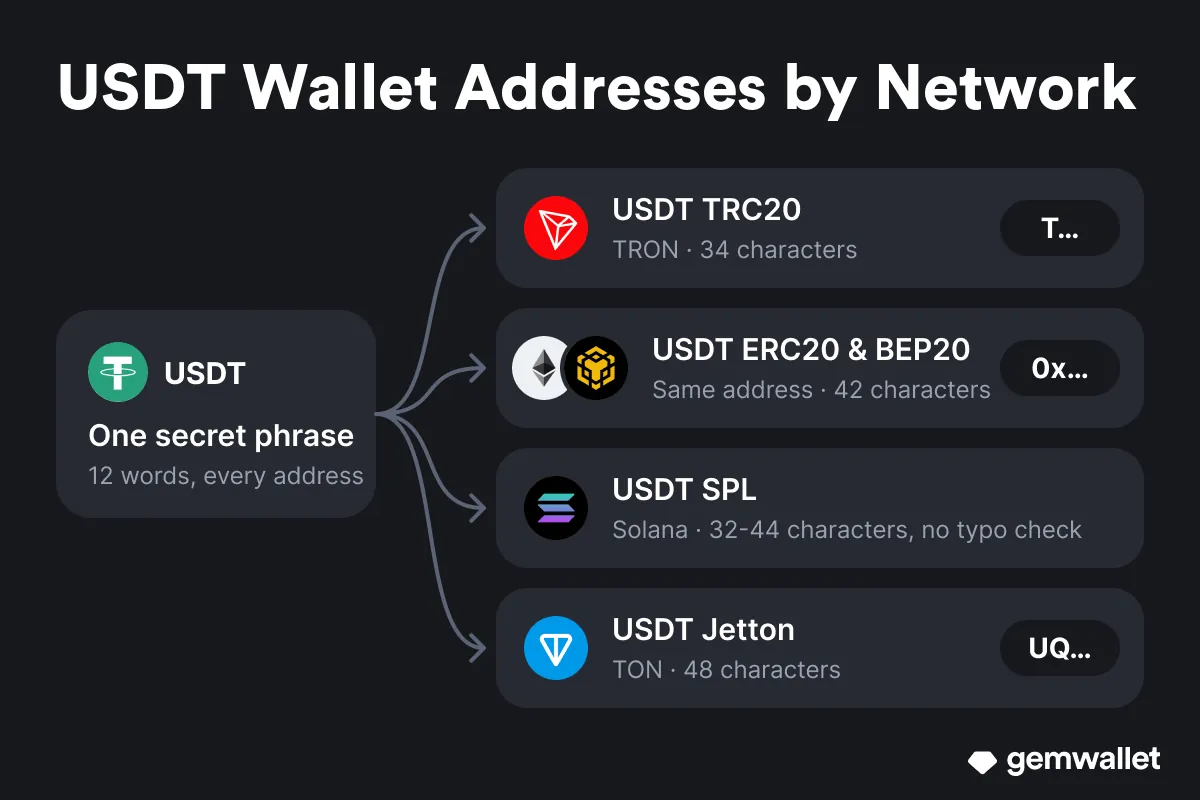 USDT addresses by network. Source: Gem Wallet
What Can You Learn From a USDT Wallet Address
Anyone who knows your USDT address can open a blockchain explorer (a website that shows all transactions on a network), such as Tronscan or Etherscan, and see:
- Balance: How much USDT and other tokens the address holds right now.
- Transfer History: All incoming and outgoing transfers with amounts and dates, and the blockchain keeps them forever.
- Links to Other Addresses: Which wallets and exchanges you have exchanged money with.
What you can’t learn from a USDT address:
- The Owner’s Name: The blockchain doesn’t store it, but an address is easy to link to a person if you post it next to your username even once. For donations and payments from strangers, it’s convenient to keep a separate wallet.
- The Wallet Keys: No one can steal USDT knowing only the address, because sending funds requires a signature with the key on your device. Only Tether can freeze USDT on an address, and under its terms of use this happens at the request of law enforcement or in cases of fraud.
USDT Wallet Address vs Contract Address
A USDT wallet address belongs to you, while a contract address is the shared address of the token itself, used to confirm the USDT is real. On Ethereum and BNB Chain, both start with 0x and have 42 characters: for example, 0x55d398…97955 is the USDT contract on BNB Chain (according to CoinGecko), and money sent to it can’t be recovered.
A transaction hash (a unique transfer ID) also starts with 0x but is longer, at 66 characters. To tell real USDT from a fake by its contract address, see How to Check a USDT Contract.
How to Create a USDT Wallet Address
A USDT wallet address appears automatically as soon as you create a crypto wallet, and it usually takes just a couple of taps:
- Download a USDT wallet
- Create a USDT wallet
- Find USDT on the right network
- Copy your USDT address
Let’s go through each step in detail.
Step 1: Download a USDT Wallet
You can download Gem Wallet, a self-custody USDT Wallet with 100% open-source code. Install it from the official website gemwallet.com, the App Store, or Google Play, and there’s no KYC (identity check with documents) because the wallet doesn’t ask for any personal data.
Step 2: Create a USDT Wallet
Create a new wallet, and the app will show you a 12-word secret phrase. Write it down on paper: it is the only way to restore your wallet and all its addresses on 100+ networks if you lose your phone.
Step 3: Find USDT on the Right Network
Open the Assets tab and type USDT in the search. The smart search built into the wallet also understands network names: type USDT TRON or USDT TRC20, and the wallet will instantly show the stablecoin on the network you need.
Step 4: Copy Your USDT Address
Tap Receive and copy the address or show the QR code, and always send the address to the sender together with the network name. You can also fund it yourself if you buy USDT with a credit card right in the app through Mercuryo, MoonPay, Paybis, and other providers.
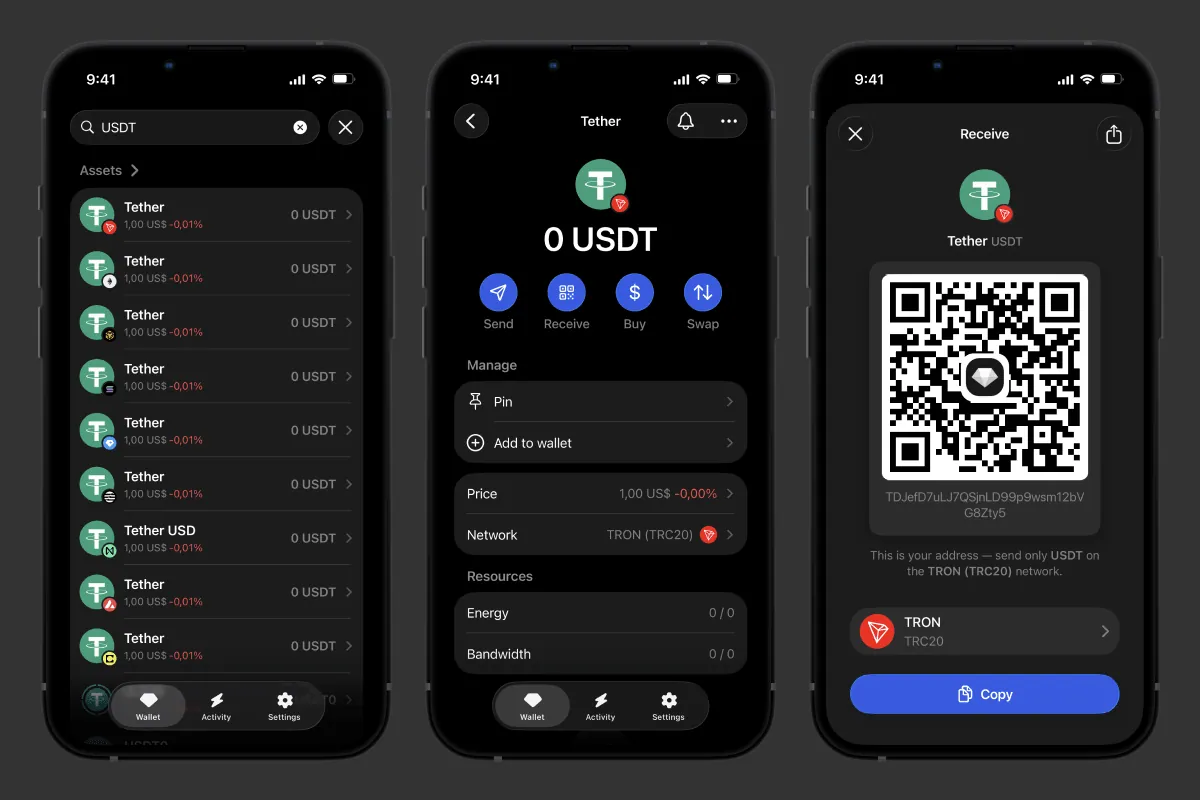 USDT TRC20 address in Gem Wallet
Common USDT Wallet Address Mistakes
Most USDT losses among users happen not because of hacks but because of an address mistake when sending. You can spot each of these mistakes before you tap “Send.”
How to Recover USDT Sent to the Wrong Network
You can recover USDT sent to the wrong network only if both networks share the same address, like ERC20 and BEP20, and you hold the keys to that address. For example, USDT BEP20 sent to your ERC20 address will arrive at the same 0x address on BNB Chain, and you just need to add USDT on BNB Chain to your asset list for the balance to appear.
USDT Address Poisoning
USDT address poisoning is a common scheme on TRON: scammers create a lookalike address with the same first and last characters as an address from your history and send a tiny transfer from it (for example, 0.000001 USDT), hoping that next time you’ll copy it instead of the real one. By our calculation, faking 4 characters on each side of a 0x address (Ethereum, BNB Chain) takes about 4.3 billion attempts, and faking 6 takes 281 trillion, so always check at least 6 characters on each side.
Gem Wallet has extra security filters against these attacks: suspicious tiny transfers and lookalike addresses are automatically hidden from your history across all 100+ networks, so you simply won’t see the “poisoned” address.
Can You Send USDT to a BTC Address
No: Bitcoin addresses start with 1, 3, or bc1, and no USDT network accepts them. Tether stopped issuing USDT on Bitcoin’s Omni protocol on August 17, 2023, and its announced return through the RGB protocol (August 2025) has not launched as of October 2026. If you need BTC, you can swap USDT for BTC right in the wallet through the built-in DEX aggregator at the best available rate.
How to Fund a USDT Wallet Address
You can buy your first USDT for a new address in a wallet, on an exchange, or through P2P, but these options are not equally safe. We compared all three in our guide: How to Buy USDT Safely →