

Table of Contents
A Hyperliquid whale tracker is a tool that shows the open positions of the largest accounts on Hyperliquid in real time: size, entry price, leverage, unrealized profit and liquidation price. It works because Hyperliquid runs its order book onchain, so every position is public. I have watched these trackers for a long time, and my conclusion is simple: the data is real, but it is the worst possible basis for your own trade.
Key Takeaways
- Everything is public: on Hyperliquid every order, cancel, trade and liquidation is onchain, so any wallet’s positions, entries and liquidation prices can be read by anyone (Hyperliquid docs, October 2026).
- You see one wallet, late: a tracker shows a single address after the fact, without the hedges, the other wallets and the plan behind it. In May 2025 James Wynn’s $1.25 billion Bitcoin long at 40x, the most watched position on Hyperliquid, lost about $99 million after Bitcoin fell only about 3.8% below his average entry.
- Trade your own plan in Gem Wallet: Hyperliquid perpetuals trade right in Gem Wallet. Join the Gem Wallet club with code GEMWALLET and get a trading fee discount.
Why Every Position on Hyperliquid Is Public
Hyperliquid is a perpetual futures exchange whose order book lives on its own blockchain. According to the Hyperliquid documentation, its HyperCore layer includes fully onchain perpetual futures and spot order books, and every order, cancel, trade and liquidation happens with one-block finality.
On a centralized exchange your position is a row in the exchange’s private database. On Hyperliquid it is public data tied to a wallet address. Nobody needs special access to read it: the same information that the exchange uses to match and liquidate positions is open to everyone.
That openness is a real advantage of onchain trading. You can check that the exchange is solvent, that liquidations happen at the stated prices and that nobody trades against you behind the scenes. The same openness is what makes whale tracking possible, and that is where the problems start.
What a Hyperliquid Whale Tracker Shows
There is no single definition of a whale: each tracker sets its own threshold, and in practice the label goes to accounts holding positions worth millions of dollars. A whale tracker is a dashboard built on top of that public data. CoinGlass, Hyperdash and HypurrScan read Hyperliquid’s onchain state and sort accounts by position size or profit. The Hyperliquid leaderboard does the same for the best-performing accounts.
For any large wallet a tracker usually shows:
- Position: asset, direction (long or short) and size in dollars.
- Entry and leverage: the average entry price and how many times the margin is multiplied.
- Liquidation price: the price at which the position is closed by force.
- Profit and loss: unrealized PnL now and realized PnL over time.
- Recent fills: when the wallet added to or cut the position.
How Traders Use Whale Trackers
Most people open a whale tracker for one of three reasons. The first is copying: a whale goes long, so they go long too. The second is alerts: bots post in Telegram and on X every time a large wallet opens, adds or gets liquidated. The third is the opposite trade: some traders look for a whale’s liquidation price and bet that the market will be pushed toward it.
There is also an official way to follow a trader on Hyperliquid: vaults. A vault is a trading account that a leader manages on behalf of depositors, who share in the profits; the leader keeps a 10% profit share and must own at least 5% of the vault (Hyperliquid docs). A vault at least puts the leader’s own money next to yours, but the market risk stays the same.
All three treat a single public position as a signal. In my experience that is exactly the mistake, and the rest of this article explains why.
Why Copying Whales Is Dangerous
Copying a whale feels like borrowing the judgment of someone with more money and more information. In practice you borrow only the visible part of a trade, and you carry its risk on your own account.
I learned this from the other side. For a while I kept public trading profiles, and friends asked for access to my statistics and positions so they could follow my trades. For about six months they kept telling me they could not make money with it, while my own account was growing. They knew the strategy worked, they saw every position, and they still could not repeat the result: they closed earlier, opened later or stepped in with their own decisions. Seeing a trade and holding it the way its owner does turned out to be two different things.
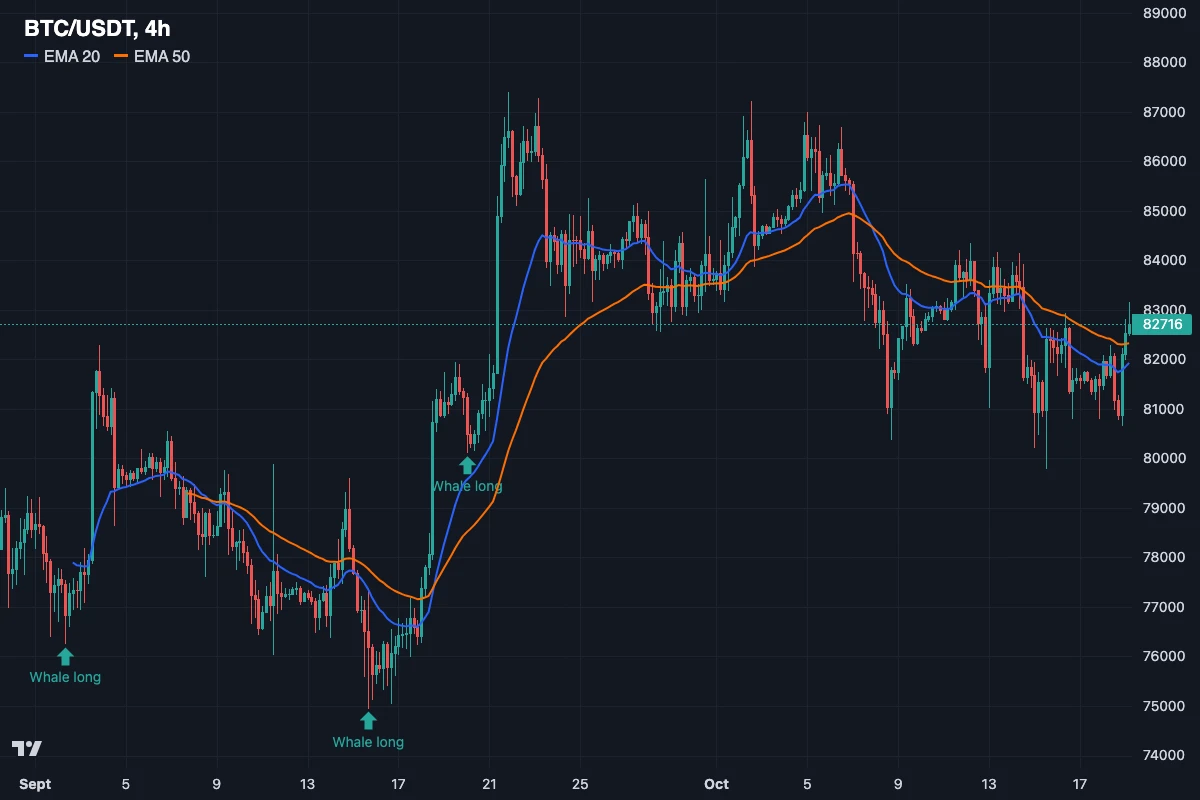 BTC/USDT, 4-hour chart, September to October 2026. The arrows mark where a whale would have opened perfect longs, at the lows right before the rebounds. In hindsight they look obvious; in real time a copier sees them only after the spike, and the same chart offered just as many moments to go short. Source: Binance data, Gem Wallet
You See One Wallet, Not the Whole Book
A large trader rarely keeps everything on one address. The long you see on Hyperliquid can be a hedge against a spot holding, a short on a centralized exchange or an options position somewhere else. On the tracker it looks like a bold directional bet. In the trader’s real book it can be a small, protected part of a strategy that you cannot see.
When you copy it, you take the exposed leg without the protection.
You Always Enter Late
A whale builds a position in parts, and the tracker shows it after the fills are onchain. By the time an alert reaches you, the price has usually moved in the whale’s favor, and your entry is worse than theirs.
Here is how it looks in numbers. Take a typical whale with $1 million of margin opening a trade at 30x: that is a $30 million position. In my experience an order that size, especially when the market is thin, can move the price on Hyperliquid by 1-2% in the moment, and arbitrage bots carry the move to other exchanges within seconds.
To copy that trade, it first has to land onchain, a tracker has to show it, the alert has to reach you and you have to place your own order. Hyperliquid states a median end-to-end latency of 0.2 seconds for a co-located client (Hyperliquid docs): that is the speed of trading bots running in the same data centers as the exchange, with a fraction of your ping and faster processing. A trader reading an alert on a phone is seconds or even minutes behind them. By the time your order fills, the 1-2% spike is already in the price, and you buy the top of it.
The timing gap can be extreme. Before the crash on 10 October 2025, a Hyperliquid whale built nine-figure Bitcoin and Ether shorts; the last short was placed at 20:49 GMT, one minute before President Trump posted about 100% tariffs on Chinese imports. Arkham Intelligence estimated the profit at $190-200 million (The Block). Nobody following that wallet through a tracker could have entered in time.
Leaderboards Show the Survivors
A leaderboard ranks the accounts that are winning now. It does not show the much larger number of accounts that took the same kind of risk and were wiped out, and it says nothing about how long the current winners will last.
James Wynn is the clearest example. In May 2025 he built a 40x long of about 11,588 BTC worth $1.25 billion, at an average entry of $108,243. When Bitcoin fell below $105,000 on 30 May, liquidations took about $99.3 million from him (Cointelegraph). By my calculation, the second liquidation came at $104,150, only about 3.8% below his $108,243 average entry: at 40x that small a move was enough. For weeks before that, his position was the one everybody watched and many copied.
The wallet is still public, so you can check the history yourself: the address tagged as James Wynn by Arkham Intelligence, 0x5078…eDb6, is open on Hyperdash and HypurrScan, with its positions, trades and profit and loss.
A Public Position Can Be Bait
When everyone can see a position, the position itself becomes a tool. A trader who wants the crowd on one side can open a visible position and let the alerts do the marketing.
In March 2025 a wallet opened a 50x Ether long worth roughly $300 million on Hyperliquid. Instead of closing it, the trader withdrew collateral, pushed the liquidation price up and let the position be liquidated into Hyperliquid’s HLP vault. The trader kept about $1.86 million in profit, and the vault absorbed about $4 million in losses from the slippage (Arkham). Anyone who copied that long saw a “whale” and missed the mechanics.
A large visible liquidation price works the other way too: it becomes a target. Other traders know exactly where forced selling or buying will start, and the whale’s position becomes the market’s fuel.
Some Whales Are Just Placing Bets
Not every big position is a considered trade. For some people with large capital, a $1 million or $10 million long or short is a way to feel the market, the same appetite for high-stakes bets that, in my view, made prediction markets like Polymarket so popular. They are not following a strategy you can learn from; they are enjoying the ride.
On a tracker such a position looks exactly like a carefully planned trade. There is no field that tells you whether a whale did research or simply wanted the thrill, and copying the second kind means paying for someone else’s entertainment.
Their Risk Is Not Your Risk
A whale with $30 million of margin and a 40x position can survive swings that would close your account several times. The leverage number on the tracker looks the same, but the money behind it, the time horizon and the ability to add margin are completely different.
By my calculation, at 40x a move of about 2.5% against the entry is enough to erase the margin, before any maintenance margin is taken into account. A whale can top up the account in seconds; most people copying the trade cannot.
You also never know the whale’s time horizon. The same position can be a trade for one day or a bet for a year or two, and the tracker shows no difference. That matters because a perpetual position pays or receives funding for as long as it is open. Even if you entered with the whale at the perfect moment and picked the right whale, funding can eat the position over the months: where the whale closes a year later with a profit, a copier with less capital can be cut down, pushed into a loss or liquidated before the move arrives.
What a Whale Tracker Shows and What It Hides
A tracker gives you precise numbers about a small part of the picture.
| What the tracker shows | What it hides |
|---|---|
| One wallet’s position on Hyperliquid | Positions on other wallets, exchanges and in spot |
| Entry price after the fills | The price you will actually get when you copy |
| Leverage and liquidation price | How much more margin the trader can add |
| Current profit | The losses of everyone who copied and got liquidated |
| What the wallet did | Why it did it, and what it plans next |
| The open position | The time horizon: a day or a year, and how much funding it can carry |
Common Mistakes When Following Whales
- Copying the leverage: using the whale’s 20x or 40x on a small account, where the same move ends in liquidation.
- Chasing alerts: opening a trade minutes after a bot post, when the move is already in the price.
- Ignoring the exit: the tracker shows when a whale enters, but you rarely know their stop or target, so you hold too long.
- Trusting a single wallet: treating one address as the whale’s whole strategy.
- Mistaking a winner for a strategy: following last month’s top of the leaderboard as if past profit were a plan.
Is a Whale Tracker Good for Anything?
Yes, but for much less than most people expect. Apart from the show itself, and many traders do stream these positions like a sport, a whale tracker has one practical use: it tells you that volatility is rising.
When a tracker or an alert bot suddenly fills up with liquidations and large entries, the market is moving fast, much like the minutes after major news. That is useful context, especially for short-term strategies such as scalping, where you need to know when the market is active enough to trade. It is one extra input next to the others a strategy already uses.
What the tracker never gives you is direction. A burst of whale activity says “something is happening”, not “buy” or “sell”. Read it as a volatility signal, never as a call to open the same trade.
What to Do Instead
Use the tracker, if at all, as a picture of crowd positioning, and make your trade from your own plan. Decide the entry, the stop-loss and the position size before you open anything, and size the trade so that the stop costs you an amount you can accept. The mistakes in our guide to the top perpetuals trading mistakes on Hyperliquid are the same ones whale copying leads to.
You can trade Hyperliquid perpetuals directly from a self-custodial wallet. In Gem Wallet, go to “Settings”, then “Preferences”, turn on “Enable Perpetuals”, deposit USDC on Arbitrum and open the Perps section: your keys and funds stay with you while you trade. Read more on the Perpetuals wallet and Hyperliquid wallet pages, or start with the beginner’s guide to the Hyperliquid trading platform.
Disclaimer: This article is for informational and educational purposes only and is not financial or investment advice. Crypto assets are highly volatile, and you can lose all the money you invest. Do your own research and make decisions at your own risk.