


Table of Contents
Japanese exchanges don’t sell USDT, so you can convert USDT to yen in a bank account or PayPay only after swapping it for another coin, while a crypto wallet lets you sell USDT straight to a credit card with no swap. We broke down each method step by step so you can pick yours and withdraw USDT without extra fees or delays.
Key Takeaways
- The Shortest Exchange Route Is USDC on SBI VC Trade: Yen withdrawals are free, but a single trade is capped at ¥1 million.
- Swapping USDT for Another Crypto Is Taxable: Profit is counted in yen, so it can appear even when USDT is still worth $1.
- A Crypto Wallet Sells USDT Without a Swap: The provider sends the money to your credit card, and you don’t need a Japanese exchange account.
Can You Sell USDT in Japan?
Yes, but not on a Japanese exchange: none of the 27 exchanges on the register of the FSA, Japan’s Financial Services Agency, trades USDT (according to CoinPost, as of July 2026). That’s why people either swap it for USDC, Ethereum, or Bitcoin first, or sell it from a crypto wallet through a provider.
Many Japanese guides suggest routing USDT through overseas exchanges, but the FSA keeps a public warning list of unregistered platforms, and in February 2025 Apple removed Bybit, MEXC, KuCoin, and other exchange apps from the Japanese App Store at the FSA’s request.
USDT is a stablecoin issued by Tether and pegged 1:1 to the US dollar, and with a weak yen it pays to hold: 1 USDT is about ¥158 (based on the US dollar rate in early October 2026, according to OANDA). Getting yen for it is harder here than in most countries, though: when we looked into how people in Japan withdraw USDT, every route ran into two local rules:
- Swaps Are Taxed: Japan’s tax agency treats swapping one crypto for another as a sale and counts the profit in yen.
- Exchanges Ask Where the Coin Came From: Under the Travel Rule, you name the owner of the wallet you send from.
For general ways to sell the stablecoin in any country, read How to Sell USDT and Convert It to USD, EUR, or Local Currency.
USDT to Yen: Withdrawal Methods Compared
You can withdraw USDT in Japan in four ways: through a Japanese exchange, through Binance Japan to PayPay, by selling from a crypto wallet to a credit card, or via P2P. We went through Japanese exchange fee schedules and provider terms and summed up in the table how these methods differ: whether you need a Japanese ID, where the money lands, how much you pay, and how fast it arrives, as of October 2026.
| Method | Best For | Japanese ID | Where the Money Lands | Fee | Speed |
|---|---|---|---|---|---|
| Japanese exchange | Residents of Japan | Yes | Yen in a bank account | Trading fee or spread plus up to ¥770 for a yen withdrawal | Business days |
| Binance Japan and PayPay | PayPay users | Yes | Yen in PayPay | ¥110 per transfer | Seconds, 24/7 |
| Crypto wallet | Everyone, including visitors | No | US dollars or euros on a Visa or Mastercard credit card | Shown before you confirm | Depends on the provider and bank |
| P2P | Not recommended | No | Yen from the buyer | Buyer’s price | Risk of a frozen bank account |
A Japanese ID means a driver’s license, a My Number card, or a 在留カード (residence card for foreign residents). A Japanese exchange won’t open an account with a foreign passport.
How to Withdraw USDT to Your Bank
You can turn USDT into yen through a Japanese exchange in two stages: first swap USDT in your own wallet for a coin the exchange accepts, then sell that coin for yen and withdraw to your bank account. The shortest route is USDC on SBI VC Trade: the dollar stays a dollar, and SBI charges nothing to withdraw yen.
- Swap USDT for a Supported Coin: For SBI VC Trade, that’s USDC on Ethereum, and a single USDC trade is capped at ¥1 million. Even if your USDT is on TRON, you can swap it for USDC on Ethereum right in your wallet: cross-chain swaps like this run through providers such as Relay, Chainflip, and THORChain. For Coincheck, TRX works, and for bitFlyer and bitbank, BTC or ETH.
- Open an Exchange Account: Japanese exchanges open accounts only for residents of Japan. A foreign resident needs a 在留カード, and verification is fastest with a My Number card.
- Send the Coin to the Exchange: A Japanese exchange won’t accept USDT on TRC20, so send the coin from step one and pick the same network the exchange shows.
- Name the Sender: Under the Travel Rule, the exchange asks whose wallet sent the coin. On bitbank, choose “Private wallet” (プライベートウォレット) and “Myself” (本人), while Coincheck asks for the sender’s name and country.
- Sell the Coin and Withdraw Yen: SBI VC Trade sells USDC through its 販売所 (dealer desk) at its own rate with a spread, while bitFlyer charges 0.01% to 0.15% per BTC or ETH trade on its order book. Yen withdrawals are free on SBI, cost ¥407 on Coincheck, and ¥220 to ¥770 on bitFlyer depending on the bank and amount (according to the exchanges, October 2026).
If you submit a yen withdrawal on bitFlyer before 14:30 on a weekday, the money arrives the same or the next business day.
You can also receive yen from an exchange in PayPay, Japan’s QR-code payment app, not only in a bank account. Since April 2026, Binance Japan supports this: the transfer arrives in seconds and costs ¥110.
Important: Yen can only be withdrawn to a bank account in your own name, and if the names at the bank and the exchange don’t match, the withdrawal is delayed or fails.
How to Sell USDT From Your Wallet
In Japan, you can sell USDT from your own crypto wallet, such as Gem Wallet, to a credit card through the sell feature right in the app. Unlike an exchange, you don’t need a Japanese account or a swap to another coin: off-ramp providers, services that exchange crypto for regular money and send it to your credit card, handle the sale. You can sell USDT in four steps:
- Open USDT in Your Wallet: You can view the balance in yen, too. To sell, you need a little of the network’s coin for the network fee, such as TRX for USDT on TRON, and you can buy it with a credit card right in the app, just as you can buy USDT.
- Switch From Buy to Sell: Type the amount of USDT to cash out.
- Choose a Provider: For example, Mercuryo or Paybis, and check the amount you’ll receive after all fees.
- Confirm the Sale: Your first sale requires identity verification, and the provider runs this check, not the wallet.
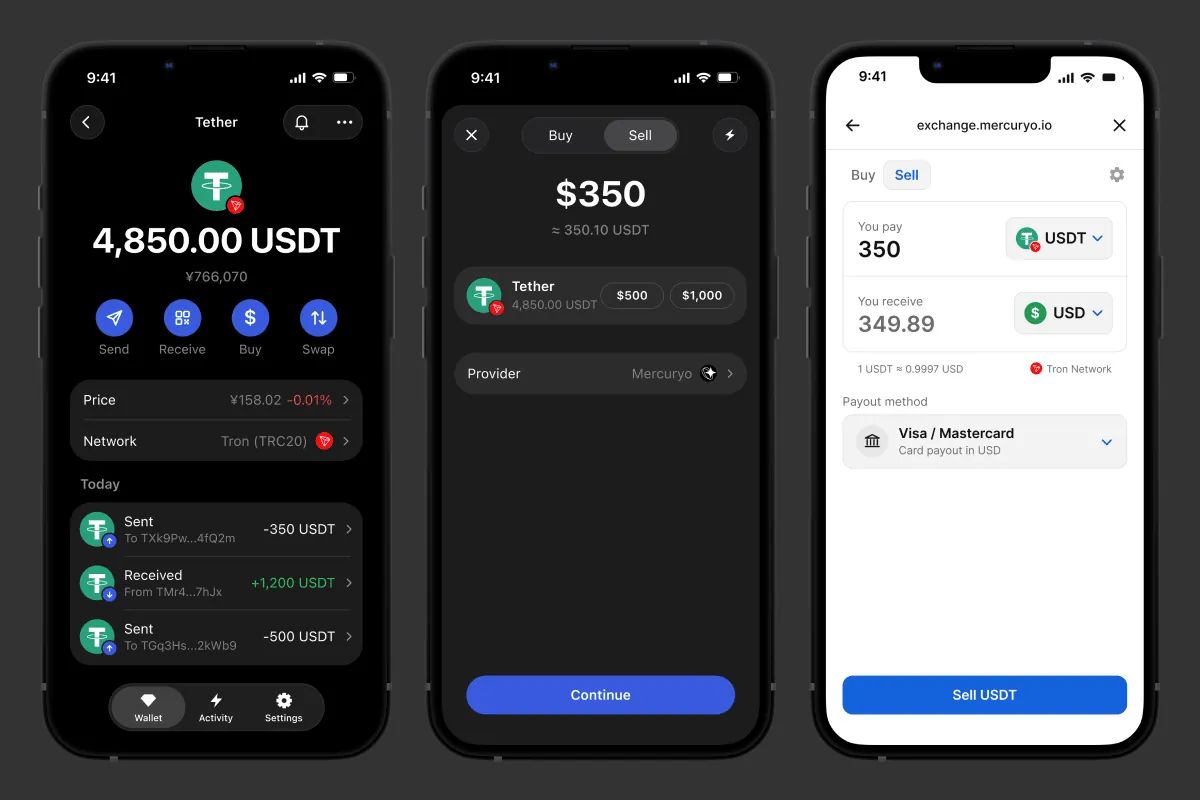 Selling USDT through Mercuryo in Gem Wallet
Important: Providers pay out to your credit card in US dollars or euros, and the bank that issued the card converts them to yen at its own rate, sometimes with a fee.
How to Cash Out USDT in Japan
You can get cash for USDT in Japan at a regular ATM: first sell USDT on an exchange and withdraw yen to your bank account, or sell it from a crypto wallet to a credit card, then withdraw the money, for example at a Seven Bank ATM in a 7-Eleven store or a Japan Post Bank (ゆうちょ銀行) ATM at a post office. Both banks accept foreign Visa and Mastercard cards.
Crypto ATMs and exchange offices that swap USDT for cash are almost nonexistent in Japan: exchanging crypto for yen as a business requires FSA registration. The official list from the Japanese exchange bitbank shows four crypto ATMs in Tokyo and Osaka as of August 2026, and one of them is temporarily out of service.
Can Tourists Withdraw USDT in Japan?
Yes, a tourist can withdraw USDT in Japan, but not through a Japanese exchange: without a 在留カード, it won’t open an account. There are two working options:
- Sell to a Credit Card From Home: Sell USDT from a crypto wallet through a provider to your own Visa or Mastercard credit card and withdraw yen at an ATM that accepts foreign cards.
- Pay With Binance Pay: Since September 30, 2026, Binance Pay users from other countries can pay with crypto at stores that accept PayPay, while the store receives yen. The feature doesn’t work for Japanese residents on Binance Japan.
Is USDT P2P Legal in Japan?
Selling USDT via P2P in Japan is legal only as a one-off: if you regularly sell crypto to anyone for profit, for example through social media ads, it counts as running an unregistered exchange business. This currently carries up to 3 years in prison or a fine of up to ¥3 million. Amendments passed in July 2026 will raise the penalty to up to 10 years and take effect by July 2027.
In 2026, police in Kyoto arrested a 22-year-old student who found clients on X and made 24 trades swapping Litecoin for cash. The second risk is fraud: in 2025, people in Japan lost ¥127.47 billion to social media investment scams, according to Japan’s National Police Agency, and part of that money moved in crypto.
Important: If a buyer pays you with money stolen from a scam victim, your bank can freeze your account even if you honestly sent the USDT.
Crypto Tax on USDT in Japan
Selling crypto in Japan is taxed as 雑所得 (miscellaneous income), and for USDT the tax already applies when you swap it for another coin:
- A Swap Counts as a Sale: Japan’s tax agency (NTA) treats swapping one crypto for another as a sale, and Japanese tax advisers apply this rule to USDT. Profit is counted in yen: if you bought $1,000 worth of USDT at ¥145 per dollar and swapped it for USDC at ¥158, your profit is ¥13,000.
- A Rate of up to 55%: National income tax runs from 5% to 45%, plus 10% local tax, and losses can’t be offset against your salary.
- When to File: Income for 2026 is declared from February 16 to March 15, 2027. If you’re an employee and your miscellaneous income for the year is ¥200,000 or less, you don’t need to file for national tax, but you still declare it for local tax.
- A Flat 20% From 2028: It applies only to trades through registered Japanese exchanges, while swaps in a wallet and on foreign exchanges stay under the progressive rate.
It’s best to check the exact amount with a 税理士 (tax accountant).
Best Way to Withdraw USDT in Japan
The best way to withdraw USDT in Japan depends on whether you have a Japanese exchange account and how much you’re withdrawing:
- No Japanese Account: Keep USDT in a self-custody crypto wallet and sell it to a credit card through a provider when you need money. This works for both residents and visitors.
- Japan Resident With an Exchange Account: Swap USDT for USDC on Ethereum and sell it on SBI VC Trade, where yen withdrawals are free.
- Large Amount: Keep the SBI VC Trade per-trade cap in mind and work out the tax in advance.
Download Gem Wallet today to store USDT securely and privately and sell it to a credit card in a few taps right from your phone, 24/7.