


Table of Contents
You can withdraw USDT in Brazil to a bank account via Pix, to a card, or as cash. In this article, we explain how each method works, how much it costs, and who it suits.
Key Takeaways
- USDT in Brazil counts as a currency exchange: That is why an exchange asks who owns the wallet that sent your USDT and holds the transfer until you fill out a form.
- No tax on sales up to R$35,000 per month: This exemption applies only to sales on Brazilian exchanges.
- P2P is the riskiest method: If a buyer pays with someone else’s money, the bank can freeze the funds in your account for up to 72 hours under MED 2.0.
Why Sell USDT for Brazilian Reais
People in Brazil sell USDT for reais because rent, groceries, and bills in Brazil are paid only in reais (BRL), most often via Pix, and paying with crypto is allowed only when both sides agree to it. When we looked into how Brazilians withdraw USDT, one route came up most often: sell it on a local exchange and get reais via Pix.
Brazil ranks fifth in the world for crypto adoption in the Chainalysis 2025 index, and the main coin here is USDT, a stablecoin from Tether pegged 1:1 to the US dollar. According to Receita Federal, Brazil’s tax authority, USDT makes up 88.7% of the declared stablecoin volume in the country. If you need the general ways to sell the stablecoin anywhere, read How to Sell USDT and Convert It to USD, EUR, or Local Currency - this guide covers only Brazil.
Pix is the instant payment system of the Central Bank of Brazil, which works 24/7 and is free for individuals. Money is sent to a Pix key: a CPF number, a phone number, an email, or a random key.
Ways to Withdraw USDT in Brazil
You can withdraw USDT in Brazil through an exchange with a Pix payout, from a crypto wallet through a provider, as cash from your bank account, or via P2P. We went through the fees of Brazilian exchanges and providers and put what sets these methods apart in the table below: whether you need a CPF, how much you pay in fees, and how fast the reais arrive, as of October 2026.
| Method | Best For | CPF Needed | Fee | Speed |
|---|---|---|---|---|
| Brazilian exchange → account via Pix | Residents with a Brazilian bank account | Yes | 0.10-0.70% to sell, Pix withdrawal free or R$3.50 | Seconds after the sale |
| Crypto wallet → Visa card or account via Pix | People who keep USDT in their own wallet and don’t want an exchange account | Yes, for a Brazilian card or account, and the provider checks your ID | Depends on the provider, shown before you confirm | Usually minutes |
| Bank account → cash | Anyone who needs cash | Yes, you need a Brazilian bank account | Bank’s own fee | Right after the money arrives |
| P2P → account via Pix | Not recommended | Yes | Depends on the buyer’s price | Minutes, with a risk of a frozen account |
CPF (Cadastro de Pessoas Físicas) is the individual tax number in Brazil. You can’t open a bank or Brazilian exchange account without it, and a foreigner can get one in Brazil through the gov.br portal and a partner office for R$7 in about two business days.
How to Sell USDT for BRL on an Exchange
Selling USDT for reais on a Brazilian exchange and withdrawing via Pix is the cheapest method: the trading fee is 0.10% to 0.70%, and Mercado Bitcoin and Foxbit charge nothing to withdraw reais. Selling on a Brazilian exchange suits residents of Brazil: Mercado Bitcoin, Binance, and Bitget open a reais account only with a CPF and send reais only to a bank account in your name.
You can sell USDT for reais on Mercado Bitcoin, Foxbit, Binance, OKX, and other exchanges:
- Sign Up on the Exchange: Have your CPF, a photo ID, and a Brazilian bank account in your name ready.
- Send USDT to the Exchange: Get the USDT deposit address on the exchange and pick the same network your USDT is on. For example, Foxbit accepts USDT on TRC20, ERC20, BNB Chain, Polygon, and TON (TON deposits need a MEMO).
- Fill Out the Transfer Form: The exchange asks who owns the sending wallet and where the funds come from, and the transfer stays pending until you answer.
- Sell USDT for Reais: The fee for selling at the market price is 0.70% on Mercado Bitcoin for up to R$10,000 in volume over 30 days, 0.50% on Foxbit, and 0.10% on Binance (according to the exchanges, October 2026).
- Withdraw Reais via Pix: The money arrives in seconds. Mercado Bitcoin and Foxbit charge no withdrawal fee, and Binance charges R$3.50.
A verified Mercado Bitcoin account lets you withdraw up to R$50,000 (about $10,000) per day. Sending USDT to the exchange also costs a network fee, which varies by network - see How Much Does It Cost to Send USDT for details.
Which Crypto Exchanges Work in Brazil
Crypto exchanges can keep working in Brazil after October 30, 2026, only if they have applied for authorization from the Central Bank of Brazil, and the rest must wind down within 90 days. As of early October 2026, Mercado Bitcoin is going through authorization, Foxbit and Bybit have said they will apply, and Binance has not announced an application.
Some exchanges are leaving the retail market: Bitso is ending service for individual customers in Brazil by October 30, 2026, and is moving balances to Mercado Bitcoin. NovaDAX and Coinext are leaving retail too. If your USDT sits on an exchange that is leaving, you can move it to your own crypto wallet ahead of time.
How to Withdraw USDT From a Wallet to a Card or Bank
You can withdraw USDT from your own crypto wallet to a card or a bank account through a sell feature. Unlike an exchange, selling from a crypto wallet needs no exchange account and no transfer form, and you see the provider’s fee before you confirm.
For example, Gem Wallet is a self-custodial, fully open-source mobile wallet for 100+ blockchains that stores USDT on TRON, Ethereum, BNB Chain, and other networks and has a Portuguese interface. In Gem Wallet, you can sell USDT in four steps:
- Open USDT in Your Wallet: USDT on the TRON network needs a little TRX to cover the network fee, and if your TRX balance is empty, you can buy crypto in the app with a credit card.
- Tap Buy and Switch to Sell: Type in how much USDT you want to cash out.
- Choose a Provider: Gem Wallet detects your country by IP address and lists only the providers available there - in Brazil, these include Transak and Paybis. Transak pays reais to a Brazilian Visa card, Paybis pays to a bank account via Pix, and you see the amount you will receive, with all fees included, before you confirm.
- Confirm the Sale: Your first sale includes an identity check, and the provider runs this check, not the wallet.
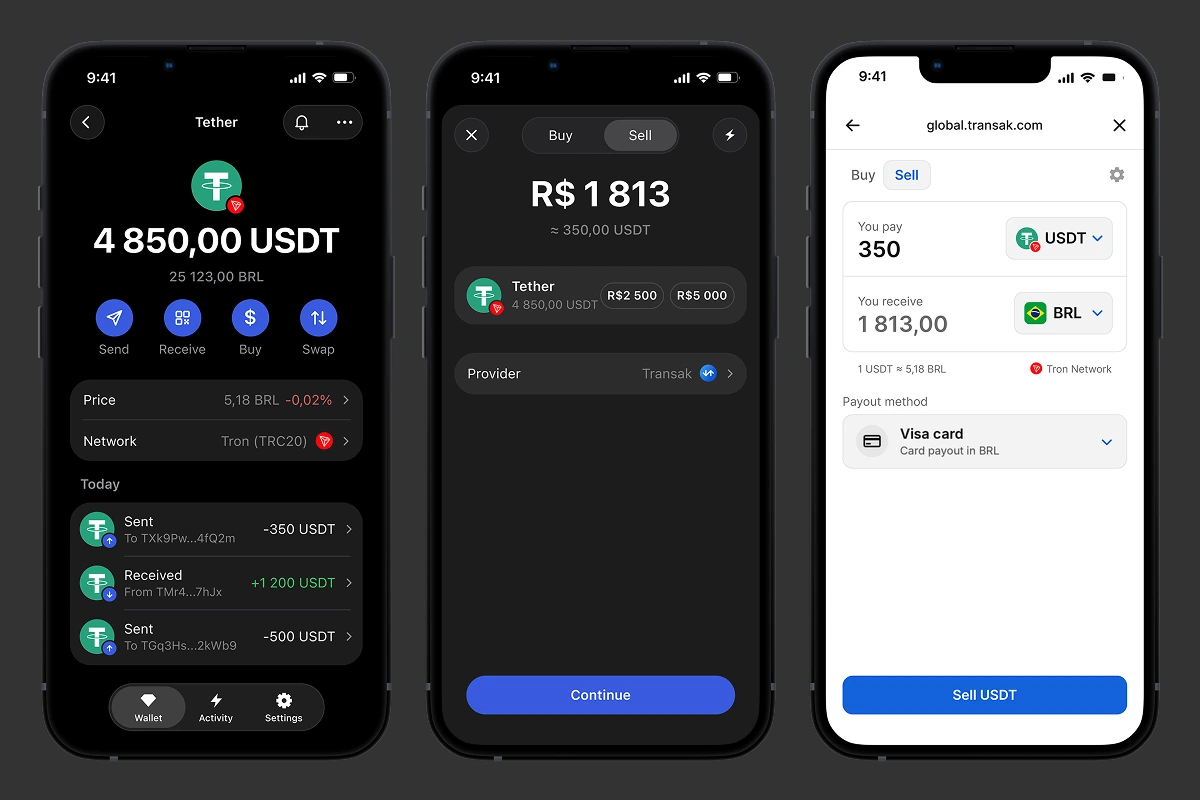 Selling USDT through Transak in Gem Wallet
You can track every sale in the Activity section. If you hold another coin, you can swap it for USDT in the wallet before selling.
Important: Payouts in reais go only to a Brazilian card or bank account in your name, so you can’t withdraw USDT to reais without a CPF.
How to Convert USDT to Cash in Brazil
Converting USDT to cash in Brazil almost always goes through a bank account: first you sell USDT and receive reais via Pix, and then you withdraw them at an ATM or with Pix Saque at a store. There are almost no places to swap USDT for cash directly: exchanges pay reais only to a bank account, and the country had just 9 crypto ATMs at the end of 2024, according to CoinATMRadar.
Pix Saque lets you withdraw cash at the checkout of a store that offers the service: you send money via Pix, and the cashier hands it to you in cash. Under the Central Bank of Brazil’s rules in force since 2023, the Pix Saque limit is up to R$3,000 (about $600) during the day and up to R$1,000 at night, but a bank or store can set a lower limit.
Is Selling USDT on P2P Safe in Brazil?
P2P is the riskiest way to sell USDT in Brazil: when a buyer pays you with a scam victim’s money, the victim disputes the Pix payment through MED, and the bank blocks the funds in your account. The scheme is called triangulação: a scammer “sells” a fake product to a victim and asks them to pay by Pix to your account, you send the USDT to the scammer, and the victim asks you for the money back.
MED 2.0 has been in force since February 2, 2026: the bank blocks the disputed amount for up to 72 hours and traces the money through a chain of up to five accounts. The victim can dispute the payment within 80 days, and in 2025, Brazilian crypto media reported a case where two banks closed a P2P seller’s accounts within a week after such complaints.
MED (Mecanismo Especial de Devolução) is the Central Bank of Brazil’s mechanism for returning Pix payments sent to scammers.
Important: Accept payment only from an account in the same name as the buyer’s profile, and don’t send USDT based on a screenshot marked Agendado - it is a scheduled transfer that can be canceled.
Crypto Tax and USDT Rules in Brazil
The Central Bank of Brazil (BCB) regulates USDT withdrawals under Brazil’s crypto asset law (Law 14.478/2022), and Receita Federal collects tax on profits from sales. Most of these rules apply to exchanges and providers rather than to you as a crypto wallet owner:
- Exchange Authorization: BCB Resolutions 519, 520, and 521 have been in force since February 2, 2026, and introduce a new type of license called SPSAV. Exchanges that don’t apply by October 30, 2026, must stop operating in Brazil.
- USDT as a Currency Exchange: BCB Resolution 521 treats buying and selling stablecoins, as well as transfers to and from a crypto wallet, as part of the foreign exchange market, so an exchange must identify the owner of your crypto wallet.
- Reports to Coaf: An exchange reports transfers of $10,000 or more between the exchange and a crypto wallet to Coaf, Brazil’s financial intelligence unit.
- Travel Rule: From February 2, 2027, exchanges will have to share the sender’s and the recipient’s details with every transfer within Brazil.
- Income Tax: Sales on Brazilian exchanges of up to R$35,000 per month are tax-free, but if your sales go over that amount in a month, all of that month’s profit is taxed at 15-22.5%, with payment due by the last business day of the following month. Provisional Measure MP 1303, which proposed a flat 17.5% rate, lapsed in October 2025.
- DeCripto Reporting: Since July 2026, anyone who trades through a foreign exchange or without an exchange for more than R$35,000 per month must file a monthly report with Receita Federal.
- IOF on Crypto: A proposed 3.5% transaction tax on crypto purchases, with an exemption of up to R$10,000 per month, was put on hold in March 2026 and is not in force as of October 2026.
SPSAV (Sociedade Prestadora de Serviços de Ativos Virtuais) is a company authorized by the Central Bank of Brazil to provide crypto services.
Best Way to Withdraw USDT in Brazil
The best way to withdraw USDT in Brazil depends on your CPF, your Brazilian bank account, and the amount you cash out each month:
- USDT in Your Own Wallet: Keep USDT in a self-custody crypto wallet, where only you hold the keys, and sell it through a provider when you need reais.
- Resident With a Brazilian Bank Account: Sell on a Brazilian exchange and withdraw reais via Pix - it is the cheapest option, and small sales fall under the monthly tax exemption.
- Foreigner Without a CPF: Get a CPF to open a Brazilian bank account and an exchange account, and keep USDT in your own crypto wallet until then.
- Anyone Who Needs Cash: Withdraw reais via Pix and take them out at an ATM or with Pix Saque.
- Large Amount: Sell on a Brazilian exchange with a verified account and keep the monthly tax exemption limit in mind.
Install Gem Wallet to hold USDT securely and privately and sell it for reais whenever you need them.