


Table of Contents
The gas fee for sending ETH is about 0.000015 ETH, or roughly $0.03 at the CoinGecko rate on November 24, 2026, when the gas price sits at the 12-month median (Blockscout). A USDT transfer or a token swap on Ethereum costs 2-6 times more because it uses more gas.
Key Takeaways
- A 25x Range in a Year: From November 2025 to November 2026, the average daily gas price on Ethereum ranged from 0.32 to 8.17 gwei - the same ETH transfer cost 25 times more on the most expensive day.
- A New Recipient Costs More: Sending USDT to an address that holds no USDT yet uses 37% more gas (November 2026).
- The Base Fee Is Burned: Since the London upgrade on August 5, 2021, the base fee is burned - and with Normal it is almost the whole fee: on November 10, 2026, the priority fee was 0.0001 gwei with a base fee of 0.40 gwei.
Open this article in
 ChatGPT
 Gemini
 Grok
 Perplexity
What Is a Gas Fee on Ethereum
The gas fee on Ethereum, also called the Ethereum transaction fee, is the amount in ETH that the sender pays the network to process a transaction and record it in a block, according to the Ethereum documentation.
Gas measures computational work: a simple ETH transfer uses 21,000 gas, while a token transfer or a swap uses more because the network runs smart contract code.
What Are the Base Fee and the Priority Fee
The base fee is the mandatory part of the gas price: the network itself sets it for every block and burns it after the transaction is executed. From November 16 to 23, 2026, the base fee in individual blocks ranged from 0.07 to 22.45 gwei, by our calculation.
The priority fee is an extra payment to the validator on top of the base fee, also known as a tip: the sender chooses its size, and when the network is busy, a transaction with a higher priority fee gets into a block sooner.
What Is Gwei on Ethereum
1 gwei equals 0.000000001 ETH, or one billion wei - the smallest unit of ETH. Wallets and trackers show the gas price in gwei: a price of 0.50 gwei written in ETH would look like 0.0000000005 ETH.
How the Ethereum Gas Fee Is Calculated
The gas fee on the Ethereum network follows one formula:
Gas fee = gas used × (base fee + priority fee)
At night, with a base fee of 0.12 gwei and a near-zero priority fee, an ETH transfer costs 21,000 × 0.12 = 2,520 gwei, or 0.00000252 ETH - almost 6 times cheaper than at the 12-month median of 0.70 gwei. 0.12 gwei is the median base fee at 04:00 UTC from November 16 to 23, 2026. So the final gas fee depends on three things: how much gas the action uses, how busy the network is and which priority fee you choose.
The Ethereum documentation estimates an ERC20 token transfer at 65,000 gas, but a real USDT transfer on November 16, 2026 used 46,109 gas, and 63,209 gas to an address that holds no USDT yet.
The table below shows the gas used by four actions, based on transactions in blocks 26,429,912-26,429,913 (November 16, 2026), and the fee in ETH at two gas prices: the 12-month median (≈0.70 gwei) and the most expensive day of the year (8.17 gwei, October 29, 2026). Gas prices are daily averages from Blockscout, fees are our calculation.
| Action | Gas | At ≈0.70 gwei | At 8.17 gwei |
|---|---|---|---|
| ETH transfer | 21,000 | 0.0000148 ETH | 0.000172 ETH |
| USDT transfer, recipient already holds USDT | 46,109 | 0.0000324 ETH | 0.000377 ETH |
| USDT transfer to an address with no USDT yet | 63,209 | 0.0000444 ETH | 0.000516 ETH |
| Uniswap swap (median of 9 trades) | 117,564 | 0.0000826 ETH | 0.000960 ETH |
A USDT transfer costs 2.2-3 times more than an ETH transfer: the token’s smart contract rewrites balances, and the first USDT balance record for an address that holds no USDT yet adds another 17,100 gas. A swap uses 5.6 times more gas than an ETH transfer because it runs the code of the router and the liquidity pool. You can swap ETH and ERC20 tokens in Gem Wallet through Uniswap, THORChain, Relay and other providers, and the wallet shows the swap’s gas fee before you sign, too.
The average Ethereum transaction fee is higher than the price of an ETH transfer because it includes swaps and smart contract calls. Across 100 blocks on November 24, 2026, the average fee of all transactions was 0.0000269 ETH, or about $0.05 at the CoinGecko rate - 3.1 times the average ETH transfer fee, by our calculation. The median of all transactions was 0.0000037 ETH: a few expensive contract calls pull the average up.
Who Receives the Gas Fee on Ethereum
The base fee is burned, and the priority fee goes to the validator who included the transaction in a block. With Normal in Gem Wallet on November 10, 2026, the validator received 0.025% of the fee and the rest was burned, by our calculation.
Burning was introduced by the EIP-1559 proposal in the London upgrade (August 5, 2021): since then, the base fee leaves ETH circulation and goes neither to the validator nor to the wallet.
The sender signs not an exact fee but a cap (max fee): the network charges the block’s actual base fee plus the priority fee and refunds the difference to the sender, according to the Ethereum documentation. If the cap is below the current base fee, the transaction does not get into a block and waits in the queue until the gas price drops.
Why a Failed Transaction on Ethereum Costs Gas
A failed transaction on Ethereum still charges the gas fee because the validator has already executed its code: according to the Ethereum documentation, the fee is paid whether the transaction succeeds or not. The network reverts the changes, your ETH and tokens stay in your balance, and the fee is not refunded.
On November 24, 2026, 214 of 18,348 transactions failed across 60 Ethereum blocks, about 12 minutes, or 1.2%, by our calculation. One of the Uniswap swaps rejected by the contract used 169,380 gas, or 0.000008 ETH, even though no tokens were exchanged.
The gas limit is the maximum amount of gas the sender allows a transaction to use. If an action runs out of gas, the network stops execution and charges all the gas in the limit. On November 24, 2026, a failed USDT transfer used up its entire limit - 100,000 gas, twice the usual 46,109.
Since September 30, 2026, Gem Wallet sends a failed transaction notification for transfers, swaps, token approvals and smart contract calls, so a charged fee never goes unnoticed.
Why Ethereum Gas Fees Are So High
The gas fee on Ethereum rises when blocks are more than half full: the block target is half the gas limit, 30 of 60 million after the Fusaka upgrade (December 3, 2025), and each block above the target raises the base fee by up to 12.5%. According to the Ethereum documentation, such spikes come from popular NFT drops and trading surges.
A block on Ethereum comes out every 12 seconds, so six full blocks in a row roughly double the base fee - in just over a minute, by our calculation. The most expensive day of the past 12 months, October 29, 2026, was 11.6 times pricier than the year’s median (Blockscout).
A high fee is a fee that stands out against the amount: on the most expensive day of the year, a 0.01 ETH transfer cost 1.7% of the amount, and 0.15% at the median gas price. To see what gas costs right now, check the Ethereum gas tracker - the current base fee and the cost of a transfer, a token transfer and a swap in dollars.
How Much ETH Do You Need for Gas
0.001 ETH in your balance covers one USDT transfer to an address with no USDT yet even on the most expensive day of the year, when such a transfer cost 0.000516 ETH at the average gas price, and about 22 such transfers at the median gas price, by our calculation.
You need ETH for gas even when sending tokens: a USDT ERC20 transfer is paid in ETH, not in USDT, and it won’t go through without ETH in your balance. What a USDT transfer costs on other networks is covered in How Much Does It Cost to Send USDT.
If you run short of ETH for gas, you can buy Ethereum right in the wallet with a credit card, Apple Pay or Google Pay.
How to Reduce Gas Fees on Ethereum
The gas fee on Ethereum goes down with the right time to send, the priority fee level, manual fee settings and layer 2 networks:
- Quiet Hours: According to the Ethereum documentation, the network is cheaper when it is night in North America. From November 16 to 23, 2026, the base fee at night and in the morning UTC was 4.4 times lower than the daytime peak, by our calculation from network blocks.
- Normal Speed Instead of Fast: If the transfer is not urgent, a high priority fee is not needed - when the network is calm, a transaction with the minimum priority fee still gets into a block.
- Manual Settings: You can set the base fee and priority fee yourself in gwei if your wallet allows it: when the network is calm, the minimum priority fee is enough.
- Layer 2 Networks: Base, Arbitrum and other layer 2 networks run on top of Ethereum: on November 22, 2026, a direct USDC transfer on Base was 38 times cheaper than on Ethereum, and 15 times cheaper on Arbitrum (our calculation for USDC, whose transfer uses almost as much gas as a USDT transfer). The transfer is cheaper only if the token already sits on that network and the recipient accepts the transfer on it.
Gem Wallet is a self-custodial Ethereum wallet with fully open-source code for iOS and Android. You can choose Normal, Fast or Custom: with Custom, you set the base fee and priority fee manually, and the network minimum is always in view, so you can’t set the fee below it. The wallet shows the final gas fee before you sign.
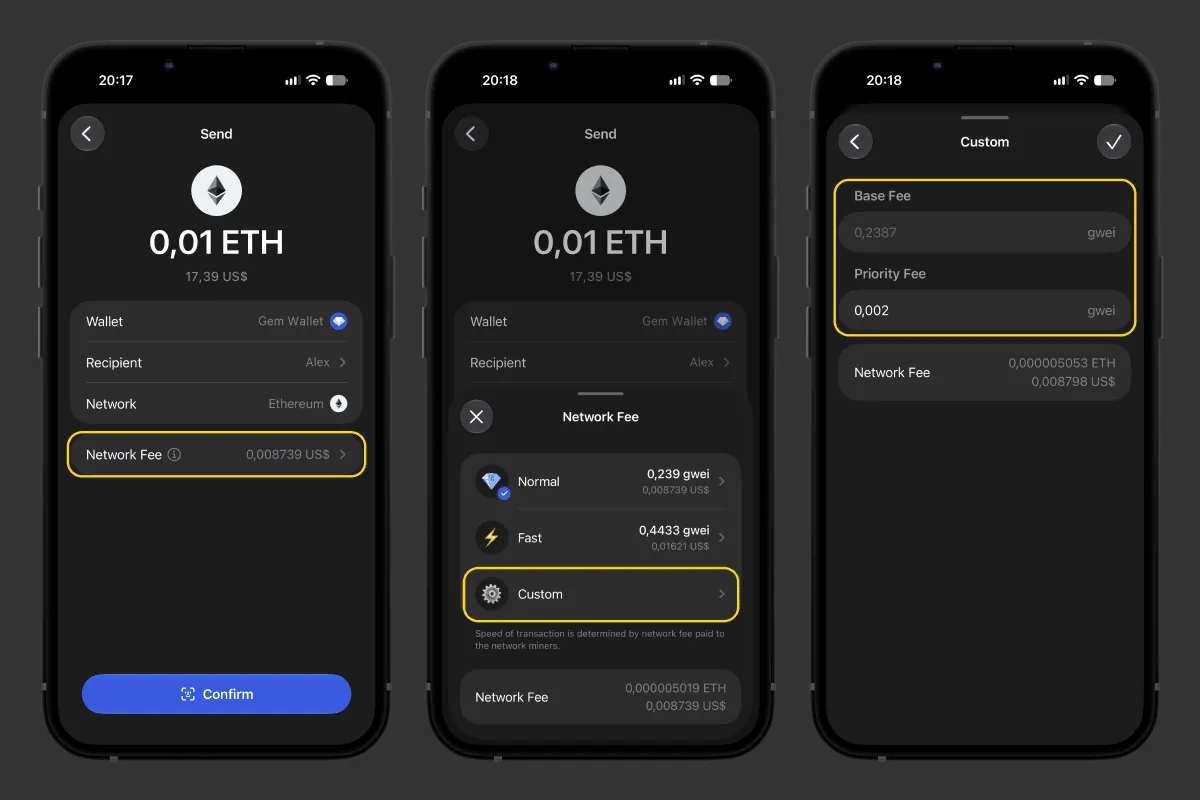 The gas fee for a transfer on Ethereum: the confirm screen, choosing Normal, Fast or Custom, and a custom fee in Gem Wallet
Download Gem Wallet and send ETH securely and privately: your keys stay only on your device, and you see and choose the gas fee yourself before you sign.
Disclaimer: This article is for informational and educational purposes only and is not financial or investment advice. Crypto assets are highly volatile, and you can lose all the money you invest. Do your own research and make decisions at your own risk.