

Table of Contents
Gem Wallet is a Trust Wallet alternative built on the same idea: a self-custodial mobile wallet for 100+ blockchains with a 12-word recovery phrase, with no account and no KYC. Trust Wallet, started in 2017 and bought by Binance in 2018, is the large incumbent with 220M+ users and a browser extension. Trust Wallet began as a light, simple phone wallet, but over time it has built perps, prediction markets, tokenized stocks and an AI assistant right into the wallet, and everyday wallet tasks now sit in one app next to a trading platform. Gem Wallet stays a wallet: simple to use and free of that overload. Gem Wallet also differs in ways you can verify: the code of the whole app is public, the swap fee is 0.5% against Trust Wallet’s 0.7% to 1%, and two 2026 audit reports are published.
Gem Wallet vs Trust Wallet: our verdict
If you want a light phone wallet you can verify, Gem Wallet is the better pick. It imports the same recovery phrase you use in Trust Wallet, keeps the app focused on holding, sending, swapping and staking, publishes its full source code and audit reports, and takes less on every swap. Trust Wallet is the better pick for browser use and breadth of features: it has a browser extension with Ledger support, staking on 25+ assets and Stablecoin Earn vaults.
Key Takeaways
- Switching: after you import the same 12-word phrase, your EVM, Bitcoin, TRON, TON, XRP and other balances appear in Gem Wallet at the same addresses; only Solana may need a transfer.
- Code: Gem Wallet publishes the code of both apps under GPL-3.0; Trust Wallet publishes its Wallet Core library, while the app code is closed.
- Focus: Trust Wallet has mixed the wallet and a trading platform into one app, which has made it harder to use; Gem Wallet stays a simple wallet.
- Fees: Gem Wallet takes 0.5% per swap, Trust Wallet 0.7% to 1% inside the rate, as of November 2026.
Gem Wallet vs Trust Wallet: Overview
Trust Wallet and Gem Wallet look alike at first sight: both are phone-first, multi-chain and self-custodial. The table shows where they differ. Values as of November 2026.
| Feature | Gem Wallet | Trust Wallet |
|---|---|---|
| Focus | A wallet: hold, send, swap, stake | Wallet and trading platform in one app: perps, prediction markets, tokenized stocks, AI assistant |
| Launched | Mobile multi-chain wallet | 2017, mobile Ethereum wallet; Binance acquisition in 2018 |
| Platforms | iOS, Android (Google Play, APK) | iOS, Android (Google Play, APK) |
| Browser extension | No | Chrome (also Brave, Edge, Opera) |
| Desktop app | In development | No; the extension serves desktop |
| Networks | 100+ blockchains | 100+ blockchains; 24 networks removed on 15 September 2026 |
| Recovery phrase | 12 words, BIP-39 | 12 words (12 or 24 on import), BIP-39 |
| Code | Whole app open source (GPL-3.0) | Wallet Core library open (Apache-2.0); app code closed |
| Published audit reports | CertiK (April 2026), Cure53 (October 2026) | Five auditors named, reports not published |
| Swap fee | 0.5% | 0.7% to 1% in the rate; 0% on promo pairs |
| Staking | 13 assets, incl. ETH, SOL, TRX, BNB, ATOM, SUI | 25+ assets |
| Perpetual futures | Hyperliquid | Hyperliquid and Aster DEX (not in the US, UK or Hong Kong) |
| Hardware wallets | Not yet, on the roadmap | Ledger, in the browser extension |
| Users | 1M+ installs | 220M+ users (per Trust Wallet) |
| Store ratings | Google Play 4.5, App Store US 4.5 | Google Play 4.5, App Store US 4.7 |
Values checked on 3 November 2026 on trustwallet.com, the Trust Wallet help center and GitHub, and in the Gem Wallet app, docs and code; sources are linked in each section.
Gem Wallet as a Trust Wallet Alternative: Switching With One Phrase
Gem Wallet imports a Trust Wallet recovery phrase as it is: both wallets use 12-word BIP-39 phrases, and on most networks they derive the same addresses from it, so your balances appear in Gem Wallet without sending anything. Trust Wallet itself notes that some coins can behave differently in another wallet because of derivation paths, in its help article on self-custody. Here is how the paths of Trust Wallet’s open-source Wallet Core compare with those in Gem Wallet’s code:
| Network | Trust Wallet (Wallet Core default) | Gem Wallet | Same address |
|---|---|---|---|
| Ethereum, BNB Chain, Base, Arbitrum and other EVM networks | m/44’/60’/0’/0/0 | m/44’/60’/0’/0/0 | Yes |
| Bitcoin, SegWit (bc1q) | m/84’/0’/0’/0/0 | m/84’/0’/0’/0/0 | Yes |
| TRON | m/44’/195’/0’/0/0 | m/44’/195’/0’/0/0 | Yes |
| TON | m/44’/607’/0' | m/44’/607’/0' | Yes |
| XRP | m/44’/144’/0’/0/0 | m/44’/144’/0’/0/0 | Yes |
| Dogecoin | m/44’/3’/0’/0/0 | m/44’/3’/0’/0/0 | Yes |
| Litecoin | m/84’/2’/0’/0/0 | m/84’/2’/0’/0/0 | Yes |
| Cosmos | m/44’/118’/0’/0/0 | m/44’/118’/0’/0/0 | Yes |
| Sui | m/44’/784’/0’/0’/0' | m/44’/784’/0’/0’/0' | Yes |
| Aptos | m/44’/637’/0’/0’/0' | m/44’/637’/0’/0’/0' | Yes |
| Cardano | m/1852’/1815’/0’/0/0 | m/1852’/1815’/0’/0/0 | Yes |
| Solana | m/44’/501’/0’ by default, m/44’/501’/0’/0’ as an option | m/44’/501’/0’/0' | Possibly not |
Moving from Trust Wallet to Gem Wallet takes three steps:
- Back up the phrase: in Trust Wallet, open the wallet settings and write down the 12 words of the wallet you want to move.
- Import it: in Gem Wallet tap Import an Existing Wallet > Multi-Coin and enter the same words. Your EVM tokens, bitcoin, USDT on TRON and TON, XRP and the other coins in the table appear at their usual addresses.
- Check Solana: if your SOL or SPL tokens do not show up, open the Solana receive address in Gem Wallet and send them there from Trust Wallet.
Nothing has to be closed: the same phrase can stay in Trust Wallet, so both apps show the same funds on the matching networks. The way back works the same way, since Trust Wallet accepts a 12-word BIP-39 phrase on import.
Swap Fees: 0.5% Against 0.7% to 1%
Gem Wallet charges 0.5% per swap, depending on the provider; every fee and the final amount are shown in the quote before you confirm, with no hidden fees. Trust Wallet lists a 0.7% swap fee “included in the exchange rate” on its comparison pages, updated in November 2026, while the FAQ on its swap page says it charges no additional service fees for swaps. On swaps routed through THORChain, Trust Wallet’s affiliate fee averaged 1.02% over the past month (Gem Wallet’s: 0.54%), per the THORChain explorer on 3 November 2026, so the real Trust Wallet fee is 0.7% to 1%, depending on the route.
Fee example: a $1,000 swap costs $5 in Gem Wallet fees and $7 to $10 in Trust Wallet fees, network fees not included. At ten such swaps a month, that is $600 against $840 to $1,200 a year.
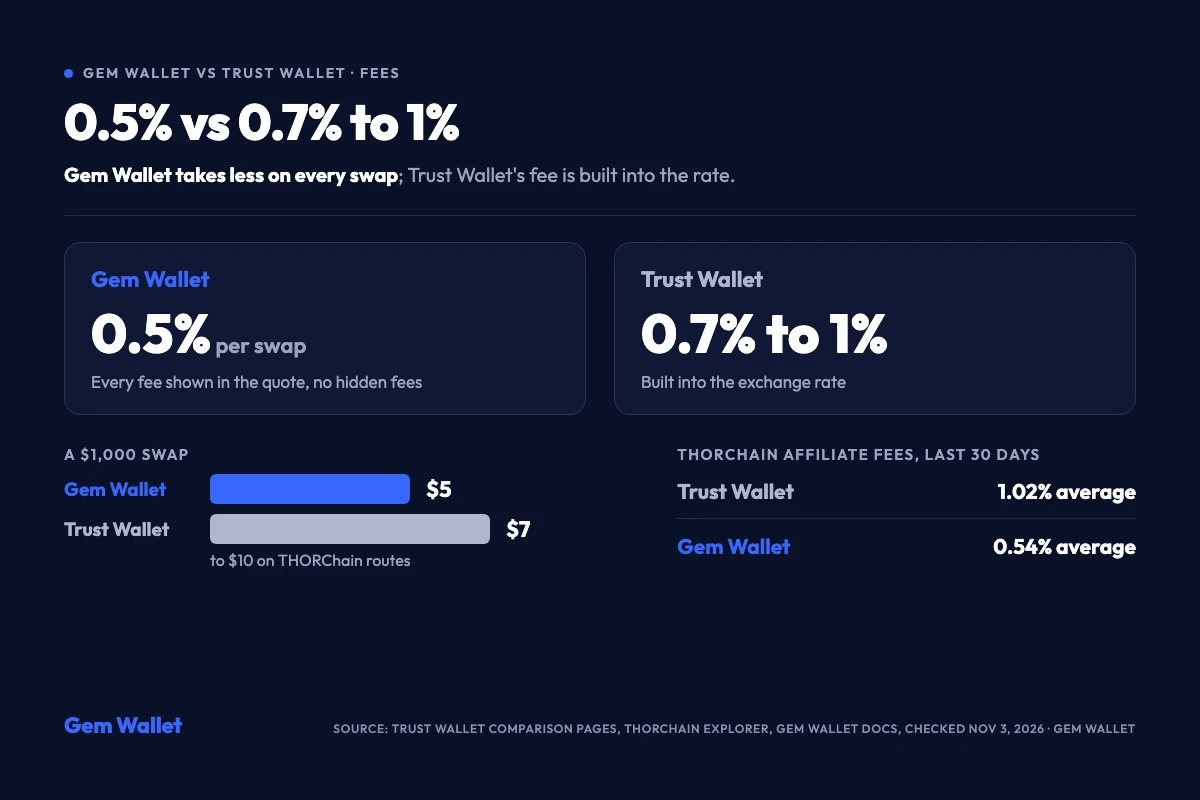 Swap fees as of 3 November 2026: Gem Wallet 0.5%, Trust Wallet 0.7% to 1%.
Trust Wallet also runs 0% promotions on selected pairs:
- Stablecoins: 0% Trust Wallet fee on same-chain swaps between stablecoins included in the promotion, such as USDT, USDC and DAI on BNB Chain, Solana, Arbitrum, Polygon, Base, Optimism and Avalanche, but not on Ethereum, per its August 2026 announcement.
- Staked and wrapped tokens: 0% on pairs such as stETH, WETH, jitoSOL and WBNB.
- TWT holders: discounted fees, according to the TWT litepaper.
Both wallets route swaps through third-party providers. For swaps Trust Wallet names THORChain, 1inch, Mimic and Axelar, and for cross-chain routes deBridge, Jupiter, Rango and others. Gem Wallet works with DEXs including Uniswap, PancakeSwap, Jupiter and STON.fi and with cross-chain protocols such as THORChain, Chainflip and Relay, shows the provider of each quote and lets you select another one before you confirm.
The difference is in who stands between you and the swap. Trust Wallet leans on aggregator services that build the route on their own servers, such as ZeroEx, Rango, SwapKit and SWFT, named in its cross-chain swap guide, and 1inch for same-chain swaps: each of them sees your address and your trade, and the route depends on the company that runs it. Gem Wallet’s providers are mostly on-chain protocols, where the swap runs through smart contracts or a decentralized network such as THORChain and Chainflip. So in Gem Wallet fewer intermediaries see your data and fewer central points can stop a swap, while Trust Wallet’s provider list is more centralized, and therefore less private and less dependable.
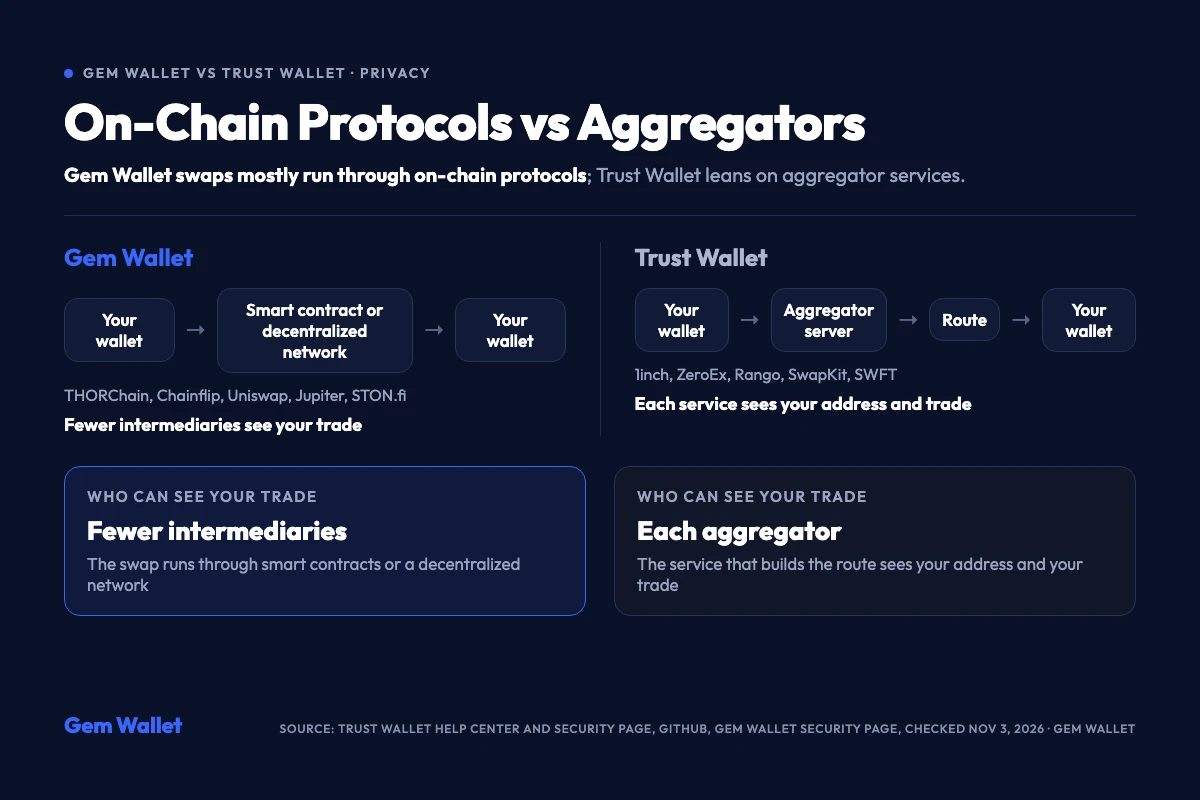 Fewer intermediaries stand between you and a swap in Gem Wallet.
Is Trust Wallet Safe? Open Source and Audits
Trust Wallet and Gem Wallet are both self-custodial: keys are created and encrypted on your phone, neither company holds them, and neither app needs an account. The difference is how much of each app anyone can inspect.
Trust Wallet Security
- Code: Trust Wallet’s Wallet Core library is public under Apache-2.0 on GitHub. The repositories of the old iOS and Android apps are archived, with no changes since 2019, and the code of today’s apps and browser extension is not public, although Trust Wallet’s comparison pages call it fully open source. For the user the closed app is a black box: neither its security nor what it does with keys and data can be checked from outside.
- Audits and certifications: Trust Wallet names CertiK, Cure53, Halborn, Kudelski Security and Quantstamp as auditors on its security page, without report links or dates, and holds ISO/IEC 27001 and 27701 certificates.
- Protection: a security scanner checks transactions before signing, and an optional encrypted backup stores the phrase in your own iCloud or Google Drive.
Gem Wallet Security
- Code: both mobile apps and the shared Rust core are public under GPL-3.0 on GitHub, and the F-Droid build is reproducible, so anyone can check that the app matches the published code. More in our guide to an open-source crypto wallet.
- Audit reports: CertiK reviewed key management and signing in April 2026, and in October 2026 Cure53 reviewed the core and both apps; both reports can be read on the security page.
- Protection: HashDit and GoPlus check sends, swaps and approvals before signing, and a spam filter hides the tiny transfers used for address poisoning.
Trust Wallet’s scale and certifications count in its favor; Gem Wallet’s point is that the app and its audits are open to anyone.
Networks and Assets
Both wallets claim support for 100+ blockchains, and most networks overlap: Bitcoin, Ethereum and EVM chains, Solana, TRON, TON, XRP, Cardano, Sui, Aptos, Cosmos, Stellar and Zcash are native in both. Two differences matter:
- Trust Wallet is trimming its list. It ended support for 24 networks on 15 September 2026, among them Moonbeam, MultiversX, Nano, IoTeX and Polygon zkEVM, per its network notice. On Android, Trust Wallet also lets you add custom EVM networks.
- Gem Wallet adds Hyperliquid’s own chain. HyperCore holds HYPE and USDC, and HYPE can be staked there. Both wallets let you add custom tokens; Gem Wallet also lets you set your own node.
For USDT, Gem Wallet supports official USDT on 14 networks plus USDT0. On TRON it helps with fees: any coin swaps into TRX, and USDT into TRX through the built-in SunSwap.
Staking and Earning
Trust Wallet offers more ways to earn:
- Trust Wallet: staking on 25+ assets, among them ETH, BNB, SOL, TRX, DOT, ATOM, NEAR, SUI, ADA and INJ, per its staking page, plus Stablecoin Earn, where USDT and USDC go into DeFi protocols such as Morpho and Aave.
- Gem Wallet: staking on 13 assets: ETH, BNB, SOL, ATOM, OSMO, TRX, APT, SUI, TIA, INJ, SEI, HYPE and MON. Staked TRX also gives the energy that pays for USDT transfers on TRON.
Neither wallet adds its own fee on staking rewards; the validator’s commission applies, as on the network itself.
Wallet or Trading App: Perps, Predictions and Stocks
Trust Wallet started in 2017 as a light mobile wallet that was easy to use. Since 2025 it has added a trading platform: perpetual futures, prediction markets, tokenized stocks, an AI assistant and Stablecoin Earn now live inside the wallet, so sending, receiving and holding crypto sit next to trading features many users never need. Gem Wallet keeps to the idea that a wallet should be a wallet: holding, sending, swapping and staking are at the center of the app, and its trading is limited to Hyperliquid perps and stock tokens bought with a regular swap.
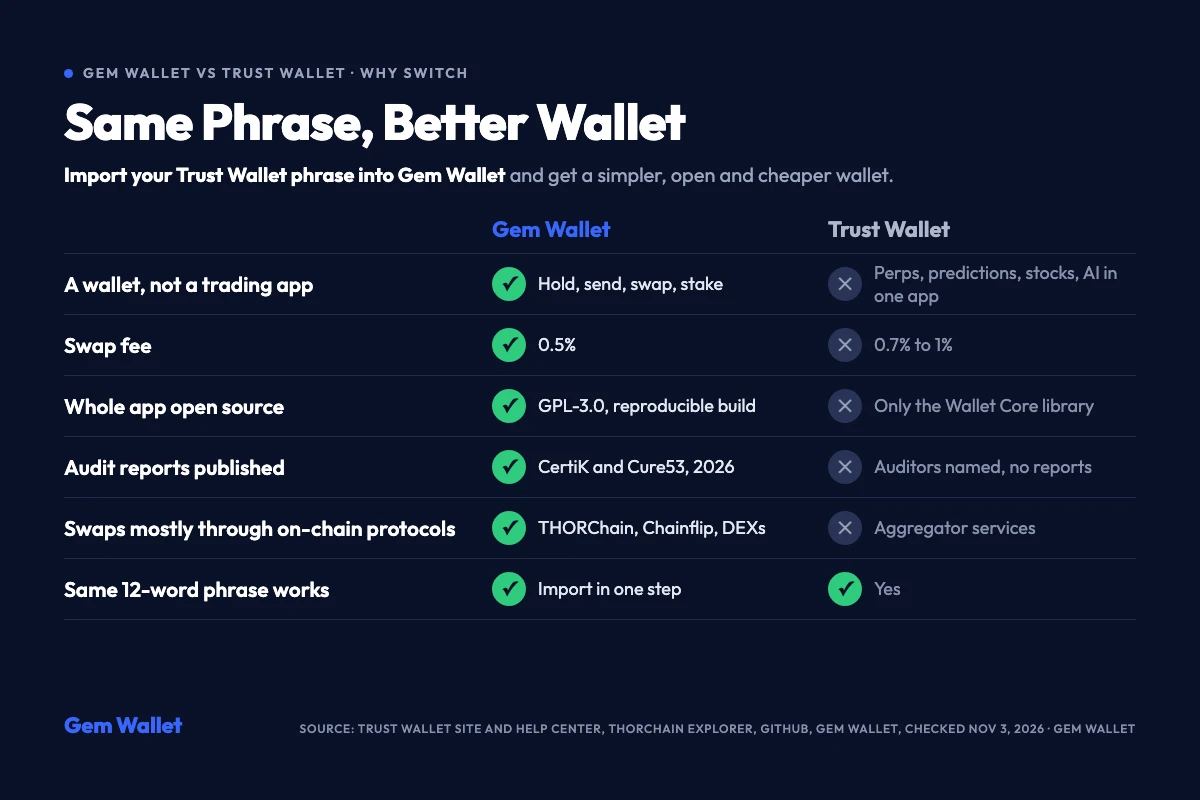 Your Trust Wallet phrase works in Gem Wallet: a simpler, open and cheaper wallet.
Trust Wallet has more trading tools inside the app, with regional limits:
- Perpetual futures: Trust Wallet lets you trade perps on Aster DEX and Hyperliquid and charges no platform fee on top of the venue’s fees; perps are not available in the US, UK and Hong Kong, and Hyperliquid perps not in most of the EU, per its perps guide. In Gem Wallet you can trade perps on Hyperliquid with stop loss and take profit; Hyperliquid’s fee plus Gem Wallet’s fee is at most 0.09% taker and 0.06% maker.
- Prediction markets: Trust Wallet integrated Polymarket and others; buying new positions is paused, according to its help center (August 2026). Gem Wallet has none.
- Tokenized stocks: Trust Wallet offers Ondo, xStocks and other stock tokens through swap; they are not available in the US, UK or EEA. Gem Wallet has no separate stocks section: you get xStocks and Robinhood Chain stock tokens with a regular swap, like any other token.
Buying and Selling Crypto
In both wallets crypto is bought and sold through third-party providers that run their own identity checks and set their own fees. Trust Wallet lists MoonPay, Banxa, Mercuryo, Transak, Ramp and others, plus Binance-powered buying and P2P. In Gem Wallet the quotes of MoonPay, Banxa, Mercuryo and others are compared for you and the best rate comes first; selling crypto goes through off-ramp providers the same way.
Browser Extension, Desktop and Hardware Wallets
Trust Wallet is ahead on devices today:
- Browser extension: Trust Wallet runs in Chrome, Brave, Edge and Opera and syncs with the mobile wallet through a QR code. Gem Wallet has no browser extension.
- Desktop: neither wallet has a desktop app; Trust Wallet covers desktop with its extension, and Gem Wallet’s desktop app is in development.
- Hardware wallets: Trust Wallet connects a Ledger in its browser extension, with the Bitcoin, Ethereum and Solana apps. Gem Wallet does not support hardware wallets yet; it is on the roadmap.
If you work with dApps from a laptop or keep savings on a Ledger, these points tip the choice toward Trust Wallet.
Users and Ratings
Trust Wallet reports 220M+ users, and its apps are rated 4.7 on the US App Store from 199,155 ratings and 4.5 on Google Play from 2.58 million reviews, with 50M+ downloads. Gem Wallet is younger and smaller: 1M+ installs across all platforms, a 4.5 rating on the US App Store from 361 ratings and 4.5 on Google Play from 4,300 reviews, as of November 2026.
Is Trust Wallet Better Than Gem Wallet?
Trust Wallet is the better choice if:
- You need a browser extension: Trust Wallet has one for Chrome, Brave, Edge and Opera; Gem Wallet is mobile only today.
- You sign with a Ledger: supported in Trust Wallet’s extension.
- You want the widest earning menu: staking on 25+ assets and Stablecoin Earn vaults.
- You want one of the most popular wallets: 220M+ users, per Trust Wallet, and millions of store reviews.
Gem Wallet is the better choice if:
- You want to check the app, not only a library: the code of both apps is public, the build is reproducible and the 2026 audit reports are published.
- You want a light wallet, not a trading app: Gem Wallet stays focused on holding, sending, swapping and staking.
- You swap often: 0.5% per swap against 0.7% to 1%.
- You want a wallet that is not tied to an exchange.
- You hold HYPE on HyperCore.
Final Thoughts
At first glance Trust Wallet and Gem Wallet look alike: both put 100+ blockchains on a phone under one 12-word phrase. A closer look shows how little they still have in common: Trust Wallet has turned into a trading app, with perps, prediction markets and tokenized stocks built into the wallet, alongside a browser extension, Ledger and the widest choice of staking assets. Gem Wallet stays a light, simple wallet that can be verified in full, with a lower swap fee. Since your Trust Wallet phrase works in Gem Wallet and gives the same addresses on most networks, you can install Gem Wallet next to Trust Wallet and compare them in practice on the same coins.
More comparisons: Gem Wallet vs MetaMask, Gem Wallet vs Exodus and Gem Wallet vs Phantom.
Disclaimer: This article is for informational and educational purposes only and is not financial or investment advice. Crypto assets are highly volatile, and you can lose all the money you invest. Do your own research and make decisions at your own risk.