

Table of Contents
Gem Wallet and Phantom are both self-custodial wallets, and on Solana they open the very same address from the same 12-word recovery phrase. Phantom started in 2021 as the wallet of Solana and has since moved its focus from the wallet to trading: today it is a trading app with perps, prediction markets and a Cash account on 9 networks. Gem Wallet stays a wallet first: a mobile wallet that runs Solana next to 100+ other blockchains, with perps as well, open-source code and a 0.5% swap fee against Phantom’s 0.85%.
Gem Wallet vs Phantom: our verdict
If you need a wallet first of all, Gem Wallet is the better and simpler choice. It keeps SOL and SPL tokens next to USDT on TRON and TON, Sui, XRP, Dogecoin and 100+ other networks, charges 0.5% on a swap, and publishes its code. If you need a trading app first of all, for memecoins and prediction markets, Phantom is the better fit: it has a Chrome extension, a web trading terminal, prediction markets and Ledger support.
Key Takeaways
- Same Solana address: both wallets derive Solana on m/44’/501’/0’/0’, so one recovery phrase opens the same SOL account in each.
- Networks: Phantom currently supports 9 networks and has already dropped networks it had added, Sui and Monad in 2026; Gem Wallet runs 100+, Sui, Monad, TRON and TON included.
- Fees: a $1,000 swap costs $5.00 in Gem Wallet and $8.50 in Phantom, as of October 2026.
Gem Wallet vs Phantom: Overview
Phantom and Gem Wallet overlap on Solana and on Ethereum-style networks, and both trade Hyperliquid perps; outside that overlap they are built for different users. The table shows where they meet and where they part, as of October 2026.
| Feature | Gem Wallet | Phantom |
|---|---|---|
| Started as | Multi-chain mobile wallet | Solana wallet (2021) |
| Platforms | iOS, Android (Google Play, APK) | Chrome extension, iOS, Android; Phantom Terminal on the web |
| Networks | 100+ blockchains | 9: Solana, Ethereum, Base, Polygon, BNB Chain, Bitcoin, HyperEVM, Robinhood Chain, Arc |
| Custom tokens and RPC | Custom tokens, custom nodes | No custom networks or RPC |
| TRON, TON, XRP, Sui | Yes | No |
| Code | Open source (GPL-3.0) | Closed source |
| Recovery phrase | 12 words | 12 words; 24-word import |
| Sign-up | No email, phone or KYC | Optional Google or Apple login; KYC for Cash card and bank features |
| Swap fee | 0.5% | 0.85%; stablecoins into Cash free |
| Solana swap sources | Jupiter, Raydium, Orca, OKX DEX and others | Not named for same-chain swaps |
| Sell crypto in the app | Yes, through off-ramp providers | Via an exchange; Cash bank withdrawal in the US |
| SOL staking | Native staking | Native staking and PSOL liquid staking |
| Other staking | ETH, TRX, BNB, ATOM, SUI and more | None |
| Perpetual futures | Hyperliquid, up to 0.09% taker | Hyperliquid, 0.095% per trade; not in the US or UK |
| Prediction markets | No | Yes, by region |
| Tokenized stocks | xStocks and Robinhood Chain stock tokens by swap; stock perps on Hyperliquid | xStocks and Ondo, by region |
| Hardware wallets | Not yet, on the roadmap | Ledger |
| Audits | CertiK (April 2026), Cure53 (October 2026) | Kudelski Security (2021), Least Authority (2024) |
| Store ratings | Google Play 4.5, App Store US 4.5 | Google Play 4.4, App Store US 4.8 |
Data checked on 29 October 2026; each row is sourced from the help center or site of the wallet, linked further down.
Gem Wallet as a Phantom Alternative: One Recovery Phrase, the Same Solana Address
Gem Wallet is a Phantom alternative for users who want a wallet rather than a trading app: Phantom has moved its focus to trading, while Gem Wallet stays a wallet first, with Solana next to 100+ other networks. Moving takes a minute, because the same recovery phrase works in both. A Phantom recovery phrase imported into Gem Wallet shows the same Solana address, because both wallets follow the same derivation path for it. The path is the rule that turns a 12-word phrase (BIP-39) into an address, and wallets that pick different paths show different addresses from one phrase. Phantom names its paths in its help center, and Gem Wallet’s are in its open-source code:
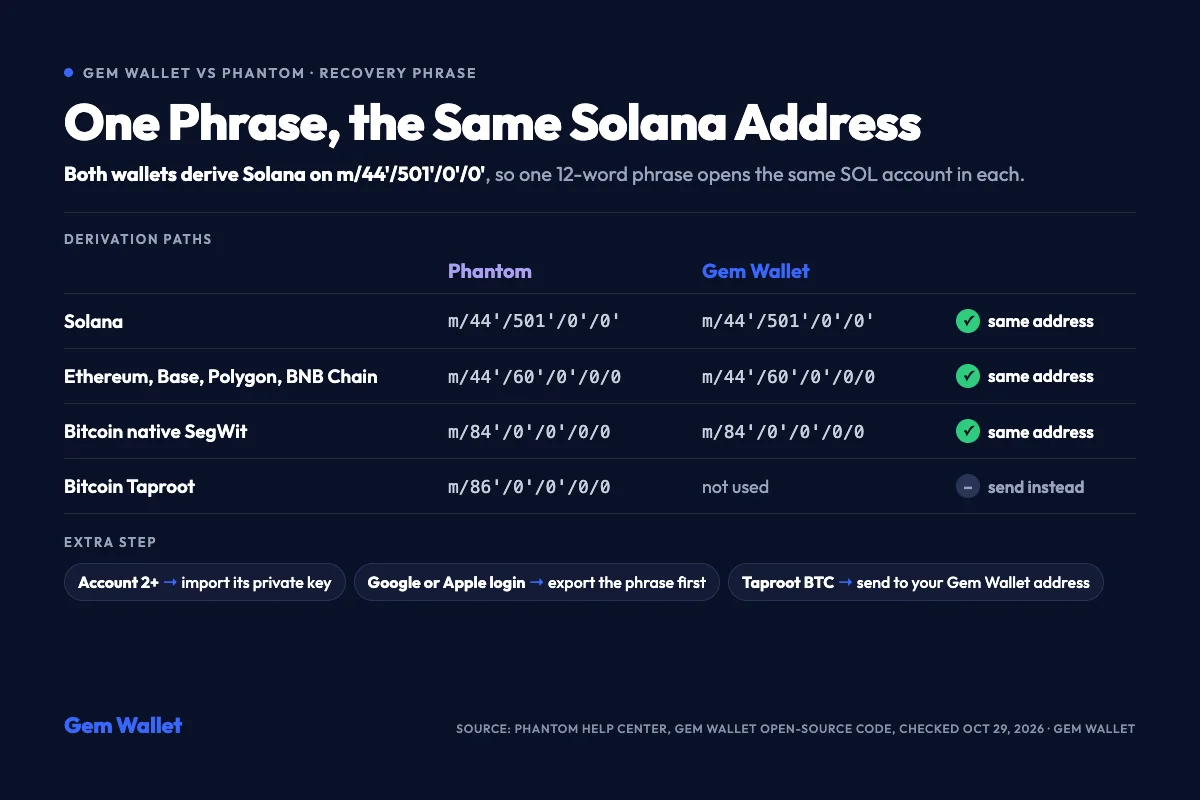 Both wallets derive Solana, Ethereum and Bitcoin native SegWit on the same paths, so one recovery phrase opens the same addresses; Taproot BTC is not used by Gem Wallet. Source: Phantom help center, Gem Wallet open-source code, checked 29 October 2026, Gem Wallet
| Network | Phantom (default) | Gem Wallet | Same address |
|---|---|---|---|
| Solana | m/44’/501’/0’/0’ (first account) | m/44’/501’/0’/0' | Yes |
| Ethereum, Base, Polygon, BNB Chain | m/44’/60’/0’/0/0 | m/44’/60’/0’/0/0 | Yes |
| Bitcoin, native SegWit | m/84’/0’/0’/0/0 | m/84’/0’/0’/0/0 | Yes |
| Bitcoin, Taproot | m/86’/0’/0’/0/0 | Not used | No |
That makes the two wallets interchangeable for the first account. A few cases need one more step:
- Moving from Phantom: in Phantom open Settings, choose the account and tap Show Secret Recovery Phrase, then in Gem Wallet tap Import an Existing Wallet > Multi-Coin and paste it; the full walkthrough is in how to import your Phantom wallet into Gem Wallet.
- Account 2 and beyond: Phantom adds accounts on the same phrase (index 1, 2 and up), while Gem Wallet opens one address per network for each phrase. Export the private key of that Phantom account and import it into Gem Wallet as a separate wallet; this works for Solana and EVM networks.
- Older Phantom wallets: a wallet created on Phantom’s older “bip44” or deprecated Solana path shows a different SOL address elsewhere. Phantom itself says mismatched addresses usually come from a derivation path; move such funds by sending them to your Gem Wallet address.
- Google or Apple login: these Phantom wallets keep the key in Phantom’s key management service, so export the recovery phrase in Phantom first.
- Taproot bitcoin: BTC on a Phantom Taproot address (starting with bc1p) is sent to your Gem Wallet Bitcoin address instead of imported.
The move works in reverse the same way: the Gem Wallet recovery phrase imported into Phantom opens the same Solana, EVM and SegWit Bitcoin addresses.
Solana in Both Wallets
Phantom is the reference wallet of Solana: Solana is always on in Phantom and cannot be switched off, and the app even offers a Solana-only mode that hides the other networks, according to the Phantom help center. Gem Wallet treats Solana as one network among 100+, with the tools a Solana user reaches for every day:
- Swaps through Solana’s own DEXs: Gem Wallet routes Solana swaps through Jupiter, Raydium, Orca and OKX DEX, and names the provider of every quote. Phantom’s swap guide does not name its same-chain sources.
- dApps: Gem Wallet connects to Solana dApps through WalletConnect since March 2026. Phantom on mobile connects to dApps only inside its own in-app browser, and its extension connects to sites directly.
- Staking: both stake SOL natively with a validator. Phantom also has its own liquid staking token, PSOL, with a 4% fee on rewards and a 0.1% exit fee.
- Solana Mobile: Gem Wallet is listed in the Solana dApp Store since June 2025.
- NFTs: both show Solana NFTs; Gem Wallet stores SPL and Metaplex collections in its Collectibles tab.
For someone who lives only on Solana, Phantom’s depth and its PSOL token are a real draw; for a Solana user who also holds coins elsewhere, Gem Wallet covers the same daily actions without a second wallet.
Networks: 9 in Phantom, 100+ in Gem Wallet
Phantom supports 9 networks as of October 2026: Solana, Ethereum, Base, Polygon, BNB Chain, Bitcoin, HyperEVM, Robinhood Chain and Arc, according to its supported networks page. Every other network is unsupported, and users cannot add one through a custom RPC.
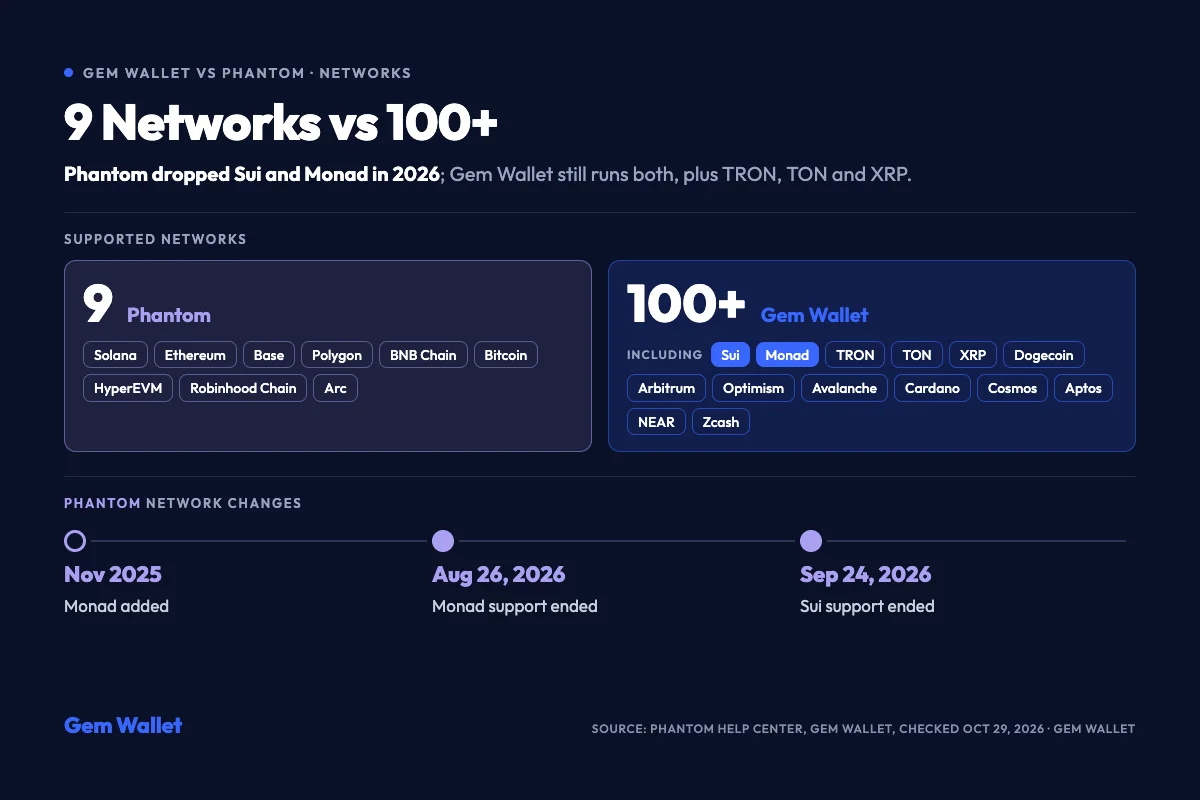 Phantom supports 9 networks and dropped Monad (26 August 2026) and Sui (24 September 2026); Gem Wallet runs 100+ blockchains. Source: Phantom help center, Gem Wallet, checked 29 October 2026, Gem Wallet
The Phantom list also shrinks as well as grows. Phantom added Sui in 2025 and ended support on 24 September 2026; it added Monad at its mainnet launch in November 2025 and ended support on 26 August 2026; Ordinals and BRC-20 tokens are no longer shown either. Gem Wallet keeps Sui and Monad, with staking on both.
Gem Wallet runs 100+ blockchains from one recovery phrase: the EVM networks Phantom lacks, such as Arbitrum, Optimism and Avalanche, plus non-EVM networks such as TRON, TON, XRP, Dogecoin, Cardano, Cosmos, Aptos, NEAR and Zcash. You can also add any token by its contract address and connect your own node.
Count: of the 14 networks named in the last two paragraphs, Phantom runs none and Gem Wallet runs all 14. A wallet that drops networks it once supported makes you move funds on its schedule; a wallet that covers the networks you already use spares you that move.
USDT and Stablecoins
USDT on TRON and on TON carries a large part of everyday stablecoin payments, and neither network is in Phantom. Gem Wallet holds official USDT on 14 networks, including TRON, TON, Solana, Ethereum and BNB Chain, plus USDT0 on networks such as Plasma, Stable and HyperEVM, as of October 2026.
Phantom builds its stablecoin side around Solana and its own Cash account:
- Phantom Cash: a dollar balance in Phantom’s own CASH stablecoin, issued by Bridge on Solana, launched in September 2025 and available on mobile.
- Free stablecoin moves: swapping USDC, USDT, USDG or PYUSD into Cash costs nothing; Cash to USDT and other tokens costs 0.85%, according to Phantom’s Cash fees page.
- Debit card: a virtual Visa debit card for Cash, in the United States except New York.
In Gem Wallet a USDT payment on TRON does not stall for lack of TRX: you can swap any coin into TRX for the network fee, stake TRX for energy, and swap USDT into TRX through the built-in SunSwap. If you get paid in USDT TRC20 or on TON, only Gem Wallet of the two can receive it; for USDT on Solana, both work.
Fees: Swaps, Bridges and Perps
Gem Wallet charges 0.5% per swap and Phantom 0.85%, both on top of the network fee, which goes to the blockchain and is the same in any wallet.
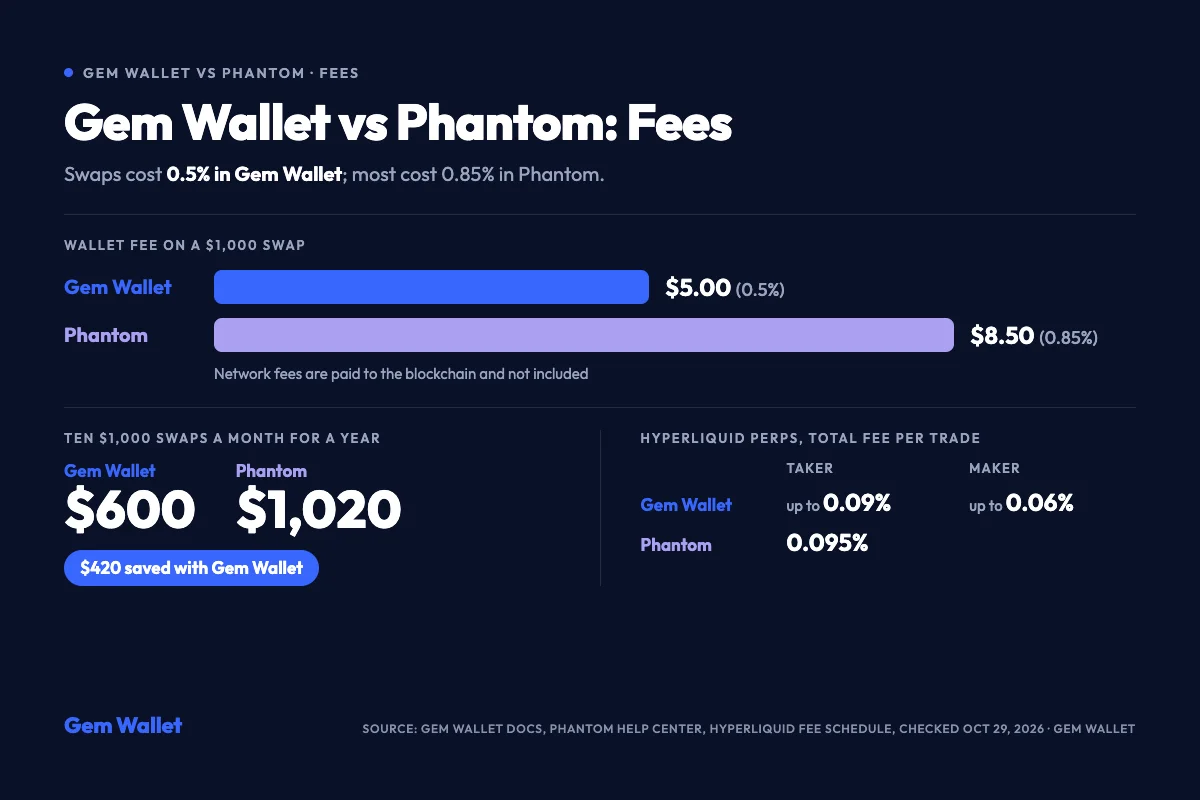 Swaps cost 0.5% in Gem Wallet and most cost 0.85% in Phantom: $420 a year saved on ten $1,000 swaps a month. Source: Gem Wallet docs, Phantom help center, Hyperliquid fee schedule, checked 29 October 2026, Gem Wallet
- Gem Wallet: 0.5% on in-chain and cross-chain swaps, already included in the quote you confirm.
- Phantom: 0.85% on most swaps, according to its swap guide. A cross-chain swap adds the bridge provider’s fee (LI.FI, Relay, deBridge or Garden), and the amount may need to be at least $2.
- Perps: Phantom takes 0.05% on top of Hyperliquid’s 0.045%, 0.095% per trade. Gem Wallet’s builder fee is up to 0.045%, so the total is at most 0.09% taker and 0.06% maker.
Fee example: a $1,000 SOL to USDC swap costs $5.00 in Gem Wallet fees and $8.50 in Phantom fees. Ten such swaps a month come to $600 against $1,020 a year: $420 stays with you in Gem Wallet.
Phantom’s free stablecoin-to-Cash swaps are cheaper than any swap in Gem Wallet for that one route; for swapping tokens, Gem Wallet costs less.
Trading: Perps, Prediction Markets and Stocks
Phantom is the stronger trading app of the two, and it markets itself as one: its App Store name is “Phantom: Trading Wallet”. Gem Wallet covers perpetual futures; Phantom adds more markets on top.
- Perps in both: both wallets trade perpetual futures on Hyperliquid. Phantom launched perps in July 2025 and reached $10B in volume by September 2025; Gem Wallet launched them in June 2026, with stop loss and take profit on every position and markets such as oil.
- Regions: Phantom perps are not available in the United States, the United Kingdom or sanctioned jurisdictions, nor with a Ledger account. Gem Wallet sets no regional restrictions in the app.
- Prediction markets: Phantom offers event contracts through Kalshi in the US since 28 October 2026 and World Prediction Markets on Solana elsewhere. Gem Wallet has none.
- Tokenized stocks: Phantom lists xStocks and Ondo tokenized US stocks and ETFs outside the US, the UK and several EU countries. Gem Wallet has them too: xStocks and the stock tokens of Robinhood Chain are bought with a regular swap, and Hyperliquid perps in Gem Wallet cover stocks, gold and oil.
- Desktop trading: Phantom Terminal at trade.phantom.com, a web app for spot and perps. Gem Wallet is mobile only for now; a desktop app is in development.
If prediction markets are why you open a wallet, Phantom has them and Gem Wallet does not.
Buying, Selling and Cashing Out
Both wallets let you buy crypto with a card or bank transfer through third-party providers; the difference is the way back to fiat.
- Buying in Phantom: 19 providers, including MoonPay, Coinbase, PayPal, Revolut and Stripe. On mobile, purchases go through the Cash balance first and are then swapped into the token.
- Buying in Gem Wallet: providers such as MoonPay, Banxa, Mercuryo and others, with the best rate shown among them.
- Selling in Phantom: the help center sends you to an exchange to sell tokens for fiat; in the US, a Cash balance can be withdrawn to a bank.
- Selling in Gem Wallet: sell crypto right in the app through off-ramp providers, without moving it to an exchange first.
Is Phantom Safe? Security and Open Source
Phantom is a self-custodial wallet with a documented security program, and its code is closed. Gem Wallet is self-custodial too, with code anyone can read.
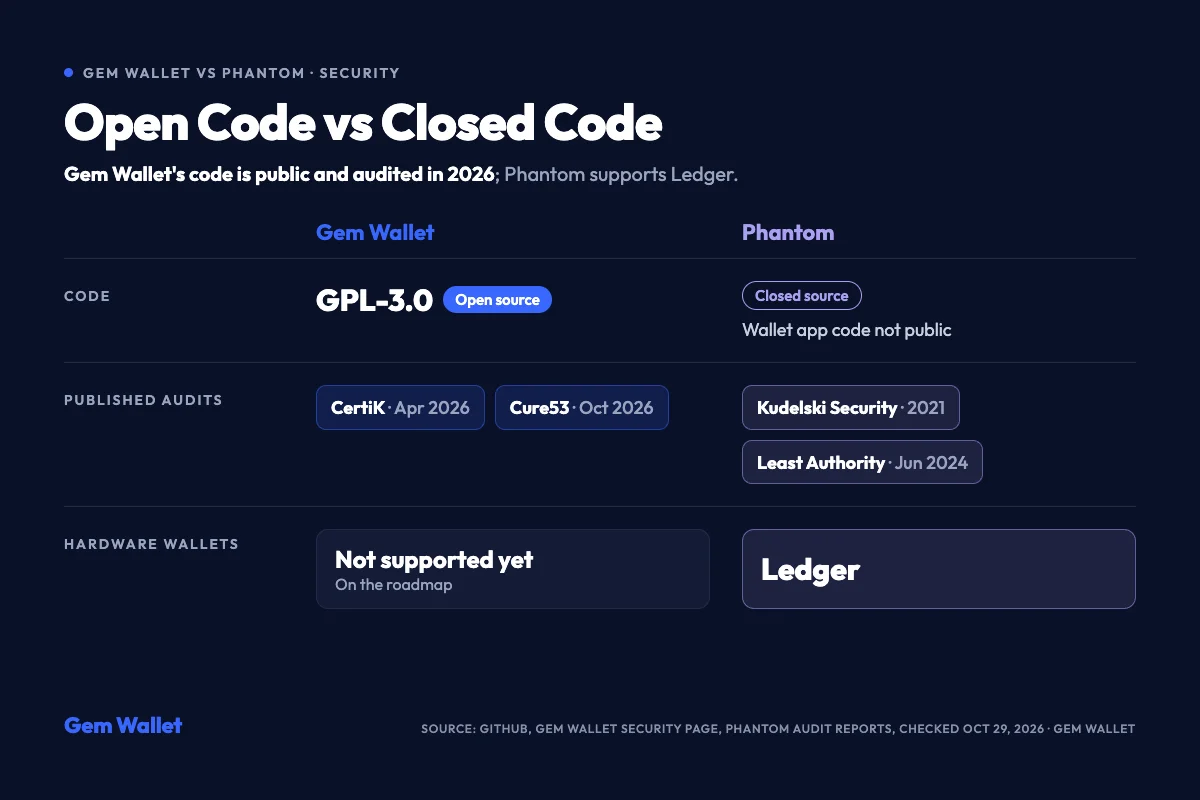 Gem Wallet’s code is public under GPL-3.0 and audited by CertiK and Cure53 in 2026; Phantom’s wallet code is closed and supports Ledger. Source: GitHub, Gem Wallet security page, Phantom audit reports, checked 29 October 2026, Gem Wallet
Phantom Security
- Closed code: Phantom’s GitHub holds SDKs, a phishing blocklist and audit reports, but not the wallet app; the repository named in its 2024 audit is not public. For the user that is a black box: neither its security nor what it does with keys and data can be checked from outside.
- Audits: Kudelski Security reviewed the Solana wallet in 2021 and Least Authority the wallet in June 2024, both published on GitHub; no later audit report is published.
- Bug bounty and scam checks: rewards up to $50,000 on Cantina, transaction previews, spam hiding and a malicious-site blocklist, built with the Blowfish team Phantom acquired in 2024.
- Documented issue: in 2022 Phantom fixed the “Demonic” vulnerability, which could leave a recovery phrase on disk in browsers; it found no evidence of exploitation.
- Login keys: wallets created with Google or Apple keep the key in Phantom’s key management service, in secure hardware on Phantom’s side.
Gem Wallet Security
- Open source: the iOS and Android apps and the Rust core are licensed under GPL-3.0, all on GitHub. More in open-source crypto wallet.
- Recent audits: CertiK in April 2026 and Cure53 in October 2026, covering key management, signing and both apps; reports on the security page.
- Keys on your phone only: no email or social login; keys stay encrypted on the device.
- Checks before signing: HashDit and GoPlus scan addresses and contracts before sends, swaps and approvals, and spam transactions used for address poisoning are hidden from the history.
Phantom’s strength is Ledger support for larger balances; Gem Wallet’s is code and audits that anyone can verify, the latest from this month.
Platforms: Browser or Phone
Phantom is built for Chrome: its extension is officially supported on Chrome, works on Brave, Edge and Opera, and no longer gets updates on Firefox, according to the supported platforms page. Phantom also has iOS and Android apps and the Phantom Terminal web app.
Gem Wallet is a phone wallet for iOS and Android, from the App Store, Google Play, the Solana dApp Store or as an APK. On a computer, Gem Wallet works only as the phone side of WalletConnect: you scan the dApp’s QR code with the app, since there is no extension, and the desktop app is still in development.
Popularity and Ratings
Phantom is the larger wallet by far: it claims 20M+ users and had 15 million monthly active users in January 2025. On the stores, Phantom is rated 4.8 on the US App Store from 64,252 ratings and 4.4 on Google Play from 153,000 reviews; Gem Wallet is rated 4.5 on both, from 361 ratings and 4,300 reviews, as of October 2026. Gem Wallet has 1M+ installs across all platforms and $200M+ in swaps made in the app.
Is Phantom Better Than Gem Wallet?
Phantom is better than Gem Wallet if you want a trading app first:
- You trade Solana at a desktop: the Chrome extension and Phantom Terminal put the wallet in your browser.
- You want prediction markets: Phantom has them, depending on your country.
- You sign with a Ledger: Phantom supports Ledger on mobile and in the extension.
- You want liquid staking for SOL: PSOL keeps your SOL staked and usable in DeFi.
Gem Wallet is better if you want a wallet first, for payments, transfers and holding crypto:
- You pay and send in stablecoins: USDT on TRON and TON, the two networks most USDT payments go through, sit next to Solana in the same app.
- Your crypto lives on more than Solana: USDT on TRON and TON, Sui, XRP, Dogecoin and 100+ networks in one app.
- You swap regularly: 0.5% against 0.85%, with Solana swaps through Jupiter, Raydium and Orca.
- You want code you can read: open-source apps and two audits in 2026.
- You want networks that stay: Gem Wallet still runs Sui and Monad, which Phantom dropped in 2026.
- You cash out in the app: sell crypto through providers without an exchange account.
Final Thoughts
Phantom started as the main wallet of Solana and has turned into a trading app: perps, memecoins, prediction markets, Cash and a browser terminal, around one network and a short list of others. Gem Wallet stays a wallet: one open-source app to hold, send and pay in crypto on Solana and 100+ other blockchains, with perps when you need them, at a lower swap fee. If you are looking for a wallet rather than a trading app, Gem Wallet is the Phantom alternative to try: one recovery phrase opens the same Solana address in both, so the move takes a minute.
See also Gem Wallet vs MetaMask, Gem Wallet vs Exodus and our guide to the Solana wallet in Gem Wallet.
Disclaimer: This article is for informational and educational purposes only and is not financial or investment advice. Crypto assets are highly volatile, and you can lose all the money you invest. Do your own research and make decisions at your own risk.