

Table of Contents
Gem Wallet and MetaMask are both self-custodial wallets: you hold the keys, no one can freeze your funds, and no account is needed. The difference is where they come from. MetaMask started in 2016 as the browser wallet of Ethereum and grew out to other networks; Gem Wallet is a mobile wallet built for 100+ blockchains from the start, with open-source code and lower swap fees. Gem Wallet is also a direct MetaMask alternative: both use the same standard 12-word recovery phrase (BIP-39), so one recovery phrase opens the same wallet in either app.
Gem Wallet vs MetaMask: the winner is Gem Wallet 🏆
Gem Wallet wins for most people who manage crypto on their phone: 100+ blockchains natively, including Bitcoin, TRON, Zcash and TON, a 0.5% swap fee against MetaMask’s 0.875%, open-source code under GPL-3.0, and apps audited by Cure53 and CertiK in 2026. MetaMask wins if you want your wallet in a desktop browser or sign with a hardware wallet: it has an extension for five browsers and supports 12 hardware wallets.
Key Takeaways
- Networks: Gem Wallet runs 100+ blockchains natively, EVM and non-EVM alike; MetaMask runs EVM networks plus Bitcoin, Solana, TRON and Stellar, and adds others such as Cosmos or Cardano through Snaps.
- Fees: Gem Wallet takes 0.5% on a swap; MetaMask takes 0.875% on swaps and bridges.
- Platforms: Gem Wallet is a mobile wallet for iOS and Android; MetaMask is a browser extension and a mobile app.
Gem Wallet vs MetaMask: Overview
Both wallets are free to download and let you create a wallet in a minute with a 12-word recovery phrase, swap, buy and sell crypto, stake, trade perpetual futures on Hyperliquid and connect to dApps. They differ in how many networks they run natively, what they charge, how their code is licensed and on which devices they live.
| Feature | Gem Wallet | MetaMask |
|---|---|---|
| Type | Self-custodial, mobile | Self-custodial, browser extension and mobile |
| Price | Free | Free |
| Platforms | iOS, Android (Google Play, APK) | Chrome, Firefox, Brave, Edge, Opera; iOS, Android; web |
| Networks | 100+ blockchains natively, EVM and non-EVM | EVM networks, Bitcoin, Solana, TRON, Stellar; others via Snaps |
| Code license | Open source: GPL-3.0 | Source-available: non-commercial (extension), inspect and study only (mobile) |
| Recovery phrase | 12 words | 12 words |
| Sign-up | No email, phone or KYC | No KYC; optional Google, Apple or Telegram login |
| Swap fee | 0.5% | 0.875% |
| Cross-chain swaps | Yes, providers named, you can pick one | Yes, bridging inside Swaps, sources not named |
| Buy and sell crypto | Yes, through on-ramp and off-ramp providers | Yes, through regional providers |
| Staking | ETH, SOL, TRX, TON, BNB, ATOM, SUI and more | ETH (pooled, validator, liquid), SOL, TRX |
| Perpetual futures | Hyperliquid perps, oil markets included | Hyperliquid perps, not in the USA, UK, Ontario, Belgium |
| Perps fees | Up to 0.09% taker, 0.06% maker | 0.1432% taker, 0.1144% maker |
| Hardware wallets | Not supported yet, on the roadmap | 12 on the extension, 3 on mobile |
| Security audits | Cure53 (October 2026) and CertiK (April 2026) of the wallet | Reports on libraries, Snaps and contracts (2020-2025) |
| Store ratings | Google Play 4.5 (4.3K reviews), App Store US 4.5 (361 ratings) | Google Play 4.5 (490K reviews), App Store US 4.7 (76K ratings) |
| Users | 1M+ | Tens of millions, 100M+ downloads |
| Google Play downloads | 100K+ | 10M+ |
Checked 27 October 2026 against the official pages of both wallets, linked in each section below.
Gem Wallet as a MetaMask Alternative: One Recovery Phrase for Both
Gem Wallet and MetaMask are interchangeable because both follow the same standard: a 12-word recovery phrase (BIP-39) from which every address is derived. A recovery phrase is not tied to an app, so the same wallet can be opened in Gem Wallet, in MetaMask or in both at once, and switching takes a minute in either direction:
- From MetaMask to Gem Wallet: in MetaMask open Settings > Security and Privacy > Reveal Secret Recovery Phrase, then in Gem Wallet tap Import an Existing Wallet > Multi-Coin and paste the phrase. Step by step: how to import your MetaMask wallet into Gem Wallet.
- From Gem Wallet to MetaMask: reveal the recovery phrase of the wallet in Gem Wallet settings, then import it when you add a wallet in MetaMask.
- Same EVM address: on Ethereum, Base, BNB Chain and other EVM networks the main account has the same address in both wallets, so your tokens and NFTs are already there.
- Several MetaMask accounts: MetaMask creates Account 1, Account 2 and more from one recovery phrase, while in Gem Wallet one recovery phrase is one wallet with one address per network. The phrase brings Account 1 into Gem Wallet; to move Account 2 or later, export its private key in MetaMask and import it into Gem Wallet as a separate wallet: private key import works for EVM networks, Solana, TRON and most other networks, but not for Bitcoin.
- Networks only one wallet runs: XRP, Dogecoin, Cardano, Sui, TON, Zcash and other networks appear in Gem Wallet natively; MetaMask shows them only through Snaps or not at all.
If you signed up for MetaMask with Google, Apple or Telegram, reveal the Secret Recovery Phrase in MetaMask first: the import needs the phrase itself.
What Changed in 2025 and 2026
Both wallets moved fast over the last two years, and MetaMask’s move into non-EVM networks narrowed some of the old gaps:
- MetaMask adds Solana, Bitcoin and TRON: Solana went live in July 2025, Bitcoin in December 2025 and TRON in January 2026, all native.
- MetaMask Perps and Rewards: in October 2025 MetaMask launched perpetual futures powered by Hyperliquid, a points program and confirmed plans for its own token.
- MetaMask Card and tokenized stocks: in February 2026 the MetaMask Card became available across the United States, and eligible non-US mobile users got access to 200+ tokenized US stocks and ETFs.
- Consensys splits in two: on 9 September 2026 Consensys announced that it will be renamed MetaMask, with its infrastructure business moving into a new company under the Consensys name.
- Gem Wallet perps: in June 2026 Gem Wallet launched perpetual futures on Hyperliquid, later adding oil and other HIP-3 markets.
- Gem Wallet audits and scam protection: CertiK audited Gem Wallet in April 2026 and Cure53 in October 2026; in October Gem Wallet also added HashDit and GoPlus checks before every transaction.
Behind these launches is a difference in design. MetaMask was built as an Ethereum wallet, and in 2025-2026 it is catching up with user demand for other networks by adding them on top of that design: its Bitcoin support covers only native SegWit addresses so far, with Taproot planned, and networks such as Cosmos, Cardano or XRP still run through Snaps, plugins from third-party developers. Gem Wallet was designed multi-chain from the start: one Rust core serves every network in both apps, so Bitcoin, TRON, TON or Cosmos work the same way as Ethereum. Both wallets now list the same headline features, but a wallet built for many chains handles them more naturally than a wallet that grew out of one chain, and the decision comes down to network coverage, fees, code license and platform.
Supported Networks and Assets
Network support is the biggest practical difference. A wallet that runs a network natively shows its balances, sends, receives and swaps without add-ons; a wallet that needs a plugin for it adds a step and a third party.
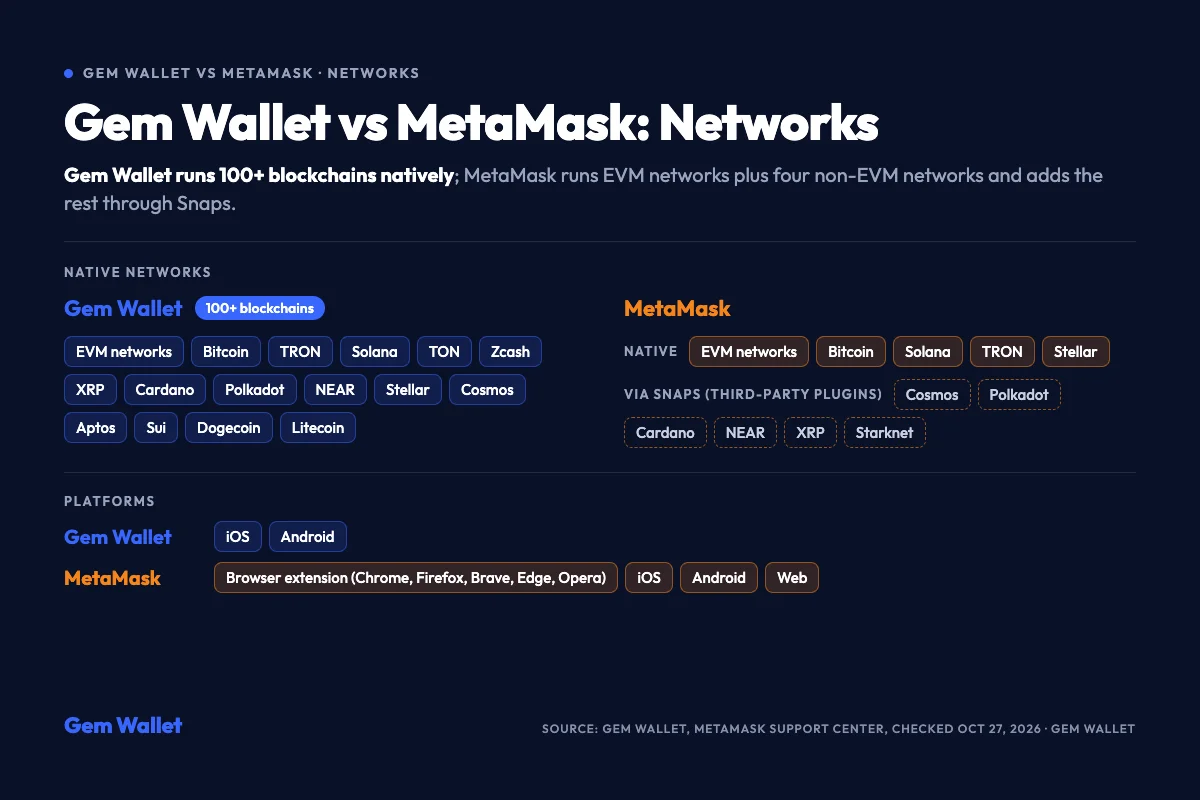 Gem Wallet runs Bitcoin, TRON, TON, Zcash, Cosmos and other non-EVM networks natively; in MetaMask several of them need third-party Snaps. Source: Gem Wallet, MetaMask support center, checked 27 October 2026, Gem Wallet
Gem Wallet Networks
- 100+ blockchains natively: Ethereum and EVM networks such as Base, Arbitrum, BNB Chain and Polygon, and non-EVM networks such as Bitcoin, TRON, Zcash, TON, Solana, XRP, Cardano, Polkadot, NEAR, Stellar, Cosmos, Aptos, Sui, Dogecoin and Litecoin.
- One recovery phrase for all of them: one 12-word phrase creates addresses on every supported network.
- Unlimited wallets in one app: separate wallets for savings, trading or a single position.
- Custom tokens and custom nodes: add any token by its contract address, and connect your own node (RPC) for Ethereum and other supported networks; new networks themselves are added by the Gem Wallet team, not by the user.
MetaMask Networks
- EVM first: MetaMask runs all EVM networks, with a pre-enabled list and any other EVM chain through a custom RPC, according to the MetaMask support center.
- Native non-EVM: Bitcoin, Solana, TRON and Stellar run natively; MetaMask names 19 supported networks in its support center and claims 700+ networks in its own marketing.
- Snaps for the rest: Cosmos, Polkadot, Cardano, NEAR, XRP and Starknet work through Snaps, plugins built by third-party developers.
If you hold XRP, Dogecoin, Cardano, Sui, TON or Zcash next to your ETH, Gem Wallet keeps them in one app without plugins; if you live on EVM networks, both wallets cover you.
Platforms and Setup
MetaMask is the wallet that lives in the browser. Its extension runs in Chrome, Firefox, Brave, Edge and Opera, and MetaMask also offers apps for iOS and Android and a web version, according to MetaMask. Gem Wallet is a mobile wallet only: iOS from the App Store and Android from Google Play or as an APK. It has no browser extension and no desktop app, and it connects to web dApps through WalletConnect by scanning a QR code.
Setup is close in both:
- Recovery phrase: both create a 12-word recovery phrase.
- No KYC: neither asks for identity checks to use the wallet; providers of card purchases run their own checks.
- Sign-up: Gem Wallet needs no email or phone at all. MetaMask also offers an optional login with Google, Apple or Telegram, which keeps an encrypted backup of the recovery phrase online.
- Moving over: the same recovery phrase works in both wallets, so you can move in either direction and keep using both.
If most of your crypto activity happens at a desktop browser, MetaMask fits that habit; if it happens on your phone, Gem Wallet is built for it.
Fees: Swaps, Bridges and Network Fees
Network fees are paid to the blockchain in both wallets and are the same for the same transaction. What differs is the wallet’s own commission on top.
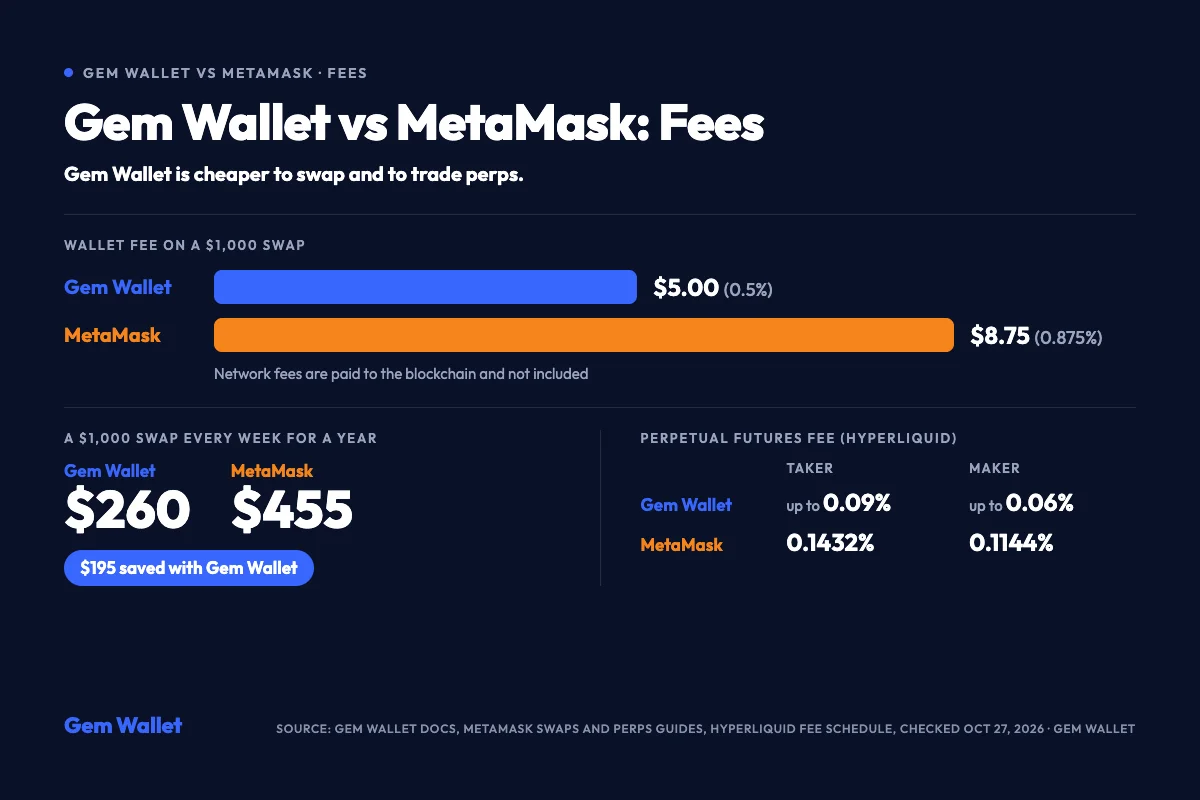 On a $1,000 swap Gem Wallet charges $5.00 and MetaMask $8.75; on Hyperliquid perps Gem Wallet’s total fee is lower too. Source: Gem Wallet docs, MetaMask Swaps and Perps guides, Hyperliquid fee schedule, checked 27 October 2026, Gem Wallet
- Gem Wallet swap fee: 0.5% of the swap, in-chain and cross-chain.
- MetaMask swap fee: 0.875% of the swap, and bridging now runs through MetaMask Swaps with the same fee, according to the MetaMask Swaps guide.
- Quotes: Gem Wallet compares quotes from its swap providers and shows the total before you confirm.
- Network fee speed: Gem Wallet lets you choose how fast a transaction goes through, and so how much network fee you pay.
Fee example: a $1,000 swap costs $5.00 in Gem Wallet fees (0.5%) and $8.75 in MetaMask fees (0.875%), network fees not included. Swapping $1,000 every week for a year, that is $260 against $455: $195 saved in Gem Wallet.
For anyone who swaps often or in large amounts, the lower fee makes Gem Wallet the cheaper wallet to trade in.
Swaps, Buying and Selling Crypto
Gem Wallet routes swaps through named providers, both decentralized exchanges such as Uniswap, PancakeSwap, Jupiter, Orca and STON.fi, and cross-chain protocols such as THORChain, Chainflip, Across and Relay. Because it runs non-EVM networks natively, it can swap assets like BTC, TRX, TON or ZEC directly, in one network or across networks. Gem Wallet also shows where each quote comes from: by default it picks the quote that gives you the most, the Provider row in the swap details names the provider, and tapping it opens the list of providers with the amount each one gives you, so you can select a swap provider yourself. MetaMask Swaps also aggregates quotes across decentralized exchanges and swap protocols, but its support page does not name the sources for swaps or say that you can see or choose them; for bridging it names the Li.fi and Socket aggregators.
Buying and selling crypto with a card or a bank transfer works in both through third-party providers. Gem Wallet works with on-ramp providers such as MoonPay, Banxa, Mercuryo and others and shows the best rate among them; MetaMask lists its providers by region on its providers page. In both, the provider sets its own limits and identity checks.
Stablecoins and USDT Payments
Stablecoin payments are one of the main ways crypto is used today, and here network coverage matters most: a USDT payment only arrives if your wallet runs the network the sender uses.
- USDT on all five main networks and more: Gem Wallet holds USDT on the five main USDT networks, TRON (TRC20), Ethereum (ERC20), BNB Chain (BEP20), Solana and TON and on Arbitrum, Polygon, Avalanche, Optimism, Mantle, Celo, Aptos, Sui and NEAR, plus USDT0 on networks such as Plasma, Stable, Tempo, Monad and HyperEVM, as of October 2026. MetaMask covers USDT on EVM networks, Solana and TRON, but not on TON, Aptos, Sui or NEAR, so USDT on TON, the network of Telegram users, is not available there.
- USDT between networks: Gem Wallet swaps USDT from one network to another right in the app, for example from TRC20 to ERC20 or TON, and in October 2026 added USDT0 swaps across chains and on Stable.
- Cheaper USDT on TRON: both wallets let you stake TRX for energy and bandwidth that cover USDT TRC20 fees; in Gem Wallet you can also swap any crypto, BTC included, into TRX to pay the network fee, so a USDT transfer never gets stuck for lack of TRX. Swaps from USDT to TRX run through the built-in SunSwap and cost little: after a one-time approval on the first swap, the next ones are cheaper still.
For a wallet used mainly for payments, the network list decides: Gem Wallet covers every major USDT network, TON included.
Staking and Earning
Both wallets let you stake from the app; the difference is how many networks you can stake on. Staking in Gem Wallet covers ETH, SOL, TRX, TON, BNB, ATOM, SUI, APT, SEI, INJ and more, and the rewards come straight to your wallet. ETH staking in Gem Wallet starts from 0.1 ETH, through Everstake.
MetaMask staking is focused on Ethereum:
- ETH staking: pooled staking for any amount of ETH and validator staking for 32 to 2,048 ETH, according to the MetaMask support center, plus liquid staking with providers such as Lido and Rocket Pool.
- Other assets: SOL staking through Figment and TRX staking.
If you hold assets on several proof-of-stake networks, Gem Wallet lets you stake more of them in one app.
Trading Perpetual Futures
Both wallets offer perpetual futures powered by Hyperliquid. In Gem Wallet, perps sit right in the app next to your other assets, with stop loss and take profit on every position and markets beyond crypto, such as oil.
In Gem Wallet you pay Hyperliquid’s trading fee, 0.045% taker and 0.015% maker at the base tier according to the Hyperliquid fee schedule, plus a Gem Wallet builder fee of up to 0.045%: at most 0.09% taker and 0.06% maker, shown before you confirm. MetaMask Perps lists a taker fee of 0.1432% and a maker fee of 0.1144%, and is not available in the USA, the UK, Ontario and Belgium, according to the MetaMask Perps guide. On top of the lower fee, Gem Wallet users can join the Gem Wallet club on Hyperliquid with code GEMWALLET and get an extra discount on Hyperliquid’s trading fee.
Everyday Use: Sending, Receiving and Finding Assets
A wallet in its original sense is the place where you keep assets and send and receive them, and most mistakes happen right there: a wrong address, a fake token, the wrong network. Gem Wallet is built to make those everyday steps safer:
- Address poisoning protection: scammers send tiny spam transactions from addresses that look like yours or your contacts’, hoping you copy one from the history. Gem Wallet hides these spam micro-transactions, so the fake address is not there to copy.
- Smart asset search: type an asset the way you think of it, “USDT Tron”, “USDT TRC20” or “USDT TRC-20”, and the search offers the right token on the right network.
- Contacts: save the addresses you pay to and receive from, and pick them instead of pasting.
- Price alerts: get notified when an asset reaches your price.
For a beginner these details matter more than any fee: they remove the most common ways to lose funds by mistake.
Security and Open Source
Both wallets keep your keys encrypted on your device, and neither has a documented hack of its wallet software. They differ in what you can verify.
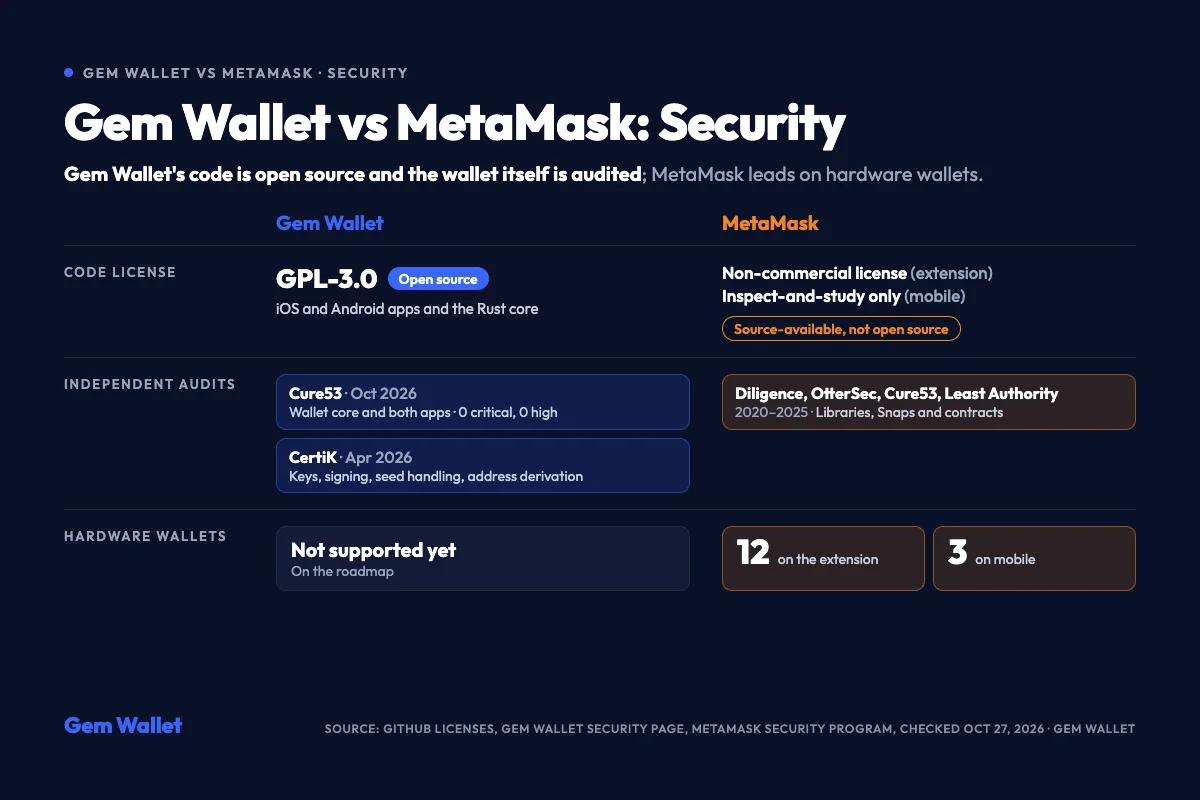 Gem Wallet’s code is open source under GPL-3.0 and the wallet itself was audited by Cure53 and CertiK; MetaMask supports 12 hardware wallets. Source: GitHub licenses, Gem Wallet security page, MetaMask security program, checked 27 October 2026, Gem Wallet
Gem Wallet Security
- Open source under a real open-source license: the iOS and Android apps and the shared Rust core are licensed under GPL-3.0, all on GitHub; anyone may read, build, modify and reuse the code. More on why it matters: open-source crypto wallet.
- Audits of the wallet itself: Cure53 audited the Rust core and both apps in October 2026 and found no critical or high-severity issues; CertiK audited key management, transaction signing, seed handling and address derivation in April 2026. Both reports are public on the security page.
- Key storage: keys are encrypted with AES-256-GCM and the password sits in the iOS Keychain or the Android Keystore.
- Scam checks: HashDit and GoPlus check addresses and contracts before every transaction.
- No incidents: Gem Wallet has had no security breach.
MetaMask Security
- Source-available code: the code is public on GitHub, but the extension license allows non-commercial use only and the mobile license allows only inspecting and studying the code, not reusing it. These are not open-source licenses.
- Audits of components: MetaMask publishes audit reports by Diligence, OtterSec, Cure53 and Least Authority on its libraries, Snaps and contracts, and runs a bug bounty on HackerOne since 2022.
- Hardware wallets: 12 hardware wallets on the extension, including Ledger, Trezor and Keystone, and 3 on mobile, a clear plus for large balances.
- Documented issues: in 2022 MetaMask fixed two extension vulnerabilities with no known exploitation and advised iOS users to turn off iCloud backup of app data. On 1 October 2026 a security incident in MetaMask’s staking infrastructure forced validator exits; MetaMask said there was no indication that wallets or customer funds were affected, CoinDesk reported.
On verifiability Gem Wallet is ahead: an open-source license and audits of the whole wallet. On hardware wallet support MetaMask is ahead.
Popularity, Ratings and Growth
MetaMask is the first-generation wallet of Ethereum: it launched in 2016 and built its audience together with Ethereum, so by size it is far ahead. In 2025 and 2026 it has been adding products beyond the wallet: prediction markets powered by Polymarket, the MetaMask Card, its own mUSD stablecoin and tokenized stocks. Over the same period its install growth slowed, while Gem Wallet, a younger wallet built multi-chain from the start, is growing faster.
- Size: MetaMask reports tens of millions of users and 100M+ downloads, with about 47 million installs on Google Play by AppBrain estimates; Gem Wallet has 1M+ users across all platforms and about 230,000 installs on Google Play.
- Ratings: both wallets are rated 4.5 on Google Play; on the US App Store Gem Wallet has 4.5 and MetaMask 4.7, as of 27 October 2026.
- Growth: MetaMask’s new Google Play installs slowed from about 377,000 in 30 days in May 2026 to about 220,000 in early October, a monthly growth of 0.47%; Gem Wallet grew 4-6% a month over the same months, one of the highest growth rates among large self-custodial wallets, according to AppBrain estimates.
- Swap volume: users have swapped $200M+ in Gem Wallet; MetaMask says its Swaps have powered billions in trade volume.
A large user base means MetaMask is supported almost everywhere in web3; fast growth and high ratings show that Gem Wallet is gaining users at a much higher rate.
Is MetaMask Better Than Gem Wallet?
MetaMask is better than Gem Wallet for some users, and Gem Wallet is the better MetaMask alternative for others. MetaMask is the better choice if:
- You work in a desktop browser: browser dApps connect to its extension directly, with no phone in the loop.
- You sign with a hardware wallet: Ledger, Trezor and 10 more devices connect to MetaMask today.
- You want the largest user base: MetaMask has 10M+ downloads on Google Play and 76,000+ ratings on the US App Store, against 100K+ and 361 for Gem Wallet.
Gem Wallet is the better choice if:
- You manage crypto on your phone and want one app for 100+ blockchains, including Bitcoin, TRON, Zcash and TON, without plugins.
- You swap or stake often: 0.5% instead of 0.875% on swaps, and staking on more networks.
- You want code you can verify: an open-source license and two independent audits of the wallet in 2026.
- You want a wallet that is growing fast: 1M+ users, a 4.5 rating on Google Play and the App Store, and 4-6% monthly growth in 2026.
- You are new to crypto: spam transactions are hidden, the asset search understands how you type, and saved contacts replace copied addresses.
Final Thoughts
MetaMask remains the default wallet of the Ethereum browser and the right tool for desktop dApps and hardware wallets. For everyday crypto on a phone, Gem Wallet gives you more networks, lower fees and code you can check, which is why it wins this comparison. The best way to decide is to try both: import the same recovery phrase into Gem Wallet and MetaMask, see which one fits the way you use crypto, and keep it. Since the phrase works in both, you can switch at any time.
Read more about what a self-custodial wallet is and how to secure your seed phrase.
Disclaimer: This article is for informational and educational purposes only and is not financial or investment advice. Crypto assets are highly volatile, and you can lose all the money you invest. Do your own research and make decisions at your own risk.