

Table of Contents
Gem Wallet and Exodus were both built as multi-chain self-custodial wallets from day one: both hold Bitcoin, Ethereum, Solana, TRON, TON and dozens of other networks under one 12-word phrase, with no account. They part ways on what the user can see and do. Exodus, founded in 2015 and listed on NYSE American, is a desktop and mobile wallet with partly closed code that left web3 in 2026; Gem Wallet is a mobile wallet with open-source code, a published 0.5% swap fee, WalletConnect and perpetual futures.
Gem Wallet vs Exodus: our verdict
For a phone wallet in 2026, Gem Wallet comes out ahead. It publishes its code and its audits, charges a published 0.5% instead of a spread inside the rate, still connects to dApps, stakes TRX and trades Hyperliquid perps. Exodus is ahead at the desk: it has full desktop apps for Windows, macOS and Linux, and Trezor and Ledger support (Ledger on mobile).
Key Takeaways
- Swap cost: Gem Wallet publishes its 0.5% fee; Exodus hides its cost in a spread inside the rate, from 0.5% and varying by pair, so the price of a swap is never shown on its own, as of October 2026.
- Web3: Exodus closed its extension on 1 October 2026 and removed WalletConnect; Gem Wallet connects to dApps through WalletConnect.
- Code: Gem Wallet is open source and audited by CertiK and Cure53 in 2026; Exodus keeps parts of its code closed and has no published audit of the app.
Gem Wallet vs Exodus: Overview
Exodus and Gem Wallet cover similar ground, multi-chain balances, swaps, buying, selling and staking, so the table below is mostly about the details: how a fee is charged, which code is public, which devices are supported. Values as of October 2026.
| Feature | Gem Wallet | Exodus |
|---|---|---|
| Started as | Mobile multi-chain wallet | Desktop wallet |
| Platforms | iOS, Android (Google Play, APK) | Windows, macOS, Linux, iOS, Android |
| Browser extension | No | Discontinued 1 October 2026 |
| Networks | 100+ blockchains | 50+ networks |
| Code | Open source (GPL-3.0) | Partly closed by design |
| Third-party audit of the app | CertiK (April 2026), Cure53 (October 2026) | Not published |
| Recovery phrase | 12 words, BIP-39 | 12 words, BIP-39; non-standard paths for Solana, Cardano, Stellar, Tezos |
| Swap cost | Published fee: 0.5%, 0.25% between stablecoins | Spread in the rate, from 0.5% |
| Swap route | Mostly straight through smart contracts: DEXs and decentralized cross-chain protocols | Crypto sent to third-party providers, half of them centralized instant exchanges |
| dApps (WalletConnect) | Yes | Removed in 2026 |
| NFTs | Yes | Ending 1 December 2026 |
| Staking | ETH, SOL, TRX, BNB, ATOM, SUI, APT and more | ETH, SOL, ADA, ATOM, APT, INJ, KAVA, POL, XTZ |
| Perpetual futures | Hyperliquid | No |
| Prediction markets | No | Polymarket (by region) |
| Tokenized stocks | xStocks and Robinhood Chain stock tokens by swap; stock perps on Hyperliquid | Ondo (by region) |
| Hardware wallets | Not yet, on the roadmap | Trezor (desktop, Safe 7 on mobile), Ledger (mobile) |
| Store ratings | Google Play 4.5, App Store US 4.5 | Google Play 4.5, App Store US 4.6 |
Values checked on 29 October 2026 in the Exodus help center, its investor releases and the Gem Wallet app and docs; sources are linked in each section.
Two Multi-Chain Wallets, Two Starting Points
Exodus began in 2015 as a desktop wallet and still runs as a full app on macOS, Windows and Linux, next to iOS and Android. Exodus Movement is a public company on NYSE American since December 2024 and reports its user numbers every month. Gem Wallet was built for the phone and has only two apps, iOS and Android (Google Play or APK), running on one shared Rust core.
Both share the idea: one app for many networks, keys on your device, no sign-up and no KYC to use the wallet. Here is what each of them shipped in 2025-2026.
Exodus in 2025-2026
- Added: Exodus Pay and the Exodus Card (2026), the XO Cash stablecoin on Solana with MoonPay (May 2026), prediction markets through Polymarket and tokenized stocks through Ondo.
- Removed: the Web3 Wallet browser extension (1 October 2026), WalletConnect and the dApp browser in the mobile app (2026), NFTs (from 1 December 2026), and networks such as Monero and Lightning (August 2025) and Fantom (August 2026).
Gem Wallet in 2025-2026
- Listings: the Solana dApp Store (June 2025) and F-Droid, with reproducible builds to check the app against its open-source code.
- dApps and trading: WalletConnect on Solana (March 2026) and perpetual futures on Hyperliquid (June 2026), later with oil and other markets.
- Swaps: new DEXs such as Raydium and Orca on Solana, DeepBook on Sui (October 2026) and USDT0 swaps across chains.
- Control over fees: a custom network fee on Bitcoin and EVM networks.
- Security: audits by CertiK (April 2026) and Cure53 (October 2026), and HashDit and GoPlus checks before sends, swaps and approvals.
Gem Wallet as an Exodus Alternative: Moving Your Wallet
Gem Wallet is an Exodus alternative for users who lost WalletConnect, the dApp browser or NFT support in Exodus in 2026: the same 12-word recovery phrase imports into Gem Wallet in a minute, and the addresses on EVM networks, Bitcoin SegWit and several other networks stay the same. The table below shows which networks match and what to do with the rest.
Exodus and Gem Wallet both use a 12-word BIP-39 phrase, but a phrase is only half of an address: the derivation path decides which address each network gets. Exodus says itself that it uses non-standard paths on some networks, so another wallet may not show those funds after import, according to its derivation paths article. Comparing that list with the paths in Gem Wallet’s open-source code:
| Network | Exodus | Gem Wallet | Same address |
|---|---|---|---|
| Ethereum, BNB Chain, Base, Arbitrum and other EVM | m/44’/60’/0’/0/0 | m/44’/60’/0’/0/0 | Yes |
| Bitcoin, SegWit (bc1q) | m/84’/0’/0’/0/0 | m/84’/0’/0’/0/0 | Yes |
| Dogecoin | m/44’/3’/0’/0/0 | m/44’/3’/0’/0/0 | Yes |
| Cosmos | m/44’/118’/0’/0/0 | m/44’/118’/0’/0/0 | Yes |
| Sui | m/44’/784’/0’/0’/0' | m/44’/784’/0’/0’/0' | Yes |
| Polkadot | m/44’/354’/0’/0’/0' | m/44’/354’/0’/0’/0' | Yes |
| Solana | m/44’/501’/0’/0/0 | m/44’/501’/0’/0' | No: one level more in Exodus |
| TRON | m/44’/195’/0’/0’/0' | m/44’/195’/0’/0/0 | No: last two levels hardened (’) in Exodus |
| TON | m/44’/607’/0’/0/0 | m/44’/607’/0' | No: two levels more in Exodus |
| XRP | m/44’/144’/0’/0’/0' | m/44’/144’/0’/0/0 | No: last two levels hardened (’) in Exodus |
| Litecoin | m/44’/2’/0’/0/0 | m/84’/2’/0’/0/0 | No: 44’ legacy (L…) in Exodus, 84’ SegWit (ltc1…) in Gem Wallet |
| Zcash | m/44’/133’/0’/0’/0' | m/44’/133’/0’/0/0 | No: last two levels hardened (’) in Exodus |
A path is read level by level, and one character changes the address: an apostrophe (’) marks a hardened level, and 44’ or 84’ at the start sets the address format.
In practice, moving from Exodus to Gem Wallet takes two steps:
- Import the phrase: in Gem Wallet tap Import an Existing Wallet > Multi-Coin and enter the 12 words from Exodus. Your EVM tokens, SegWit bitcoin, DOGE, ATOM, SUI and DOT appear at the same addresses.
- Send the rest: for SOL, TRX, TON, XRP, LTC and ZEC, open the receive address of the same coin in Gem Wallet and send the funds there from Exodus. A Taproot or legacy bitcoin address in Exodus is moved the same way.
Exodus also lets you export the private key of a single asset; Gem Wallet imports a private key on EVM networks, Solana, TRON, XRP and TON, but not on Bitcoin, Litecoin, Dogecoin or Zcash. In the other direction, Exodus Mobile also scans the Solana path Phantom and MetaMask use, which is the one Gem Wallet uses, so a Gem Wallet phrase restored in Exodus Mobile finds your Solana funds if the address has history.
How Swaps Work and What They Cost
Gem Wallet publishes its fee: 0.5% on most swaps, 0.25% between stablecoins on one network, and a few provider-specific rates listed in its docs. Exodus has no separate fee line and earns through a spread built into the quote, which is less transparent: the user does not see what the swap costs. Exodus’s homepage says its rates “start as low as 0.5%”, and its help center adds that the spread is not fixed and changes with liquidity and volatility, according to the Exodus fees article.
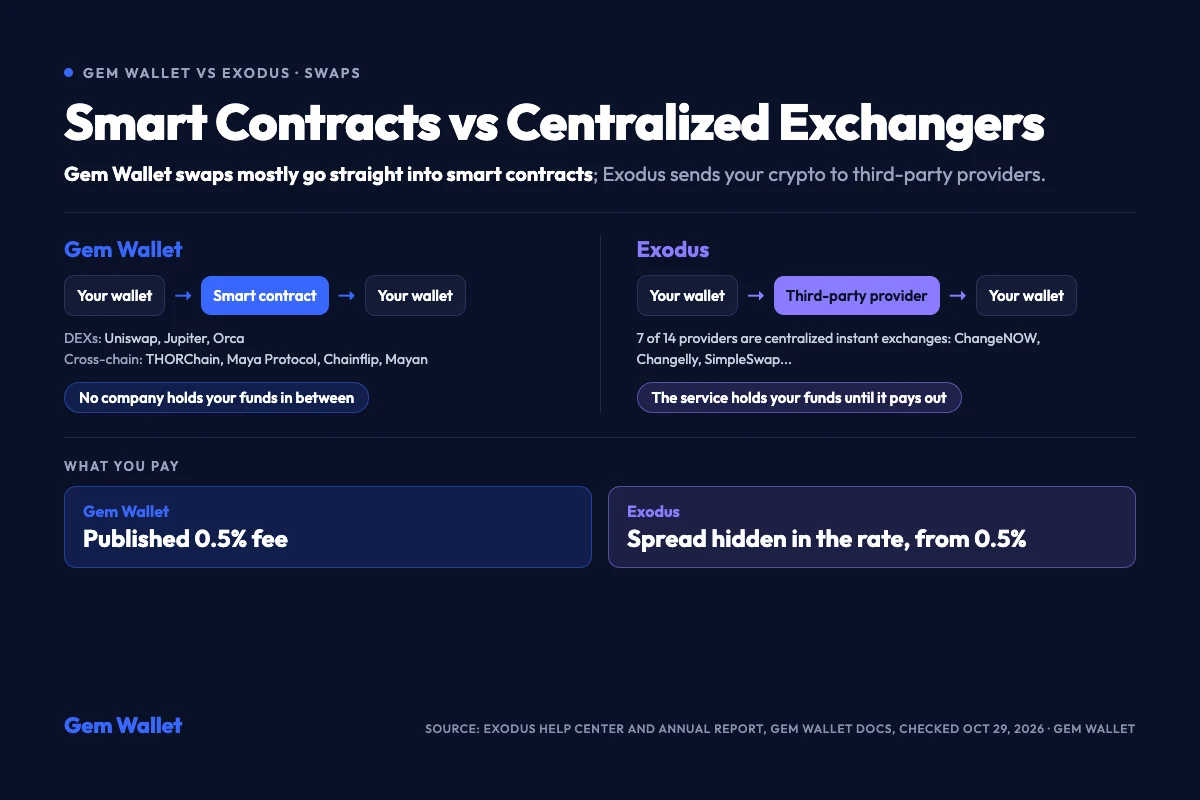 Gem Wallet routes most swaps through smart contracts with a published 0.5% fee; Exodus routes them through third-party providers and builds a spread into the rate. Source: Exodus help center and annual report, Gem Wallet docs, checked 29 October 2026, Gem Wallet
Fee example: on a $1,000 swap Gem Wallet’s fee is $5.00 at the published 0.5%, already included in the quote you confirm. In Exodus the same swap costs at least $5.00 at the lowest stated spread, and more on pairs with a wider spread; the cost is inside the rate, so it can only be seen by comparing the quote with the market price.
The route of a swap differs most, and it decides who holds your crypto during the trade:
- Exodus: through centralized services. Your crypto is sent from the wallet to a third-party swap provider, and the provider sends the result back. Half of the 14 providers named in Exodus’s annual report are centralized instant-exchange services: ChangeNOW, Changelly, ChangeHero, SimpleSwap, Exolix, n.Exchange and Switchain; the rest include DEX aggregators such as 1inch, LI.FI and Jupiter. On a centralized route the service holds your funds until it pays out, under its own rules.
- Gem Wallet: mostly straight through smart contracts. Swaps go from your wallet into the smart contracts of DEXs such as Uniswap, PancakeSwap, Jupiter, Raydium, Orca and STON.fi, and across networks through decentralized protocols such as THORChain, Maya Protocol, Chainflip and Mayan. When a direct on-chain route is within 0.1% of the best quote, Gem Wallet picks it, so that no third-party service stands between your wallet and the trade. The Provider row names the source of each quote, and you can select a swap provider yourself.
- Network fee: in both wallets it goes to the blockchain. Exodus lets you set a custom fee for Bitcoin, Ethereum and ERC20 sends; Gem Wallet lets you choose the speed or set a custom fee on Bitcoin and EVM networks.
For a user who swaps often, a published fee is easier to compare than a spread you have to work out.
Web3 After October 2026: dApps, WalletConnect and NFTs
Exodus is no longer a dApp wallet. Support for the Exodus Web3 Wallet browser extension ended on 1 October 2026, and WalletConnect and the dApp browser are no longer available in Exodus Mobile, according to the Exodus help center, which advises users who need dApps to use a different wallet. NFT support ends on 1 December 2026 on all networks.
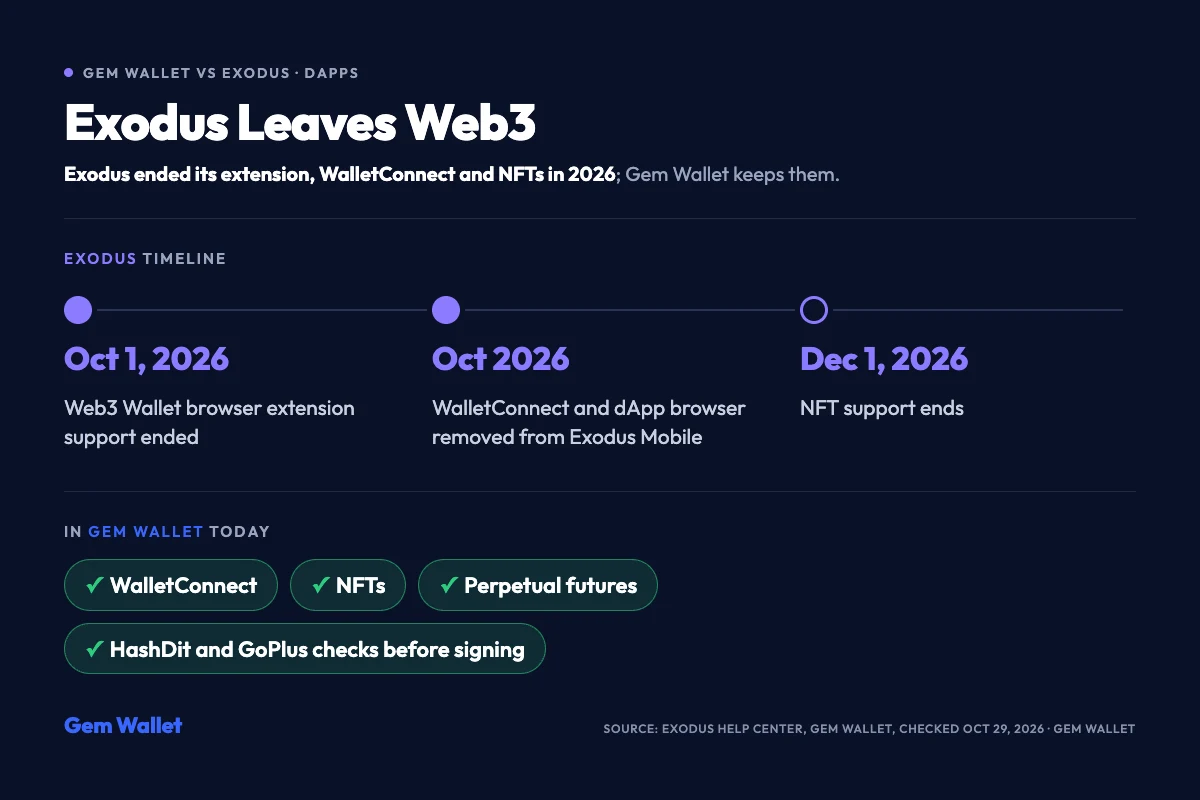 In 2026 Exodus removed its extension, WalletConnect and the dApp browser and is ending NFT support; Gem Wallet keeps all of them. Source: Exodus help center, Gem Wallet, checked 29 October 2026, Gem Wallet
Gem Wallet keeps all three:
- WalletConnect: connect to DeFi apps, NFT marketplaces and other dApps on EVM networks and on Solana by scanning a QR code.
- NFTs: the Collectibles tab shows NFTs on Ethereum, Solana and other networks, and sends and receives them.
- Scam checks before signing: HashDit and GoPlus check addresses and contracts before sends, swaps and approvals.
If you hold NFTs in Exodus, move them before 1 December 2026: send them to your Gem Wallet address on the same network, or import the phrase where the paths match (EVM networks).
Is Exodus Wallet Safe? Closed Code and Open Source
Exodus is self-custodial: the 12-word key is encrypted and stored on your device, and Exodus does not store it. Gem Wallet works the same way. The difference is how much of each wallet can be checked from outside.
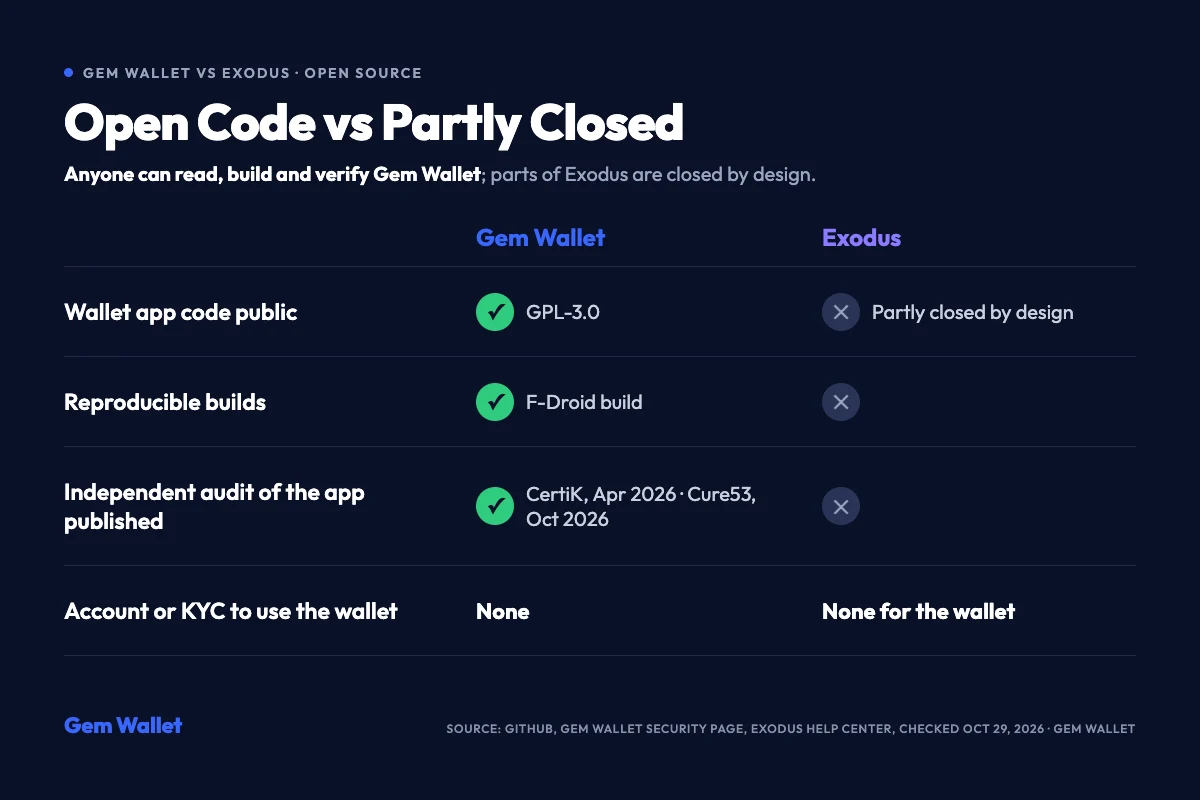 Gem Wallet’s code is public under GPL-3.0, its F-Droid build is reproducible, and CertiK and Cure53 audits are published; parts of Exodus are closed by design. Source: GitHub, Gem Wallet security page, Exodus help center, checked 29 October 2026, Gem Wallet
Exodus Security
- Partly closed code: Exodus states that some components are not open source, on purpose, to make fake copies of the wallet harder, according to its open-source article. Its GitHub holds libraries and tools, not the wallet apps. For the user, the closed part is a black box: neither its security nor what it does with keys and data can be checked from outside.
- Audits: no third-party audit of the desktop or mobile app is published; Exodus describes in-house reviews of its open-source dependencies.
- Bug bounty: a program on HackerOne.
- Login: a password on desktop and the device lock or biometrics on mobile; Exodus has no traditional 2FA. On mobile the encrypted key can be backed up with a passkey in iCloud or Google.
Gem Wallet Security
- Open source: both mobile apps and the Rust core are public under GPL-3.0 on GitHub, so anyone can read and build them. See open-source crypto wallet.
- Two audits in 2026: CertiK reviewed key management, signing and seed handling in April, and Cure53 the core and both apps in October, with no critical or high-severity issues; both reports are on the security page.
- Key storage: keys are encrypted on the device, with the password in the iOS Keychain or the Android Keystore.
- Spam filter: the tiny spam transactions used for address poisoning are hidden, so a look-alike address is not there to copy.
Exodus’s long track record is a point in its favour; Gem Wallet’s is that its code and its audits are public.
Networks, Staking and USDT
Exodus supports 50+ networks according to its help center, and has been trimming the list: Monero and Lightning in August 2025, Zilliqa in November 2025, Axelar in June 2026, EOS and Fantom in August 2026, per its asset sunset page. Gem Wallet runs 100+ blockchains, including NEAR, which Exodus lists only as a token on Ethereum, and lets you add custom tokens and your own node.
Staking is where the lists differ most:
- Gem Wallet: staking on ETH, SOL, TRX, BNB, ATOM, SUI, APT, SEI, INJ and more.
- Exodus: ETH, SOL, ADA, ATOM, APT, INJ, KAVA, POL and XTZ through Everstake, with some jurisdictions and addresses excluded.
- TRX: Exodus does not list TRX staking. In Gem Wallet staked TRX also brings the energy that pays for USDT transfers on TRON.
Both wallets hold USDT on TRON, TON, Ethereum, Solana and BNB Chain. Gem Wallet holds official USDT on 14 networks plus USDT0; Exodus lists USDT on 12 networks. For TRON it also helps with the network fee: any coin can be swapped into TRX, and USDT into TRX through the built-in SunSwap.
Trading and Payments
Exodus and Gem Wallet have each added a different kind of market to the wallet:
- Perpetual futures: Gem Wallet trades perps on Hyperliquid with stop loss and take profit and markets such as oil; the total fee is at most 0.09% taker and 0.06% maker. Exodus has no perps.
- Prediction markets: Exodus Predictions on mobile, with a balance in Polymarket USD. Gem Wallet has none.
- Tokenized stocks: Exodus Markets, Ondo tokenized stocks on Solana in permitted jurisdictions. Gem Wallet has them too: xStocks and the stock tokens of Robinhood Chain are bought with a regular swap, and Hyperliquid perps in Gem Wallet cover stocks, gold and oil.
- Spending: Exodus Pay, launched in April 2026, with the Exodus Card for Visa and Mastercard merchants in a list of countries; identity verification is required for these features. Gem Wallet has no card.
Buying and Selling Crypto
Both wallets buy crypto through third-party providers that run their own identity checks. Exodus lists XO Ramp, MoonPay, Banxa, PayPal, Ramp Network, Robinhood Connect and others by location, and sells crypto through MoonPay for USD, EUR or GBP. Gem Wallet works with MoonPay, Banxa, Mercuryo and others, shows the best rate among them, and lets you sell crypto through off-ramp providers in the app.
Desktop and Hardware Wallets
Exodus has two advantages Gem Wallet does not match today:
- Desktop apps: full wallets for Windows, macOS and Linux. Gem Wallet has no desktop app yet; one is in development.
- Hardware wallets: Trezor on desktop (Model T, One, Safe 3, Safe 5, Safe 7) and on mobile (Safe 7 over Bluetooth), and Ledger Nano X and Flex on mobile. Gem Wallet does not support hardware wallets yet; it is on the roadmap.
If your crypto sits on a Trezor or you manage it from a laptop, these points decide the choice in favour of Exodus.
Users and Ratings
Exodus reported 1.4 million monthly active users on 30 September 2026 and 19.2 million downloads by the end of 2025. Its apps are rated 4.6 on the US App Store from 37,768 ratings and 4.5 on Google Play from 133,000 reviews. Gem Wallet has 1M+ installs across all platforms and is rated 4.5 on both stores, from 361 ratings and 4,300 reviews, as of October 2026.
Is Exodus Better Than Gem Wallet?
Exodus is the better choice if:
- You manage crypto on a computer: Exodus has desktop apps for Windows, macOS and Linux today; Gem Wallet’s desktop app is still in development.
- You keep savings on a Trezor or Ledger: both connect to Exodus.
- You want payments or prediction markets in the same app, where available.
- You want a company with public reports: Exodus files with the SEC and publishes monthly user numbers.
Gem Wallet is the better choice if privacy and control come first:
- You want to verify the app yourself: the whole code is open, and with reproducible builds anyone can build the F-Droid app from that code and check that it matches the one they run. Two independent audits in 2026 back it up.
- You want swaps without a middleman: Gem Wallet sends most swaps straight into DEX smart contracts and decentralized cross-chain protocols, not through centralized exchange services, and lets you pick the provider yourself.
- You want to know the fee: a published 0.5%, not a spread hidden in the rate.
- You use dApps, perps or TRX staking, or keep NFTs: Gem Wallet has all of them; Exodus has no dApps, perps or TRX staking, and its NFT support ends on 1 December 2026.
Final Thoughts
Exodus and Gem Wallet both promise one wallet for many coins, and they keep that promise differently in 2026. Exodus is the pick for the desktop and the hardware wallet. Gem Wallet is the pick for privacy and verifiability: open, reproducible code, swaps that go straight to smart contracts, a fee you can see and dApps that still work. The 12-word phrase you already have opens your EVM, Bitcoin SegWit and several other addresses in Gem Wallet in a minute, so you can try it without closing Exodus.
More comparisons: Gem Wallet vs MetaMask.
Disclaimer: This article is for informational and educational purposes only and is not financial or investment advice. Crypto assets are highly volatile, and you can lose all the money you invest. Do your own research and make decisions at your own risk.