

Table of Contents
Binance is closing accounts in Spain on December 31, 2026: the exchange has no MiCA authorization, and from November 29 it takes at least 10 USDC a month from the remaining balance. So which Binance alternative suits your crypto best today? It is Gem Wallet - a self-custody crypto wallet with 100% open-source code, where your coins are stored securely and privately, and only you hold the keys to them.
Key Takeaways
- The Fee in Euros: The minimum 10 USDC at the CoinGecko rate on November 20, 2026, is about €9.10 a month, and on a €200 account two charges take 9% of the balance.
- The Percentage Threshold: By Gem Wallet’s calculation, the 0.025% rate exceeds the 10 USDC minimum only on accounts above €36,400, so everyone with less pays the same.
- Where Clients Go: According to Binance co-CEO Richard Teng, 70% of the funds that EU clients withdrew from the exchange went to self-custody wallets.
Open this article in
 ChatGPT
 Gemini
 Grok
 Perplexity
What Is Happening With Binance in Spain
Binance in Spain is closing client accounts on December 31, 2026. A Binance spokesperson confirmed the date to CoinDesk on November 7 (according to crypto.news):
“Affected accounts will be closed with effect from 31 December 2026.” - Binance spokesperson, November 2026
According to the Spanish portal Rankia, as of November 17, 2026, clients received closure emails in four countries where Binance has a local company: Spain, France, Italy, and Poland.
On November 9, 2026, the Spanish outlet Merca2 summarized the terms for Spanish accounts based on emails that clients shared on social media:
- Deposits: You can no longer top up a Binance account.
- Withdrawals: Crypto and euros can be withdrawn until the account closes, euros - to the client’s bank account.
- Fee: 0.025% of the balance per month or 10 USDC, whichever is greater; the first charge comes within three days after November 29, the second - after December 24.
- After Closure: Binance will treat an account that still holds assets as inactive.
Binance did not reopen withdrawals for all coins at once: according to Rankia, as of November 8, 2026, Litecoin and NEAR still could not be withdrawn. While a coin cannot be withdrawn, the account is not empty, and Binance will charge the monthly fee on it too.
In Spain, compliance with MiCA, the European Markets in Crypto-Assets regulation, is overseen by the National Securities Market Commission (Comisión Nacional del Mercado de Valores, CNMV). The transition period for platforms that operated before the regulation ended on July 1, 2026.
How Much Binance Takes From Your Balance in Spain
Binance takes at least 10 USDC a month from a Spanish account - about €9.10 at the CoinGecko rate on November 20, 2026, and about €18.20 over the two charges before closure.
The 0.025% rate exceeds the minimum only on accounts above €36,400 (Gem Wallet’s calculation: 10 USDC ÷ 0.025% = 40,000 USDC), so everyone with less pays the same amount regardless of account size.
The table below shows the losses of a Spanish account for balances from €50 to €50,000 at the CoinGecko rate on November 20, 2026: how much Binance takes after November 29, the total by closure, and what share of the balance that is, in euros and percent.
| Balance on Binance | Charge After Nov 29 | Total by Dec 31 | Loss, % |
|---|---|---|---|
| €50 | €9.10 | €18.20 | 36% |
| €200 | €9.10 | €18.20 | 9% |
| €1,000 | €9.10 | €18.20 | 1.8% |
| €5,000 | €9.10 | €18.20 | 0.36% |
| €50,000 | €12.50 | €25 | 0.05% |
According to the client emails summarized by Merca2, Binance charges the fee first in USDC, and in other coins if there is not enough USDC. A balance below 3 USDC can no longer be withdrawn via BNB Chain, because it is under Binance’s withdrawal minimum (data as of November 20, 2026), so small amounts are better withdrawn together with the main part.
What MiCA Means for Binance in Spain
For a Binance client in Spain, MiCA means that since July 1, 2026, they have been using a platform without authorization from the Spanish or any other European regulator. On its MiCA regulation page, CNMV warns that clients of such platforms are left without the regulation’s protection and supervision:
“No contarán con los mecanismos de protección y supervisión que ofrece el Reglamento MiCA.” - CNMV, MiCA regulation page
In a statement dated June 15, 2026, CNMV required unauthorized providers to prepare a client migration plan with a reasonable withdrawal period. As summarized by Funds Society, such a plan is needed so that clients can move their crypto-assets to other addresses and their money to cash accounts. Before trusting a new platform with your money, CNMV advises checking its authorization in the ESMA and CNMV registers.
Binance is not on the list of authorized providers: in June 2026, the exchange withdrew its MiCA license application in Greece. What this changed for clients across the EU is covered in the article “Binance Is Leaving the EU After MiCA”.
Where EU clients move their funds from Binance was shared by the exchange’s co-CEO Richard Teng at the Reuters NEXT Asia conference in Singapore, according to Cointelegraph on July 9, 2026:
“70% of those funds went to self-hosted wallets. Only 30% flowed to MiCA-regulated entities.” - Richard Teng, co-CEO of Binance
Why MiCA Does Not Apply to a Self-Custody Wallet
The MiCA regulation does not apply to self-custody wallets: recital 83 of MiCA explicitly excludes providers of hardware and software wallets where the keys stay with the user. MiCA authorization is required for crypto-asset service providers (CASPs) - those who hold clients’ coins and transfer them on the client’s behalf, like Binance.
That is why a self-custody wallet is more reliable than an exchange account: your coins are not held by a company but on the blockchain, at an address whose key only you have. Nobody can close such a wallet or charge a storage fee on it - neither because of a license nor because of leaving a country. Your crypto is safe and available to you at any moment.
Which Binance Alternative to Choose in Spain in 2027
The best Binance alternative in Spain in 2027 is Gem Wallet, a self-custody mobile crypto wallet for iOS and Android: storing, swapping, staking, buying, and selling for euros in one app. How such a wallet works is explained in the article “What Is a Self-Custody Wallet”.
Here is what Gem Wallet gives to anyone leaving Binance:
- Keys Only With You: The private key is created on your phone and never leaves it, so there is nothing Gem Wallet could use to block your coins or wallet - your crypto stays under your control, securely and privately.
- 100% Open Source: All of Gem Wallet’s code is open on GitHub: you can read every line that signs your transfers yourself. Independent code audits were carried out by CertiK (April 2026) and Cure53 (report dated October 2026).
- Privacy by Default: Gem Wallet opens without registration - creating a wallet needs no email, phone number, passport, or selfie.
- Multichain: More than 100 blockchains in one app (November 2026) - BTC, ETH, SOL, USDC, and USDT on different networks sit side by side, with no separate wallet for each network.
- Built-In DEX Aggregator: Swaps happen right in the wallet, on-chain and cross-chain: for example, BNB to USDC within BNB Chain or BTC to ETH between networks, and the best rate is found among THORChain, Chainflip, and other top DEX providers.
- Staking Instead of Earn: Instead of Binance Earn products, you can stake SOL, TRX, and other coins directly on the network - rewards arrive at your address, and your coins never go to an exchange.
- Perpetual Futures: Perps on Hyperliquid are available to users in Spain 24/7 - you can go long or short on Tesla, Nvidia, and Apple stocks, gold, oil, and crypto.
- Selling for Euros: Supported coins can be sold in Spain through Mercuryo, MoonPay, Transak, and Paybis: the coins go to the provider via a blockchain transfer, and the provider pays out euros by the method you choose.
- Buying for Euros: You can buy crypto in Spain with a credit card, Apple Pay, or Google Pay from Mercuryo, MoonPay, Banxa, and other providers - the app picks those available for your amount.
- Simple and Clear Interface: Gem Wallet is a native app for iOS and Android where sending, swapping, and staking are clear from the first launch, even if you have only used an exchange before.
Important: You are responsible for keeping your secret phrase safe, so never store it in notes or screenshots and never send it to anyone.
How to Withdraw Crypto From Binance to a Self-Custody Wallet
Coins move from Binance to Gem Wallet in three steps.
Step 1. Create a Wallet
Install Gem Wallet, create a new wallet, and write down the 12-word secret phrase on paper - it is what restores the wallet on a new phone.
Step 2. Copy the Address
Open the coin you need in Gem Wallet, tap “Receive”, and copy the address. In the Binance app, choose the same network as in the wallet, for example Ethereum (ERC20) for USDC, and after pasting check the first and last 4-6 characters of the address.
Step 3. Send a Test Amount
Withdraw a small amount from Binance: withdrawing USDC via Ethereum costs 1 USDC with a 5 USDC minimum (Binance data as of November 20, 2026). Once it arrives in the wallet, withdraw the rest. Binance screens step by step are collected in the guide “How to Withdraw Crypto From Binance”.
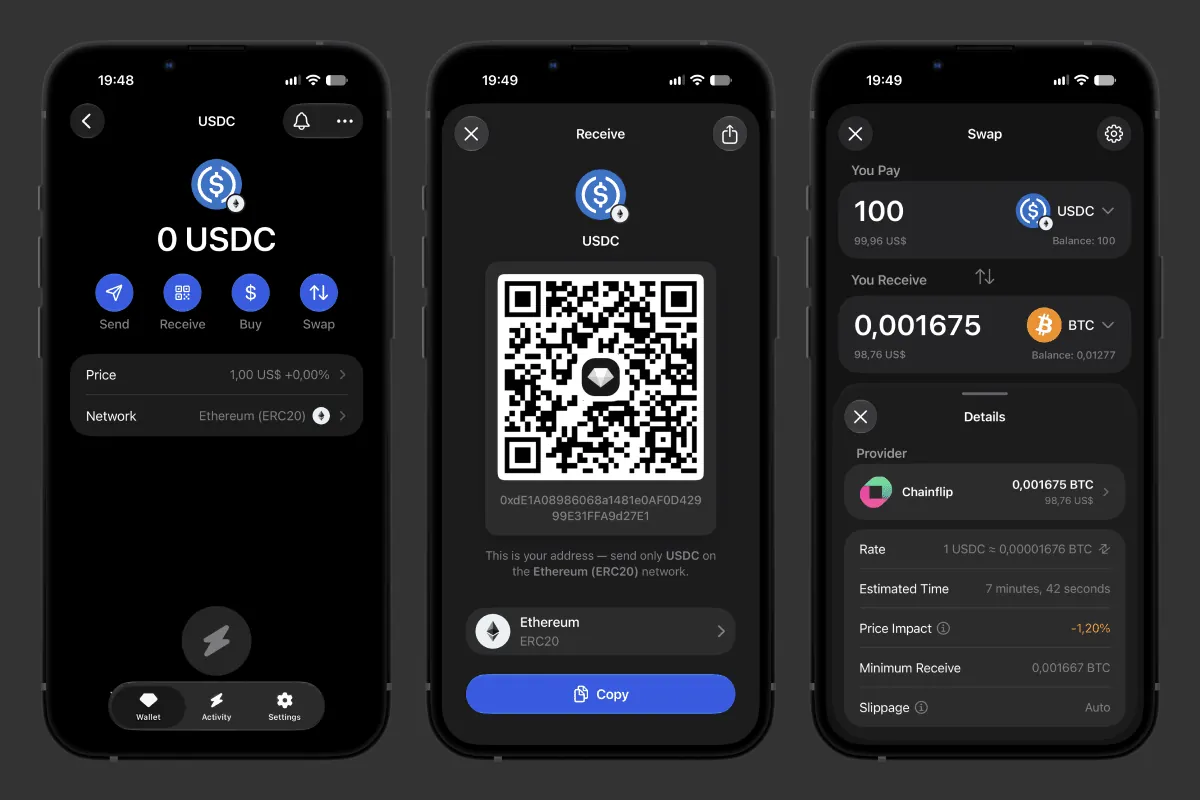 Receiving USDC on Ethereum and swapping it for BTC in Gem Wallet.
Until November 29, you pay Binance only the withdrawal fee, and after that - the monthly charge as well, until the closure on December 31. Don’t put it off: welcome 2027 with your crypto at your own address on the blockchain - securely and privately.
Disclaimer: This article is for informational and educational purposes only and is not financial or investment advice. Crypto assets are highly volatile, and you can lose all the money you invest. Do your own research and make decisions at your own risk.