# Best Ethereum Wallet in 2027: Top 7 ETH Wallets Compared
> Which Ethereum Wallet to choose in 2027? We compared 7: who charges 0.25% to swap, why a USDT transfer can use 37% more gas, and whose code is 100% open.
The best Ethereum Wallet opens the whole Ethereum ecosystem from one address: in it you store ETH and stablecoins, swap tokens, earn staking rewards, and use dApps, while the keys stay only with you. We compared seven popular wallets on security, fees, ETH staking, and open-source code using November 2026 data, and Gem Wallet took first place.
> **Key Takeaways**
>
> - **USDT to an Address Without USDT Takes 37% More Gas:** A USDT transfer to a recipient who does not hold USDT yet uses 63,209 gas units instead of 46,109, and at the peak gas price any action costs almost 12 times more than usual (Gem Wallet calculation based on transactions from November 16, 2026).
> - **Gem Wallet Is First in the Ranking:** It is the only one of the seven wallets whose entire code is published under the free GPL-3.0 license. The same app on your phone has ETH staking, token swaps, and buying ETH with a credit card.
> - **Ethereum Holds Almost Half of All Stablecoins:** The Ethereum network has $130.68 billion of stablecoins out of $283.05 billion, or 46.2%, and it also accounts for 53% of the funds in DeFi (DefiLlama, November 16, 2026).
## What Is an Ethereum Wallet?
An Ethereum Wallet is a phone app, browser extension, or hardware device that stores the key to your address on the Ethereum network and signs transfers and in-app actions with it. The address starts with 0x, and the balances are recorded not in the wallet but on the [Ethereum blockchain](https://gemwallet.com/learn/what-is-the-ethereum-blockchain/): the key only proves that you alone can manage them.
### What Assets an Ethereum Wallet Holds
An Ethereum Wallet holds three kinds of assets at one address:
- **[ETH](https://gemwallet.com/ethereum-wallet/):** The network's coin, used to pay for gas - the fee for every transfer, swap, and approval.
- **[ERC20 Tokens](https://gemwallet.com/erc20-wallet/):** USDT, USDC, and thousands of other tokens, each with its own smart contract.
- **[NFTs](https://gemwallet.com/nft-wallet/):** Tokens of the ERC721 and ERC1155 standards, including ENS names like name.eth.
The same 0x address also works on layer 2 (L2) networks - Arbitrum, Base, Optimism, and others - but each network has its own balance. How one address serves several networks at once is explained in the article ["What Is an EVM Wallet"](https://gemwallet.com/learn/what-is-an-evm-wallet-and-how-one-address-works-across-ethereum-networks/).
### How the Ethereum Network Fee Is Calculated
The Ethereum network fee depends on the complexity of the action, not on the amount: a standard ETH transfer from one address to another uses 21,000 gas units, and a token swap on a decentralized exchange uses more than 100,000. Under the EIP-1559 mechanism, the price of a gas unit is made up of the Base fee, which the network sets for every block, and the Priority fee - a tip to the validator for speed.
*Gas is the unit of computational work on the Ethereum network; the gas price is measured in gwei, billionths of an ETH. The EVM (Ethereum Virtual Machine) is the environment that runs the smart contracts of Ethereum and compatible networks.*
## Hot vs Cold Ethereum Wallet
A hot Ethereum Wallet signs transactions on a phone or computer connected to the internet, while a cold Ethereum Wallet signs them on a separate device where the key never goes online. You reach dApps, token swaps, and staking through a hot wallet, and a cold one guards what sits untouched. The general differences between the two types are covered in the article ["Hot Wallet vs Cold Wallet"](https://gemwallet.com/learn/hot-wallet-vs-cold-wallet/).
### Hot Ethereum Wallet
A hot Ethereum Wallet is a mobile app, browser extension, desktop program, or exchange account where the key sits on a device or server with internet access. Every connection to a dApp ends with a signature: one signature can send ETH, and another can give someone else's contract the right to spend your tokens.
#### Custodial Ethereum Wallet
A custodial Ethereum Wallet is an exchange account where the key to the address with your ETH belongs to the exchange, not to you, and the account requires identity verification with documents (KYC). On October 29, 2026, assets worth about $6.3 billion were withdrawn from the hot wallets of the Binance exchange on several networks (Binance statement of October 30, 2026), and on February 21, 2025, about $1.5 billion in ETH was withdrawn from a wallet of the Bybit exchange (FBI estimate). In both cases the keys were held by the exchange, not by its customers.
#### Self-Custody Ethereum Wallet
A [self-custody](https://gemwallet.com/self-custody-wallet/) Ethereum Wallet is a wallet where the key is created on your device and never leaves it. The developer can neither freeze your ETH and tokens nor sign a dApp approval for you, but no one except you can restore the secret phrase either.
### Cold Ethereum Wallet
A cold Ethereum Wallet is a hardware device like Ledger: the key is created and signs inside it, and only the signed transaction goes to the phone or computer. The device costs money and asks you to confirm every action with a button, and for staking, swaps, and dApps it needs a companion app or a hot wallet, so a cold wallet is chosen for savings.
## Best Ethereum Wallets Compared
We compared seven Ethereum Wallets by type, networks, platforms, and open-source code - the result is in the table below: six of them are hot and one is cold, and four have a browser extension (help centers, websites, GitHub, and app stores, November 2026).
| Wallet | Type | Networks | Platforms | Open-Source Code | Best For |
|---|---|---|---|---|---|
| Gem Wallet | Hot | Ethereum + 100+ networks | iOS, Android | 100% | ETH, tokens, swaps, staking, and dApps on your phone |
| MetaMask | Hot | Ethereum, EVM networks, Bitcoin, Solana, TRON, Stellar | iOS, Android, extension | Readable, non-free license | dApps in the browser |
| Rabby Wallet | Hot | EVM networks only | iOS, Android, extension, desktop | Extension - MIT, mobile unlicensed | DeFi and approval control |
| Trust Wallet | Hot | Ethereum + 100+ networks | iOS, Android, extension | Partial (library) | Many networks and gas in tokens |
| Coinbase Wallet | Hot | 12 networks, including Bitcoin and Solana | iOS, Android, extension, web | Not published | Those with a Coinbase account |
| Exodus | Hot | 50+ networks | Windows, macOS, Linux, iOS, Android | Partial | A portfolio on desktop |
| Ledger | Cold | 100+ networks | Device + Ledger Wallet | App - MIT, device OS partial | Long-term ETH storage |
Any of the seven wallets can be created without KYC: identity verification appears only with buy and sell providers.
Ethereum Wallets differ most in staking, gas, and approvals for [dApps](https://gemwallet.com/dapp-wallet/). In the second table we compared the same wallets on ETH staking, the wallet's swap fee (among those that publish it, from 0.25% to 1%), paying for gas without ETH, manual network fee settings, and revoking approvals (wallet help centers and documentation, November 2026).
| Wallet | ETH Staking | Wallet Swap Fee | Gas Without ETH | Custom Network Fee | Revoking Approvals |
|---|---|---|---|---|---|
| Gem Wallet | Pool | 0.25-0.7%, usually 0.5% | No | Base fee and Priority fee | In an external service |
| MetaMask | Pool, validator (from 32 ETH), liquid | 0.875% | Swaps and transfers | Gas limit, Max fee, Priority fee | Via MetaMask Portfolio |
| Rabby Wallet | Not described in the help center | 0.25% | GasAccount | Gas price | Built in, bulk |
| Trust Wallet | Pool, new deposits paused | Not published | FlexGas: TWT, USDT, USDC | Yes | In the extension |
| Coinbase Wallet | Not described in the help center | Up to 1% | Swaps on Ethereum and Polygon | Not described in the help center | In settings |
| Exodus | Pool (from 0.1 ETH), mobile only | Spread, from 0.5% | No | Slider | Not described in the help center |
| Ledger | Liquid, pool, validator (from 32 ETH) | Not published | Some swaps | Three speeds | Not described in the help center |
## Top 7 Ethereum Wallets in 2027
Gem Wallet ranks first among Ethereum Wallets: buying, swapping, staking, and a check before signing are gathered in a mobile app whose code is fully open. It is followed by wallets built for dApps - MetaMask and Rabby Wallet - then the multichain wallets Trust Wallet and Coinbase Wallet, and then Exodus, which does not connect to dApps. The cold Ledger closes the list: it is a device for storage, not for everyday use. All seven features in the matrix below are fully available only in Gem Wallet.
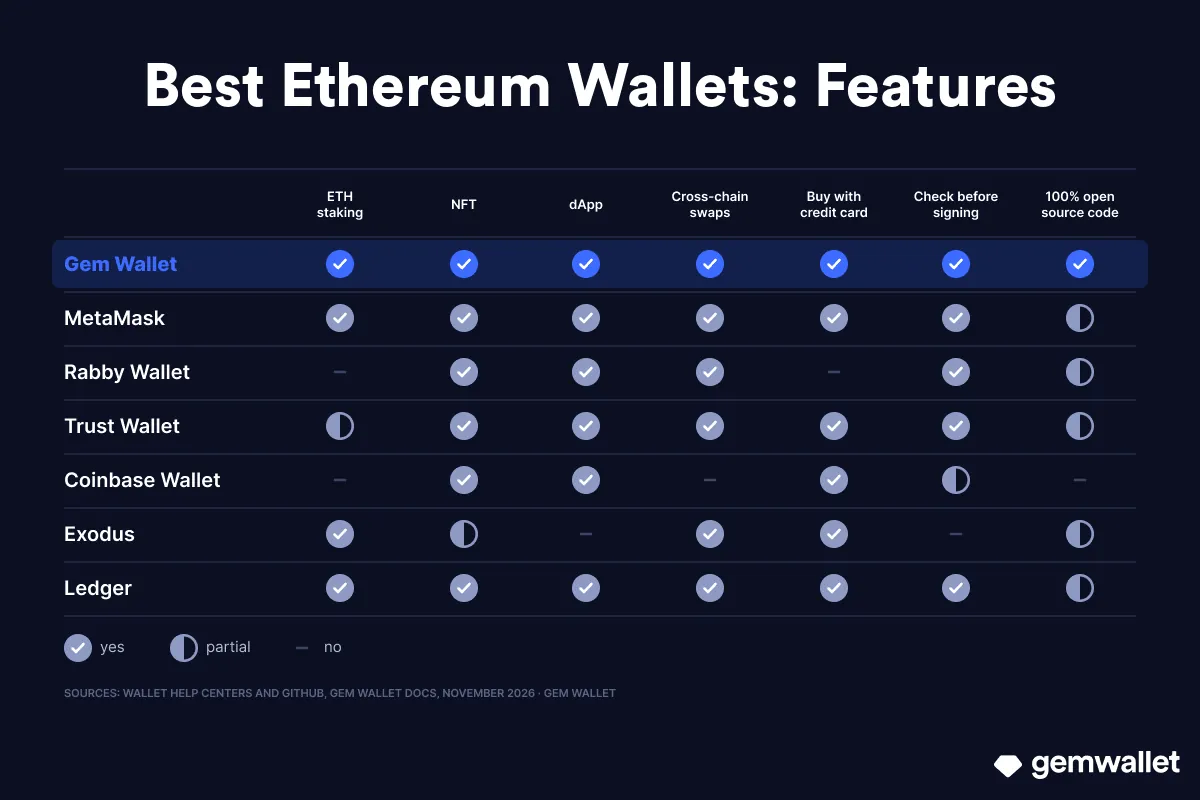
*What the Ethereum Wallets in this list can do: from ETH staking to open-source code. Source: Gem Wallet*
### 1. Gem Wallet - Ethereum, L2, and 100+ Networks in One App
Gem Wallet is a self-custody mobile wallet with fully open-source code that holds ETH, ERC20 tokens, and Ethereum NFTs, as well as assets of 100+ other networks. The same 0x address works on the L2 networks - [Arbitrum](https://gemwallet.com/arbitrum-wallet/), [Base](https://gemwallet.com/base-wallet/), Optimism, Linea, and ZKsync.
**Strengths:**
- **Self-Custody Wallet:** The secret phrase is created and stored only on your phone, and neither the Gem Wallet team nor any third party has access to it.
- **100% Open-Source Code:** The apps for iOS and Android have fully [open-source code](https://gemwallet.com/open-source-crypto-wallet/): it is published on GitHub under the GPL-3.0 license, and the wallet's security was audited in 2026 by CertiK (April) and Cure53 (October).
- **No Sign-Up and No KYC:** The wallet does not ask for an email, phone number, or documents and does not run identity verification.
- **Built-In DEX Aggregator:** You can [swap](https://gemwallet.com/swap/) ETH and ERC20 tokens into BTC, BNB, USDT, and other assets - within the Ethereum network via Uniswap and PancakeSwap and cross-chain via Chainflip, THORChain, Relay, and other providers. The wallet's fee is already included in the rate: 0.5% for most swaps, 0.25% between stablecoins on the same network, 0.45% via Chainflip, and 0.7% via OKX DEX (Gem Wallet documentation, November 2026).
- **ETH Staking in the App:** The wallet sends ETH to [staking](https://gemwallet.com/ethereum-staking/) through the Everstake pool, withdrawal takes from 3 days, and the same app offers staking of SOL, TRX, BNB, and other coins.
- **ETH With a Credit Card:** You can [buy ETH](https://gemwallet.com/buy-ethereum/) right in the app with a credit card or Apple Pay via Mercuryo, MoonPay, Transak, and other providers, and [sell](https://gemwallet.com/sell-crypto/) it where the app's providers work with your country.
- **A Check Before You Sign:** The wallet checks the address, token, and dApp website through HashDit and GoPlus, and the confirmation screen shows the expected balance change and the approval: the token, the spender, and the amount.
- **Custom Network Fee:** On the Ethereum network you can set a [custom network fee](https://gemwallet.com/learn/gem-wallet-adds-custom-network-fees-on-evm-chains-set-your-own-base-and-priority-fee/) - the Base fee and Priority fee in gwei - and the total is recalculated on screen before you sign.
- **NFTs and dApps:** Gem Wallet supports Ethereum NFTs of the ERC721 and ERC1155 standards and connects securely to Uniswap, OpenSea, and other dApps via WalletConnect.
**Limitations:**
- **Phone Only:** Gem Wallet has apps for iOS and Android, but no browser extension and no desktop version.
- **No Hardware Wallets:** You cannot sign Gem Wallet transactions with a Ledger or Trezor yet.
- **Network Fee Only in ETH:** Under the Ethereum network rules the fee is paid in the native coin, and Gem Wallet cannot pay it with a token.
- **No Approvals List:** The app does not show granted approvals; you revoke them in an external service by connecting the wallet via WalletConnect.
**Best For:** Secure and private everyday use of ETH, tokens, and dApps in the Ethereum ecosystem, when the wallet is always on your phone and your assets are accessible 24/7.
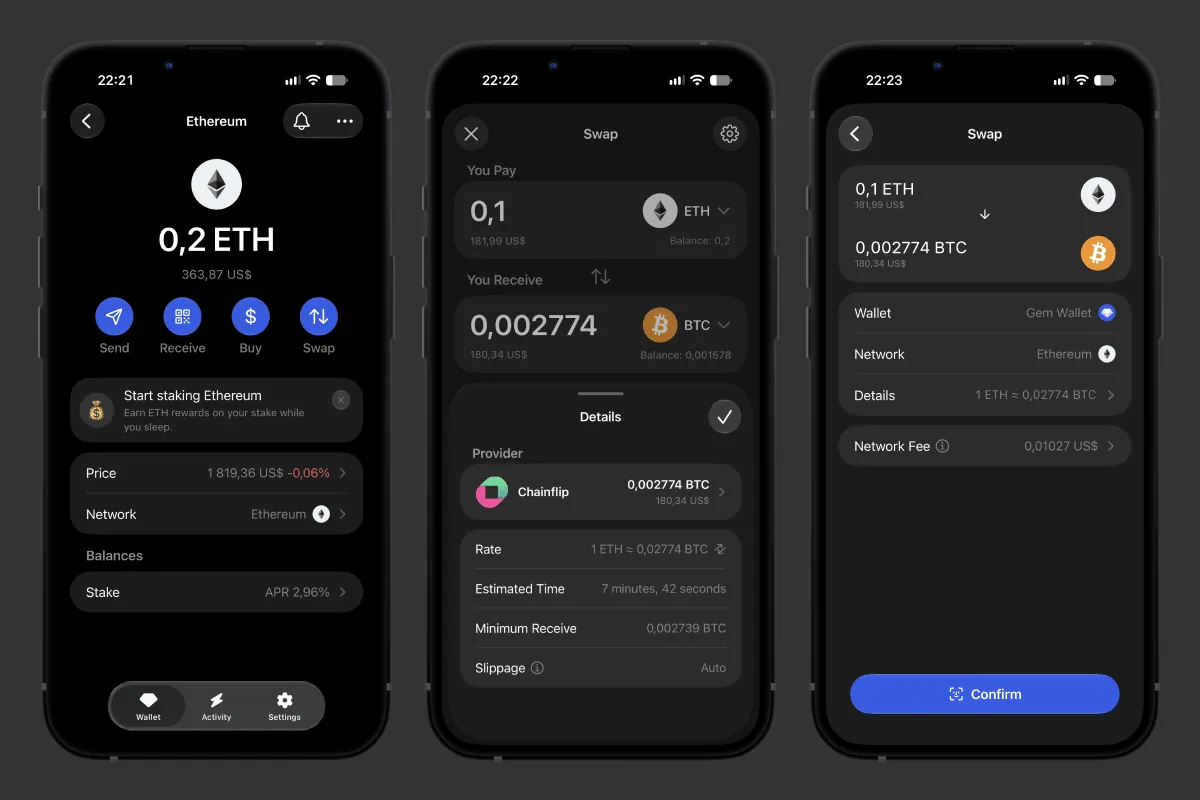
*Swapping ETH to BTC in Gem Wallet*
### 2. MetaMask - An Extension Wallet for dApps
MetaMask is a self-custody wallet by Consensys for the browser and phone; the first commit to its code appeared on July 31, 2015, the day after Ethereum launched. Besides EVM networks, MetaMask works with Solana and Bitcoin, since January 2026 with TRON, and since October 2026 with Stellar. See the full comparison in the article ["Gem Wallet vs MetaMask"](https://gemwallet.com/learn/gem-wallet-vs-metamask/).
**Strengths:**
- **Fine-Tuned Network Fee:** Besides three preset speeds, MetaMask lets you manually set the gas limit, Max fee, and Priority fee and save the settings for a network.
- **Gas Without ETH:** In a swap the network fee is taken from the token you are swapping, and for transfers and dApp actions on the Ethereum network you can pay it with another token for a small MetaMask fee.
- **Three Kinds of ETH Staking:** A pool with no minimum amount, your own validator for amounts in multiples of 32 ETH, and liquid staking through third-party protocols.
- **12 Hardware Wallets:** The extension works with Ledger, Trezor, Lattice, and nine air-gapped wallets, and the mobile app with Keystone, Ledger, and NGRAVE ZERO.
**Limitations:**
- **0.875% Fee:** That is what MetaMask charges both for a swap on one network and for a cross-chain swap (MetaMask help center, November 2026).
- **Non-Free License:** The code can be read on GitHub, but the extension's license allows only non-commercial use, and the app's license allows viewing only.
**Best For:** Those who use dApps in the browser and want to manage gas and a hardware wallet by hand.
### 3. Rabby Wallet - A Wallet for DeFi on EVM Networks
Rabby Wallet is a self-custody wallet from the DeBank team for Ethereum and EVM networks only; its repository was created on GitHub on April 9, 2021. If a website offers to connect only MetaMask, Rabby Wallet can present itself as MetaMask and connect on its own.
**Strengths:**
- **Simulation and Risk Blocking:** Rabby Wallet shows how a transaction will change your balance, and when it finds a risk it disables the sign button until you confirm that you have seen the warning.
- **Bulk Approval Revoking:** A built-in screen shows all granted approvals and revokes several at once, including EIP-7702 delegations - rights that a regular address hands over to a smart contract (available since the Pectra upgrade of May 7, 2025).
- **0.25% Fee:** Rabby Wallet charges 0.25% for a swap and a cross-chain swap, while swaps between stablecoins and between ETH and its derivatives (WETH, stETH, wstETH) on one network carry no wallet fee (Rabby Wallet help center, November 2026).
- **GasAccount:** Gas on all supported networks can be paid from one top-up balance, without holding each network's coin.
**Limitations:**
- **EVM Networks Only:** Rabby Wallet does not support Bitcoin, Solana, or TRON.
- **Buying ETH Not Described:** The Rabby Wallet help center has no option for buying ETH with a credit card.
- **Not for Firefox:** The extension works in Chrome, Brave, and Edge, and the wallet itself calls Firefox add-ons with the Rabby name fake.
**Best For:** Those who use DeFi on EVM networks every day and want to see and revoke approvals in the wallet itself.
### 4. Trust Wallet - Ethereum Among 100+ Networks
Trust Wallet is a self-custody wallet for 100+ networks that grew out of a mobile wallet for Ethereum and ERC20 tokens: Viktor Radchenko founded it in 2017, and Binance acquired it in 2018. It runs on iOS, Android, and as an extension for Chrome, Brave, Edge, and Opera. See the full comparison in the article ["Gem Wallet vs Trust Wallet"](https://gemwallet.com/learn/gem-wallet-vs-trust-wallet/).
**Strengths:**
- **FlexGas:** Gas on the Ethereum network, as well as on BNB Chain, Arbitrum, Optimism, and Base, can be paid with TWT, USDT, or USDC tokens from the same address.
- **Security Scanner:** Trust Wallet simulates the result of a transaction, checks the address against a database of scam contracts, and warns about risky approvals, and the extension shows granted approvals and revokes them.
- **A Hundred Networks and an Extension:** ETH and ERC20 tokens sit in one wallet with coins of 100+ networks, and on a computer you can use the same address from the browser.
**Limitations:**
- **Swap Fee Not Stated:** The Trust Wallet help center says there is no service fee, while the terms of its 2026 promotions mention a standard swap fee whose percentage is not published.
- **App Code Not Published:** Only the Wallet Core library under the Apache 2.0 license is publicly available.
**Best For:** Those who hold ETH among coins of many networks and want to pay for gas with stablecoins.
### 5. Coinbase Wallet (Formerly Base App) - The Coinbase Exchange Wallet
Coinbase Wallet is Coinbase's wallet app, separate from the exchange: on July 16, 2025, it was renamed Base app, and since version 30.11 of September 10, 2026, it is called Coinbase Wallet again. One account holds up to 10 wallets of three types: a smart wallet with a passkey, a wallet with email sign-in, and a regular wallet with a 12-word secret phrase.
**Strengths:**
- **A Smart Wallet Without a Secret Phrase:** It is protected by a passkey on your device, and there is no need to write down 12 words.
- **Buying and Cashing Out via Coinbase:** ETH is bought from a Coinbase account balance or with a credit card and sold with a payout to a Coinbase account or through third-party providers.
- **Swaps Without ETH for Gas:** On the Ethereum and Polygon networks the network fee for a swap can be paid with the token you are swapping.
- **Revoking Approvals in Settings:** The Token Allowances section shows approvals for tokens and NFTs and revokes them.
**Limitations:**
- **Fee Up to 1%:** Coinbase Wallet states only the upper limit of its swap fee (Coinbase help center, November 2026).
- **App Code Not Published:** On GitHub, Coinbase has opened only the SDK for dApps and the smart wallet contracts.
- **Fewer Networks Since August 2026:** After the classic version closed on August 15, 2026, ZKsync Era, Gnosis, and a number of other networks disappeared from the app.
- **An Exchange's Wallet:** Coinbase Wallet is developed by the Coinbase exchange, buying and cashing out ETH in it are tied to an exchange account with identity verification, and the Coinbase help center does not specify where the key of a wallet with email sign-in is stored.
**Best For:** Those who already use the Coinbase exchange and want to keep part of their ETH off the exchange: on an exchange the keys stay with the company, and it is important to understand that risk.
### 6. Exodus - Ethereum on Desktop and Mobile
Exodus is a self-custody portfolio wallet for desktop and mobile, founded in 2015 by JP Richardson and Daniel Castagnoli. Its browser extension, Exodus Web3 Wallet, stopped working on October 1, 2026. See the full comparison in the article ["Gem Wallet vs Exodus"](https://gemwallet.com/learn/gem-wallet-vs-exodus/).
**Strengths:**
- **A Desktop Program:** Exodus has separate versions for Windows, macOS, and Linux.
- **Staking From 0.1 ETH:** ETH can be sent to a pool through a third-party provider in the mobile app, and rewards are added to the stake automatically.
- **Trezor and Ledger:** On a computer Exodus signs transactions with a Trezor, and on a phone with a Ledger Nano X, Ledger Flex, and Trezor Safe 7.
- **Selling With a Bank Payout:** ETH can be sold for dollars, euros, or pounds and withdrawn to a bank account.
**Limitations:**
- **No dApp Connection:** After the extension closed, Exodus itself recommends another wallet for dApps.
- **NFTs Until December 1, 2026:** After December 1, 2026, Exodus will stop showing, receiving, and sending NFTs.
- **Swap Fee "From 0.5%":** There is no fixed percentage: the fee is part of the spread and depends on the pair.
**Best For:** Those who keep ETH in a portfolio on a computer and do not use dApps.
### 7. Ledger - A Hardware Wallet for Storing ETH
Ledger is a French maker of hardware wallets that has been operating since 2014 and stores the key in a protected Secure Element chip. Since October 23, 2025, its companion app has been called Ledger Wallet (formerly Ledger Live), and as of November 2026 the lineup has five devices - from the Nano S Plus to the Stax.
**Strengths:**
- **A Readable Signature on Screen:** Clear Signing technology shows the action on the device's screen in plain words rather than a string of characters.
- **Three Kinds of ETH Staking:** Ledger Wallet has liquid staking with no minimum amount, a pool, and your own validator from 32 ETH.
- **Open-Source App Code:** The Ledger Wallet code is published on GitHub under the MIT license.
- **Works With Other Wallets:** A Ledger device signs transactions in MetaMask, Rabby Wallet, and other wallets when you need a dApp that Ledger Wallet does not have.
**Limitations:**
- **The Device Costs Money:** The most affordable Nano S Plus costs $69, and the flagship Stax costs $399 (shop.ledger.com, November 2026).
- **Swap Fee Not Stated:** Ledger takes its own fee from swaps in Ledger Wallet but does not publish the percentage.
- **Not for Everyday Use:** Ledger is a separate device that you have to keep at hand and connect for every signature, so you cannot send or swap ETH from your phone at any moment, 24/7, with it.
**Best For:** Those who save ETH and tokens for the long term and are ready to confirm every action on a separate device.
## Which Is the Best Wallet for Ethereum in 2027?
The best wallet for Ethereum for every day is Gem Wallet: you can buy ETH, swap tokens, send ETH to staking, and see the network fee before signing from your phone, without opening a second app. MetaMask suits you if you open dApps in the browser and need an extension, Rabby Wallet if you are in DeFi every day and want to revoke approvals in the wallet itself, and Ledger if your ETH sits for years.
Trust Wallet is worth choosing if you want to pay for gas with stablecoins, Coinbase Wallet if you already have a Coinbase account, and Exodus if you need a wallet on a computer and do not use dApps. If this is your first wallet, start with a mobile app: in Gem Wallet an Ethereum address is ready a couple of minutes after installation.
Besides fees, the seven Ethereum Wallets differ in open-source code, audits, privacy, handling of approvals, staking, buying ETH, the secret phrase, and hardware device support:
- **Open-Source Code:** When a wallet's code is publicly available, an independent developer can read every line and make sure the keys do not go to someone else's server. Gem Wallet's code is open under the GPL-3.0 license, and the Android version from F-Droid matches it byte for byte: these are [reproducible builds](https://gemwallet.com/security/reproducible-builds/). Rabby Wallet has the MIT license on its extension, Ledger on its app, MetaMask's code can be read but the license is non-free, Trust Wallet and Exodus open part of their components, and Coinbase Wallet does not publish its app code.
- **Audits:** An independent audit report shows which vulnerabilities were found in a wallet and which of them were fixed. Reports are published by Gem Wallet (CertiK in April and Cure53 in October 2026) and Rabby Wallet (SlowMist and Least Authority, 2025 and 2026), while Trust Wallet names CertiK, Cure53, Halborn, Kudelski Security, and Quantstamp among its auditors.
- **Privacy:** A self-custody wallet needs no email, phone number, or KYC. Gem Wallet and Rabby Wallet are created without an account or personal data, while MetaMask and Coinbase Wallet also offer sign-in with Google or Apple: it makes restoring access easier, but the wallet ends up linked to your account.
- **dApps and Approvals:** An approval gives a contract the right to spend your token, so a wallet should show it before you sign and let you revoke it afterward. A list of granted approvals is built into Rabby Wallet, Coinbase Wallet, and the Trust Wallet extension, while MetaMask and Gem Wallet send you to a separate service for that. Rabby Wallet, MetaMask, Trust Wallet, Ledger, and Gem Wallet simulate the result of a transaction before you sign.
- **ETH Staking:** Your own validator on Ethereum requires 32 ETH, so in a pool a provider combines the ETH of many holders, and with liquid staking you receive a token in return that you can sell or use in DeFi. Trust Wallet, in a post updated in July 2026, says that new ETH deposits to the pool are paused.
- **Buying ETH:** You can buy ETH with regular money in six wallets out of seven: the Rabby Wallet help center does not describe buying. Coinbase Wallet also lets you buy ETH from a Coinbase account balance, and the rest work through third-party providers that verify identity themselves.
- **Secret Phrase:** A [secret phrase](https://gemwallet.com/learn/how-to-secure-your-seed-phrase/) restores your wallet on a new device, so it matters how many words it has and where its copy is kept. The six hot wallets create a 12-word phrase (in Coinbase Wallet, except for the smart wallet), Ledger creates a 24-word one, and Rabby Wallet, Coinbase Wallet, and Exodus let you save an encrypted copy of it in iCloud or Google Drive.
- **Hardware Wallets:** A hot wallet paired with a hardware one builds the transaction, and the device signs it. The MetaMask (12) and Rabby Wallet (11) extensions connect the most devices, Exodus works with Trezor and Ledger, Trust Wallet and Coinbase Wallet only with Ledger and only in the extension, and Gem Wallet does not support hardware wallets.
## Common Ethereum Wallet Mistakes
Ethereum Wallet owners most often lose money on gas they did not calculate in advance, on forgotten approvals, and on transfers to the wrong network:
- **USDT to an Address Without USDT and No Spare ETH:** When the recipient does not hold USDT yet, the contract writes their balance for the first time, and the transfer uses 63,209 gas units instead of 46,109 - 37% more. If the ETH at your address is barely enough, the fee may fall short, so keep a reserve.
- **Tokens but No ETH:** The Ethereum network fee is paid in ETH even when you send USDT or USDC. Without ETH at the address you cannot send a token unless your wallet lets you pay for gas another way.
- **A Transfer at Rush Hour:** The gas price changes with every block, and on October 29, 2026, it was almost 12 times higher than the yearly median. A non-urgent transfer is better postponed after checking the price in the [gas tracker](https://gemwallet.com/gastracker/), or made on an L2 network, where fees are lower.
- **A Failed Transaction:** If a contract rejects a transaction, the Ethereum network still charges gas for the work already done, and the tokens stay where they were. Check the wallet's warnings before you sign.
- **A Forgotten Approval:** An approval you gave a dApp stays valid until you revoke it, even if you have not opened the app for a long time, and many dApps ask for an unlimited amount. Check granted approvals in the Etherscan Token Approval Checker and revoke the ones you no longer need: revoking is a separate transaction with a fee.
- **The Wrong Network When Withdrawing From an Exchange:** An exchange will accept a 0x address on Ethereum, Arbitrum, and Base alike, and the token will arrive only on the network you chose at withdrawal. Match the withdrawal network with the network where you expect the token.
- **An Address From Your Transfer History:** Scammers send zero-value transfers from an address whose first and last characters match your recipient's, so that you copy it from the history. How this scheme works and how to protect yourself is covered in the article ["Address Poisoning Is No Longer a Problem"](https://gemwallet.com/learn/address-poisoning-is-no-longer-a-problem-how-gem-wallet-protects-your-crypto/).
### How Much the Ethereum Network Fee Costs
The Ethereum network fee for five common operations ranges from $0.027 to $1.75 depending on the action and the gas price (Gem Wallet calculation, November 16, 2026). We took the gas usage from real transactions in blocks 26,429,912-26,429,913: the most frequent value for USDT transfers and the median of nine approvals and nine swaps on Uniswap.
In the table below this usage is multiplied by two gas prices from Blockscout data - the median of average daily prices over 12 months, 0.70 gwei, and the price on the peak day of October 29, 2026, 8.17 gwei - at an ETH rate of $1,821.16.
| Action | Gas | At the Usual Gas Price | On the Peak Day |
|---|---|---|---|
| ETH transfer | 21,000 | $0.027 | $0.312 |
| USDT transfer, recipient holds USDT | 46,109 | $0.059 | $0.686 |
| USDT transfer to an address without USDT | 63,209 | $0.081 | $0.940 |
| Approval (approve), median | 48,573 | $0.062 | $0.723 |
| Swap on Uniswap, median | 117,564 | $0.150 | $1.749 |
The dollar amounts change with the ETH rate and the gas price, while the gas usage of the same operation changes little - that is what to compare actions by.
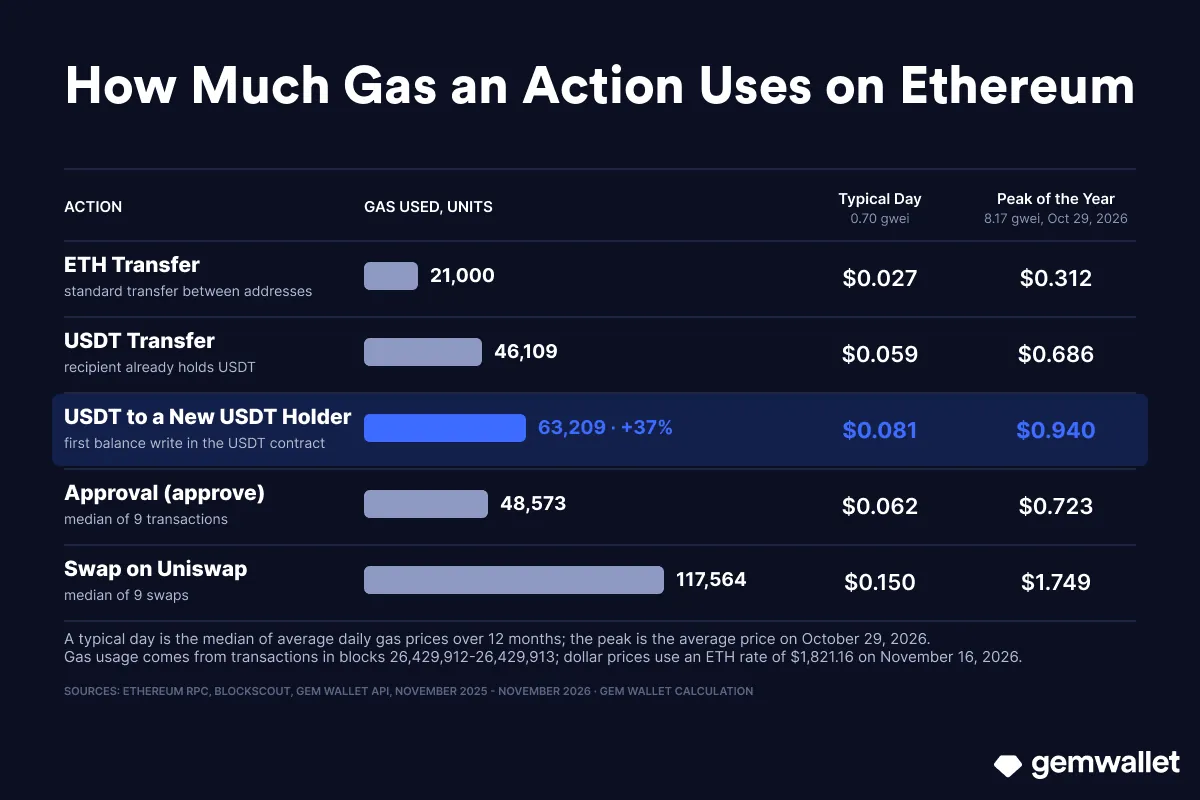
*How much gas actions on the Ethereum network use. Source: Gem Wallet*
## How to Create an Ethereum Wallet
Once you've chosen an Ethereum Wallet, create it in a couple of minutes: download the app, write your secret phrase down on paper, and your 0x address is ready to receive ETH, tokens, and NFTs. All the steps with tips are in our guide ["How to Create an Ethereum Wallet"](https://gemwallet.com/learn/how-to-create-an-ethereum-wallet-and-what-you-can-do-with-it/).