


Table of Contents
Tempo is a Layer 1 blockchain from Stripe for stablecoin payments: the network has no coin of its own, the fee is charged in the same stablecoin you send, and a transaction becomes final in about 0.6 seconds.
Key Takeaways
- No Gas Token to Buy: Tempo mainnet has been running since March 18, 2026 without a coin of its own: the fee is charged in the same TIP20 stablecoin you send.
- A Transfer Costs a Fraction of a Cent: The protocol caps the gas price from above and from below, so a stablecoin transfer always costs between $0.00003 and $0.0006.
- Payments Do Not Queue Behind Apps: 94% of the space in a block is reserved for transfers, so activity from other applications on the network does not slow a payment down or push its price up.
What Is the Tempo Blockchain?
Tempo is a Layer 1 for stablecoin payments incubated by Stripe and Paradigm: mainnet went live on March 18, 2026, the network has no coin of its own, and the fee is paid in the same asset as the transfer itself. In its first two months Tempo processed 3.9 million transactions from 177,000 active addresses, and by July 2026 the counter reached 7.5 million (according to Dune).
An ordinary blockchain requires you to hold two assets - the one you send and a gas token - and the transfer does not go through if you run short on the gas token: Tempo removes the second asset entirely. The network is EVM compatible (Ethereum Virtual Machine - the virtual machine that runs Ethereum smart contracts), so existing contracts move over without a rewrite, and stablecoins are issued under the TIP20 standard - an extension of ERC20 that stays backward compatible.
TIP20 is the token standard of Tempo, which adds a message for the recipient to an ordinary transfer and the option to pay the fee with the transferred token itself.
How Tempo Works
A transfer on Tempo becomes final in about 0.6 seconds: you sign the transaction, validators agree on it through the Simplex BFT protocol, and the result no longer rolls back - there is no need to wait for extra confirmations.
How many payments the network handles follows from its own parameters. A block holds 500 million gas, 470 million of it is reserved for transfers, and one stablecoin transfer spends about 50,000 gas - that comes to 9,400 transfers per block, or roughly 15,700 payments per second. The public testnet showed about 20,000 TPS in a benchmark (a performance measurement under controlled conditions), so the calculation and practice line up.
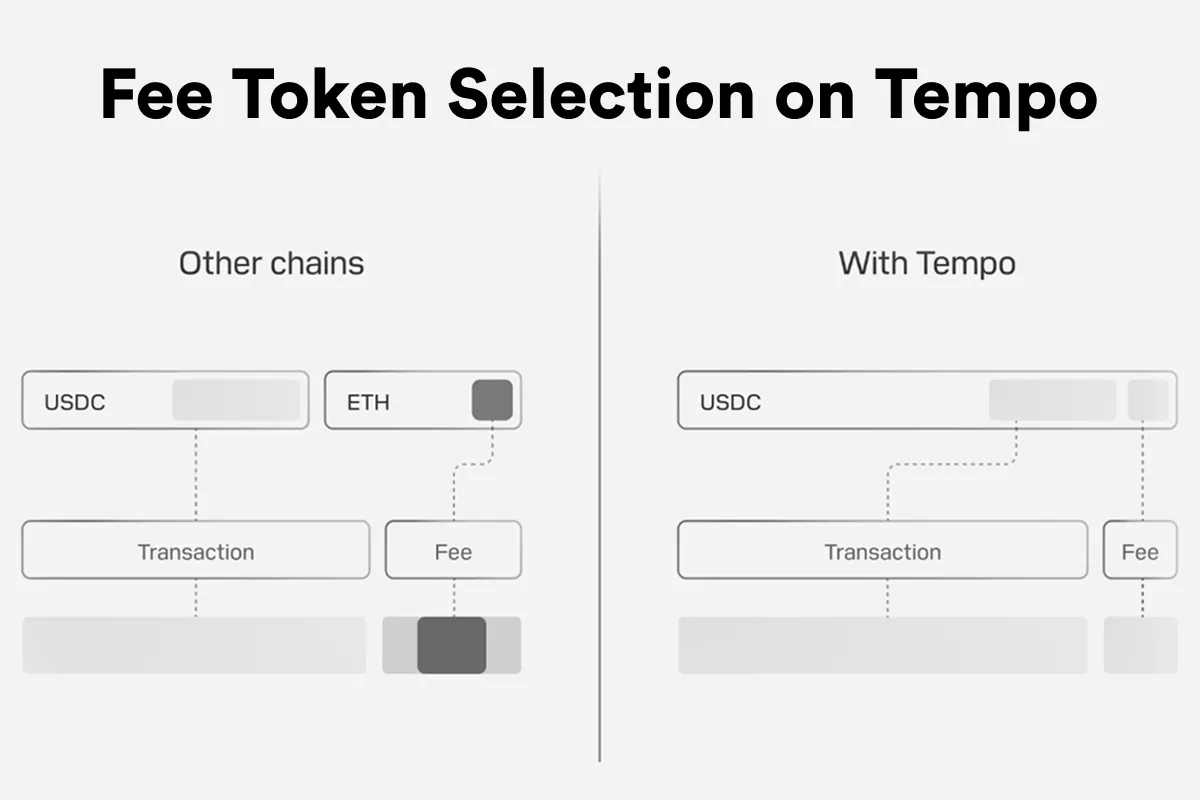 How the fee is paid on other blockchains and on the Tempo blockchain. Source: Tempo Blog
How Much a Transfer Costs on Tempo
A stablecoin transfer on Tempo costs between $0.00003 and $0.0006 - the protocol does not let the price go higher. The fee is counted in attodollars (10⁻¹⁸ of a dollar): the base gas price cap is 12 billion attodollars, the floor is 600 million, and one transfer spends about 50,000 gas. The gap between the most expensive and the cheapest minute on the network is only 20x, while on networks with auction-based gas it runs into the hundreds.
You do not have to pay the fee with the same stablecoin you send: the protocol checks five sources in order - the field in the transaction, the account setting in FeeManager, the TIP20 contract, the stablecoin DEX of the network, and pathUSD at the very end. When the chosen asset is not the one the validator expects, the built-in Fee AMM converts it at a fixed rate of 0.9970, and 0.3% of the fee amount goes to liquidity providers.
What the Tempo Blockchain Is Used For
The stablecoin market cap has passed $302 billion (according to rwa.xyz, August 2026), and Tempo was built for four scenarios where that money works every day. The design partners of the network are Visa, Mastercard, Deutsche Bank, Standard Chartered, Shopify, DoorDash, Revolut, Nubank, and OpenAI:
- Transfers Abroad: You send money to family, friends, or partners in another country in seconds, and the distance between you affects neither the fee nor the speed, while a bank transfer of $200 costs 6.36% of the amount on average (according to the World Bank, Q3 2025).
- Salaries and Contractor Payouts: A company pays thousands of employees and contractors in different countries at once, and neither the company nor the recipients need to buy a gas token - a stablecoin wallet is enough.
- Settlements Between Companies: Over 2025 companies moved $226 billion to each other in stablecoins (according to McKinsey and Artemis, January 2026), and on Tempo such settlements go through at night, on weekends, and on holidays, when banking channels are closed.
- Payments Between Programs: The Machine Payments Protocol has been running since day one of mainnet and lets a program or an AI agent pay for a service on its own, without a person and without a credit card.
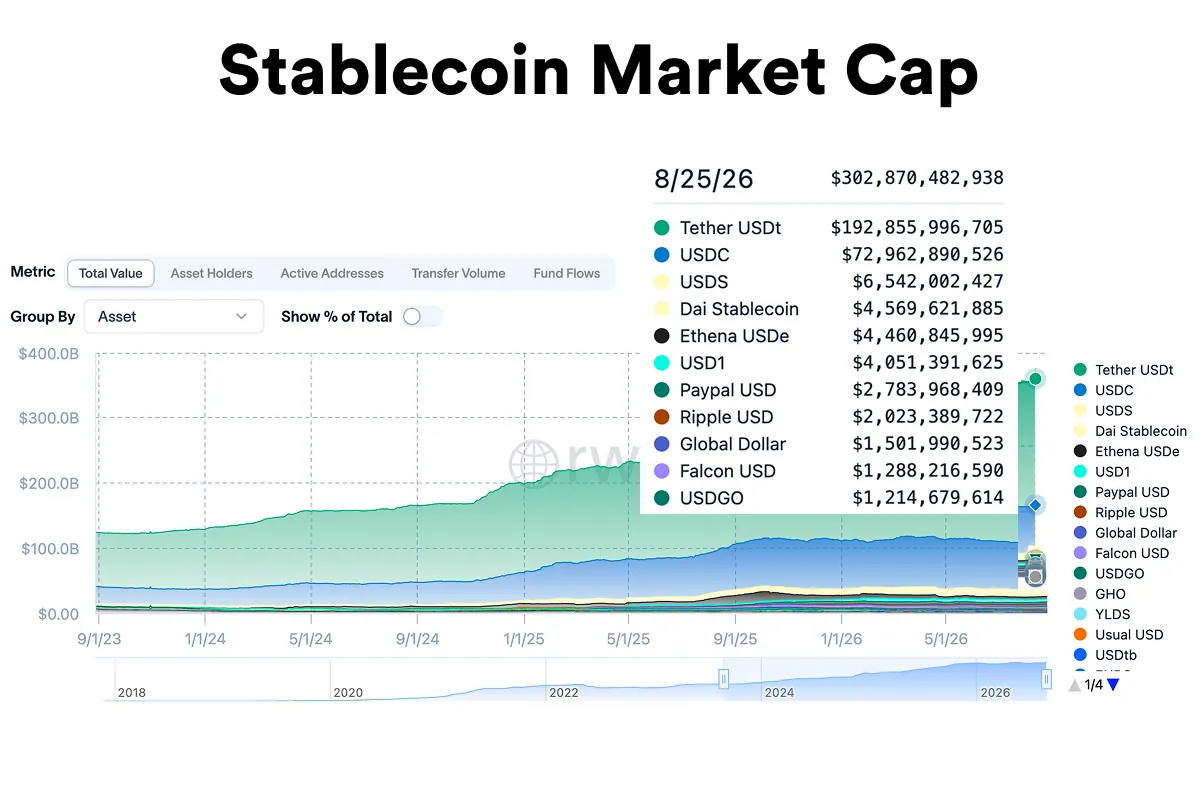 Stablecoin market cap by asset. Source: rwa.xyz
Key Advantages of Tempo
Since April 2026 the validators of Tempo have included Stripe, Visa, and Zodia Custody by Standard Chartered - companies whose core business is settlement; here is what the network adds on top of an ordinary EVM chain:
- One Asset Is Enough for a Transfer: Tempo issues no gas token, so the balance of the stablecoin you send covers everything, and a second position in the wallet for the fee is not needed.
- The Message Travels Inside the Transfer: The TIP20 standard adds a memo field to a transfer, so an invoice number or a customer ID arrives together with the money instead of through a separate channel.
- Compliance Is Described Once: The TIP-403 Policy Registry stores the whitelist and blacklist of an issuer, and every token that issuer releases applies this rule automatically.
- Code Moves Over Without Edits: Execution is built on the Reth SDK, so four familiar developer tools - Solidity, Foundry, Hardhat, and JSON-RPC - work on Tempo the same way they work on other EVM networks.
- A Validator Failure Does Not Cancel Payments: Simplex BFT degrades gracefully, which means the network slows down when some nodes fail but does not fork, while deterministic finality rules out chain reorganizations.
- The Standard Is Not Only for Dollars: TIP20 is a general-purpose standard, and bridged BTC and ETH are issued under it as well, not only stablecoins.
How Tempo Differs From Other Blockchains
What sets Tempo apart comes down to one architectural decision: blockspace and gas here are assigned to payments in advance instead of being split evenly among all applications.
| Parameter | Tempo | Ethereum | Solana | Stablecoin chains |
|---|---|---|---|---|
| Finality | ~0.6 sec, deterministic | ~12.8 min, ~12 sec per block | ~12.8 sec, first confirmation ~0.4 sec | from one second to several seconds |
| What pays for gas | any TIP20 stablecoin | ETH only | SOL only | the native coin of the network |
| Blockspace for payments | 470 of 500 million gas reserved | shared queue for all transactions | shared queue | shared queue |
| Validators | 3 organizations, permissioned | thousands, open to join | thousands, open to join | depends on the network |
Unlike Ethereum, where the fee is paid only in ETH and every application competes for the same blockspace, Tempo reserves most of the block for transfers, so heavy computation does not push payments out of the queue. Tempo also differs from Plasma and other stablecoin chains: instead of subsidizing free transfers of one chosen stablecoin, it makes paying the fee with any stablecoin a rule of the protocol.
Blockspace is the room inside a block that all transactions on the network compete for.
TIP20 Stablecoins: Gas on the Tempo Blockchain
$52.9 million in stablecoins circulates on Tempo, and 59.4% of that volume is pathUSD (according to DefiLlama, August 2026), while the fee can be paid with any asset on the network:
- pathUSD: The settlement stablecoin of the network from the issuer Bridge, backed 1:1 and minted with USDC.e; the protocol takes it as the fallback fee asset when no other suitable token is on the balance.
- USDC.e and USDT0: Bridged versions of the two largest dollar stablecoins, about $12 million and $9.4 million respectively - USDC and USDT remain the main settlement assets of the network.
- Euro and Yield-Bearing Stablecoins: EURC.e covers settlement in euros, while sUSDe, USDe, Frax USD, cUSD, stcUSD, and syrupUSDC earn yield right on the balance; all of them are issued under TIP20 and work for paying the fee.
All of these assets sit on one address in Tempo Wallet, where you can securely store stablecoins, manage them, and swap them at the best rate.
How to Get Started With Tempo
To work with the network you can install a fully self-custody wallet for Tempo - Gem Wallet, for example - and learn how to manage the Tempo blockchain securely and privately in our Beginner’s Guide to Tempo Blockchain.


