


Table of Contents
A self-custody wallet is a crypto wallet where you alone hold the private keys, so no exchange, bank, or company can freeze, block, or lose your funds. When FTX collapsed in November 2022, it still owed customers around $8 billion they could no longer withdraw - self-custody removes that single point of failure.
Key Takeaways
- You Hold the Keys - a self-custody wallet stores your private keys on your own device; the guiding principle is “not your keys, not your coins”.
- No Third-Party Risk - if an exchange freezes withdrawals or goes bankrupt, funds you hold in self-custody stay untouched.
- You Are the Only Backup - if you lose your seed phrase, no support line can restore access, which is the trade-off for full control.
What Is a Self-Custody Wallet?
A self-custody wallet is a crypto wallet that gives one person - you - exclusive control of the private keys that authorize transactions on a blockchain. The wallet itself does not “hold” your coins; the blockchain does. What the wallet holds is the private key, the secret that proves ownership and signs every transfer. Whoever controls that key controls the funds, which is why the crypto community repeats the phrase “not your keys, not your coins”.
This is the opposite of a custodial wallet, where a centralized exchange or company keeps the keys on your behalf and you simply trust them to honor withdrawals.
Custodial vs Self-Custody Wallets: Who Holds the Keys?
So what actually separates the two? One question settles it: if the provider disappeared tomorrow, could you still move your crypto? With a custodial wallet the answer is no; with self-custody it is yes.
| Feature | Custodial Wallet | Self-Custody Wallet |
|---|---|---|
| Who holds the private keys | The exchange or company | You, on your device |
| What you actually own | A claim on the provider (IOU) | The on-chain assets themselves |
| Account freezes possible | Yes | No |
| Identity verification (KYC) | Usually required | Not required |
| Risk if the provider fails | Funds can be lost | Unaffected |
| Access to DeFi and DApps | Limited to the provider’s options | Direct, via WalletConnect |
| Recovery if you lose access | Provider can reset login | Only your seed phrase |
The risk in the custodial column is not theoretical. Mt. Gox handled roughly 70% of all Bitcoin traffic before 740,000 BTC vanished in 2014, and FTX held about $20 billion in deposits from over 7 million customers before its 2022 bankruptcy. In both cases, users who held their own keys were never exposed.
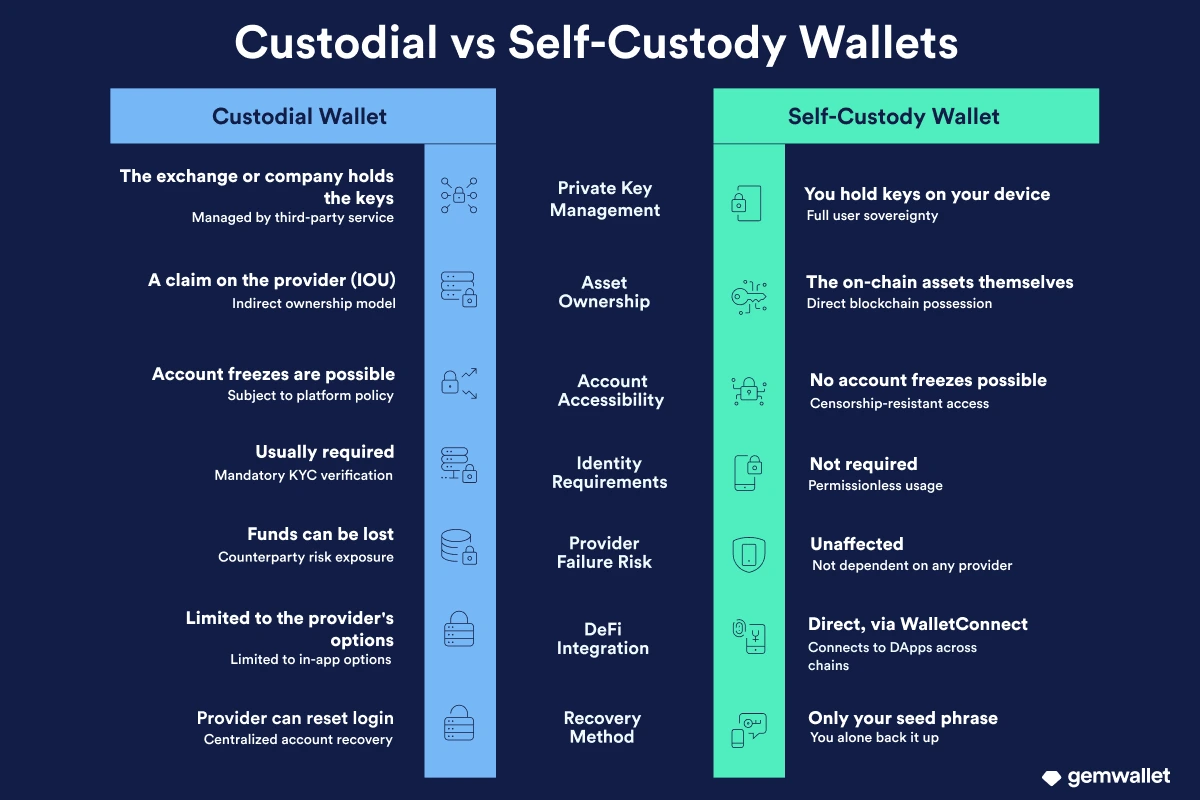 A comparison of custodial and self-custody wallets. Source: Gem Wallet
How Does a Self-Custody Wallet Work?
A self-custody wallet runs on three pieces of cryptography working together:
- Private Key: A secret number that signs transactions and proves you own the funds. It never needs to leave your device.
- Public Address: Derived from the private key, this is what you share to receive crypto - safe to post publicly.
- Seed Phrase: A list of 12 to 24 words, generated under the BIP-39 standard, that backs up every key in the wallet. Anyone with the seed phrase can rebuild the wallet, so it must stay offline and private.
When you send crypto, the wallet uses your private key to sign the transaction locally, then broadcasts it to the blockchain - the key itself is never transmitted. If you ever switch phones, your seed phrase restores access in minutes. Because that phrase is the master backup, learning how to secure your seed phrase is the single most important habit in self-custody.
Hot vs Cold Self-Custody Wallets: Which Type Should You Use?
Self-custody is about who holds the keys, not what device they live on. Two formats dominate:
- Hot wallets are software apps connected to the internet - mobile or browser based - built for everyday sending, swapping, and staking.
- Cold wallets are hardware devices that keep keys offline, favored for large, long-term holdings.
Cold wallets cost money and are impractical for daily use: you cannot quickly pay with USDT or buy BTC at the right moment, because every transaction has to be confirmed on the connected device. A self-custody hot wallet is exactly what makes using crypto every day both convenient and secure. The right choice comes down to how often you transact versus how much you store, which we break down in Hot Wallet vs Cold Wallet.
What Are the Responsibilities of Self-Custody?
Full control means full responsibility - and the things you need to handle are concentrated, not complex:
- Lost Seed Phrase: There is no password reset and no support team - a lost phrase usually means permanently lost funds.
- Phishing and Fake Apps: Scammers imitate wallets to trick you into typing your seed phrase. No legitimate wallet ever asks for it.
- Irreversible Transactions: Blockchain transfers cannot be undone, so a wrong address is final.
You reduce these risks by backing up your seed phrase offline and choosing a wallet whose code can be inspected. A fully open-source wallet lets anyone verify there are no hidden backdoors, which is why code transparency is the standard for serious self-custody.
How Do You Keep Your Crypto Secure and Private?
You hold the keys - the next step is keeping them secure. Learn more about the security and privacy of your crypto assets and how Gem Wallet protects them: Gem Wallet Security →


